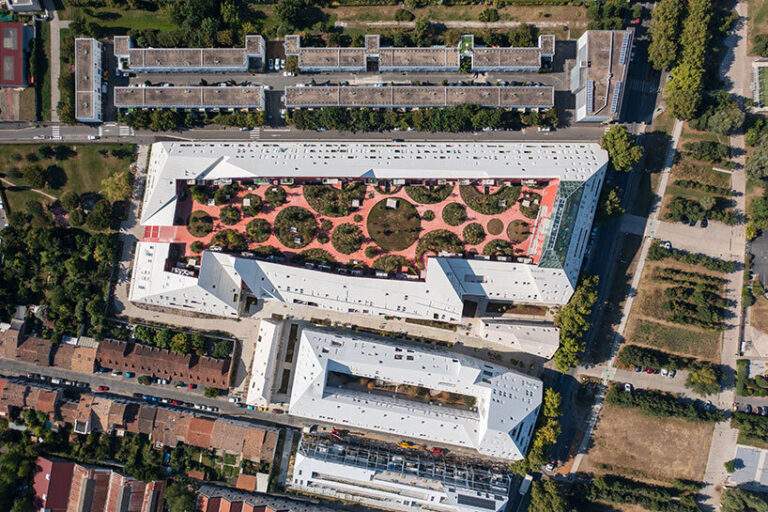
IIT Hyderabad Sports & Cultural Complex


| Item | Details |
|---|---|
| Architects | APL design workshop, IITH Campus Design Team of the University of Tokyo, NIHON SEKKEI |
| Area | 30,881 m² |
| Year | 2022 |
| Photographs | Masaki Hamada (kkpo), Hidetoshi Ohno |
Organization of Residential Areas and University Facilities
In the master plan of the Indian Institute of Technology Hyderabad (IITH), a student residential area is designed on the northern edge of the campus. This arrangement reflects a focus on providing an integrated living environment close to educational facilities, enhancing students’ daily experience and allowing easy access to classrooms and shared spaces.
Integration of Sports and Cultural Activities
Adjacent to the residential area, space has been allocated for a sports and cultural complex aimed at supporting students’ extracurricular activities. This complex includes multiple facilities that contribute to the physical, social, and cultural development of students, reflecting a modern approach in campus design that integrates academic life with extracurricular engagement.
International Collaboration in Campus Design
This complex forms part of a broader campus development executed in collaboration with international engineering and architecture teams, whose diverse expertise helped shape a comprehensive vision for the campus. Such partnerships highlight the importance of international knowledge exchange in the urban planning of educational institutions, with a focus on campus sustainability and improving students’ quality of life.


Structure of the Sports and Cultural Complex
The sports and cultural complex consists of a group of buildings dedicated to physical and cultural activities, including three buildings for indoor sports halls and a separate building designated for cultural club activities. Surrounding these buildings are various outdoor facilities such as a swimming pool, an open-air theater, a football field, a cricket pitch, and a running track, forming an integrated system that supports a wide range of student activities.
Challenges of Large Roof Spans
The roofs of the indoor sports halls extend over large distances, reaching 42 and 49 meters respectively, while the cultural activities building features two spans of 35 meters each. The design team faced an engineering challenge in efficiently achieving these large spans using reinforced concrete.
Innovation Inspired by Traditional Architecture
To overcome these challenges, the team adopted a folded plate system, providing a practical solution to expand interior spaces without requiring dense supports that would obstruct usage. During the design process, the team drew inspiration from the distinctive roofing styles of temples in the West Bengal region, reflecting the potential to combine modern engineering with local architectural traditions to enhance both structural performance and aesthetic quality simultaneously.


Architectural Inspiration from Bengal Temples
Among the traditional temples in the West Bengal region, the 17th-century Jor Bangla Temple stands out as a prominent example with its curved gabled roofs. These roofs are characterized by arched ridge lines extending over two connected chambers, reflecting the complexity and uniqueness of traditional temple design. When this form is transferred to a reinforced concrete structure, it results in a wide-span roof system that provides additional structural logic not present in the original construction, representing an unintended yet practically significant structural advantage.
Enhancing Functional Performance through Edge Expansion
Beyond the traditional temple model, the edges at the ends of the gables were designed to extend considerably, creating shaded walkways that improve circulation within the complex. This expansion helps reduce direct sun exposure, thereby minimizing heat accumulation inside the sports halls, reflecting a conscious use of open spaces to achieve a more comfortable and efficient indoor environment.


Construction Challenges
Due to the complexity of the connections between the folded roof panels and the supporting elements, which together function as a structural arch, the design team faced a significant challenge in achieving the stability and structural efficiency of the system. This relationship between the panels and supporting elements requires precision in both connection and execution to ensure that the large roof spans can be carried without deformation or vibration.
Selecting the Appropriate Concrete Method
Initially, the Japanese team explored the technique of spraying cement onto a steel mesh as a potential solution. However, after discussions with their Indian counterparts, the conventional cast-in-place concrete method using standard formwork was adopted. This approach resulted in a high level of construction accuracy, with a refined surface finish, highlighting the importance of aligning innovative design with practical execution to ensure the durability and efficiency of buildings with large spans.


✦ ArchUp Editorial Insight
The Sports and Cultural Complex at IIT Hyderabad emerges as a product of international government funding commitments and educational policy constraints, where the need to increase student housing density alongside providing clear sports and cultural facilities was established as a pre-institutional requirement. The complex’s form and the massive folded roof spans illustrate tensions between construction speed, labor costs, and the limited adaptability of traditional structural models, which led to the adoption of standard cast-in-place concrete solutions.
The large spans and extended edges represent a material compromise between structural limitations and high-occupancy requirements, while incorporating elements inspired by gabled roofs to balance solar radiation distribution and ventilation. The result is a campus space that achieves a balance between multiple functions and population flows, with the building remaining a reflection of regulatory standards and project funding rather than an independent architectural choice. For further reading, explore our Archive and Projects sections.