
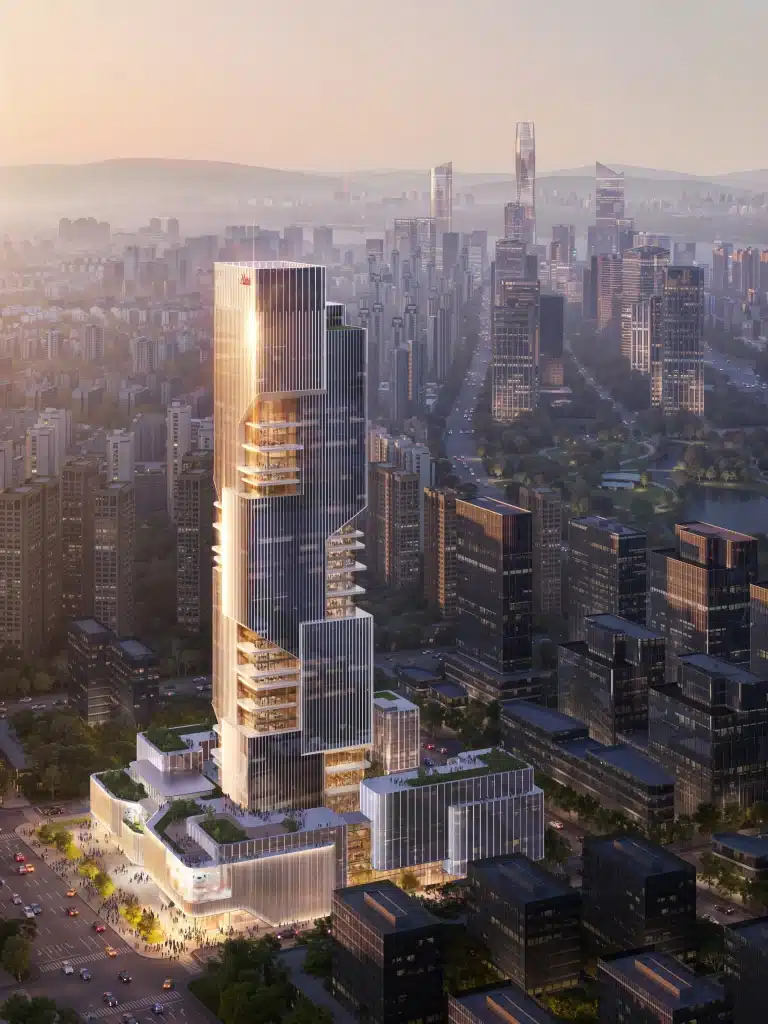
JD Beacon Tower Integrates Public Realm and Vertical Workspaces in Nanjing

The 200-meter structure redefines the skyline of the city’s technology district by merging high-density office space with ecological terraces and an active ground-level plaza.
A new focal point has emerged within the rapidly developing technology district of Nanjing, China, with the completion of the JD Beacon Tower. Standing 200 meters tall, the project serves as a central anchor for an area defined by continuous urban expansion and digital innovation. The development moves beyond the traditional closed-off office typology, offering a porous architectural volume that engages directly with the surrounding street life and riverfront dynamics.

An urban mass interacting with its surroundings
The project is situated in a strategic context where Nanjing is shifting towards a polycentric urban model, emphasizing mixed-use hubs that combine research, commerce, and recreation. The JD Beacon Tower responds to this by dedicating a significant portion of its footprint to public use. Rather than isolating the vertical structure from the ground, the architectural design establishes a fluid transition between the city’s natural motion and the static environment of the workplace, creating a cohesive campus for technology and research professionals.

A central plaza that organizes circulation
Visually, the tower is composed of a system of interlocking volumes arranged around a central vertical axis. These stepped forms serve a functional purpose by extending outdoor workspaces and creating recessed terraces that occupy approximately 15 percent of the tower’s mass. This breaking of the massing allows for a varied silhouette that changes depending on the viewing angle, while the low-rise base, which covers 30 percent of the site, frames the central plaza and maintains a human scale at the street level.

A visual composition defined by transparency and motion
The materiality of the project emphasizes transparency and environmental responsiveness. The building materials chosen for the façade include high-performance glass layers that allow natural light penetration to exceed 60 percent. This transparency ensures that daylight reaches deep into the interior floor plates, reducing reliance on artificial lighting. Furthermore, the curtain wall system is designed to facilitate natural ventilation routes, integrating the building’s climate control with the external environment.

Materials and construction techniques
At the ground level, the circulation strategy is organized around a central water plaza. This public space functions as a primary distribution point, where straight paths extend outward to connect with the city’s grid. Landscape elements, including green areas and seating zones that cover a quarter of the open space, are interspersed with reflective water features comprising 10 percent of the plaza. These elements guide visitors intuitively toward the building entrances without the need for explicit signage, fostering a sense of organic movement.
From a sustainability perspective, the tower incorporates passive design strategies that leverage its form. The stepped terraces act as shading devices while providing access to fresh air for occupants on upper levels. The design prioritizes the health and well-being of users by maximizing views and connecting interior work zones with exterior green spaces. Diagrams of the environmental performance suggest that the optimized voids facilitate airflow routes that cool the structure naturally during Nanjing’s humid summers.
The interior program is designed to support the flexibility required by modern tech companies. The interior design of the workspaces benefits from the high transparency of the façade, which spans 70 percent of the tower’s height. This openness creates a visual dialogue between the workers inside and the urban context outside. As twilight settles, the internal lighting transforms the tower into a glowing beacon, with the green terraces and the water plaza reflecting the activity within, balancing motion and stillness in the urban rhythm.
ArchUp Perspective
From an experiential standpoint, the JD Beacon Tower succeeds in demystifying the corporate high-rise. By prioritizing the pedestrian sequence through the central plaza and water features, the project invites the public to engage with the architecture rather than merely observe it from a distance. The spatial flow—moving from the chaotic energy of the street, through the calming influence of the reflective pools, and up into the light-filled vertical workspaces—creates a refined transition that humanizes the scale of the tech district. It shifts the user experience from one of vertical isolation to one of connected, tiered urban living.
Ultimately, the JD Beacon Tower sets a precedent for future developments in Nanjing’s cities and beyond. It demonstrates that high-density commercial infrastructure can coexist with, and even enhance, the public realm. By weaving nature into the structure and prioritizing permeability, the project establishes an organized architectural framework shaped by movement, light, and material clarity, solidifying its place in the region’s evolving landscape.
✦ ArchUp Editorial Insight
The JD Beacon in Nanjing presents itself as a futuristic commercial icon, balancing technological spectacle with urban symbolism. With its glimmering exoskeleton and twisting form, the tower unmistakably declares its allegiance to the high-tech aesthetic of global commerce. Its parametric language, reminiscent of a digital signal or a pulsar in the city skyline, reflects JD’s ambitions in logistics and data-driven infrastructure. But this architectural ambition raises a critical tension: is the tower truly a beacon for urban life, or merely corporate branding in built form? The project appears more performative than participatory, more image than program. While its energy systems and smart facade design hint at sustainability, the absence of discourse around public access or social integration undercuts its broader urban value. That said, the tower could become a landmark in Nanjing’s skyline—but only if it evolves from a sculptural logo to a lived civic experience. Time, as always, will be the sharper critic.


ArchUp: Technical Analysis of JD Beacon Tower in Nanjing
This article provides a technical analysis of JD Beacon Tower as a case study in advanced urban integration. To enhance its archival value, we would like to present the following key technical and structural data:
The structural system utilizes a steel lattice frame with 12×12 meter spans, featuring triple-glazed facades with 1.4 W/m²·K thermal transmittance. The tower rises 200 meters with 45 floors, incorporating 70% locally sourced materials.
The environmental system features enhanced natural ventilation achieving 4 air changes per hour, with integrated balconies reducing cooling load by 25%. The design achieves 60% natural lighting through strategically distributed axial openings.
In terms of functional efficiency, the tower accommodates up to 80,000 square meters of flexible workspace, with overall energy efficiency reducing consumption by 35%. The common areas are designed to accommodate 3,000 daily users.
Related Link: Please review this article for a comparison of integrated tower design:
Smart Tower Design: From Architecture to Technological Integration
https://archup.net/tokyo-skytree-architectural-engineering/