Klafar Housing Project: Urban Gradient from Street to Gardens


Clear Gradient from Public to Private
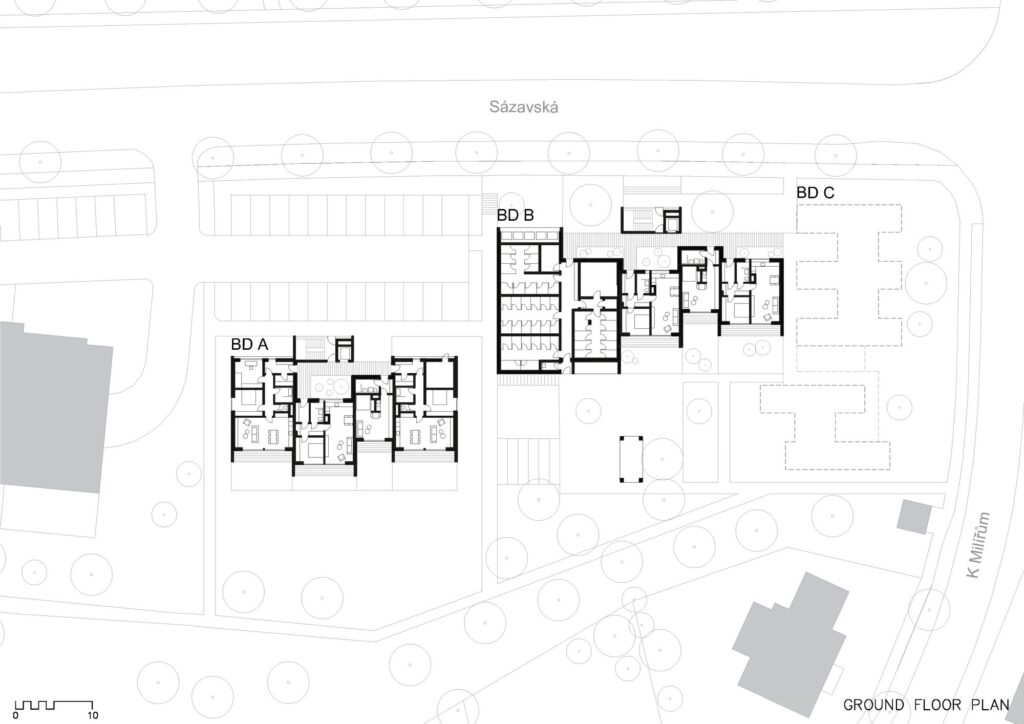
The project is located in the Klafar area and is based on the principle of the traditional urban block to organize space. The gradation begins from the public street, passing through a semi-private courtyard, and extending to private gardens, creating a clear sequence of privacy levels. This approach to Architecture prioritizes spatial hierarchy and user experience.
Massing and Internal Courtyard Formation
The building mass is positioned at the corner of two streets, allowing the formation of a semi-public courtyard oriented toward the south to enhance natural lighting. In contrast, the western part is allocated for recreational green spaces, in an attempt to achieve a balance between density and natural elements. Such Cities planning strategies help integrate built form with environmental performance.
Simple System and Graduated Visual Effect
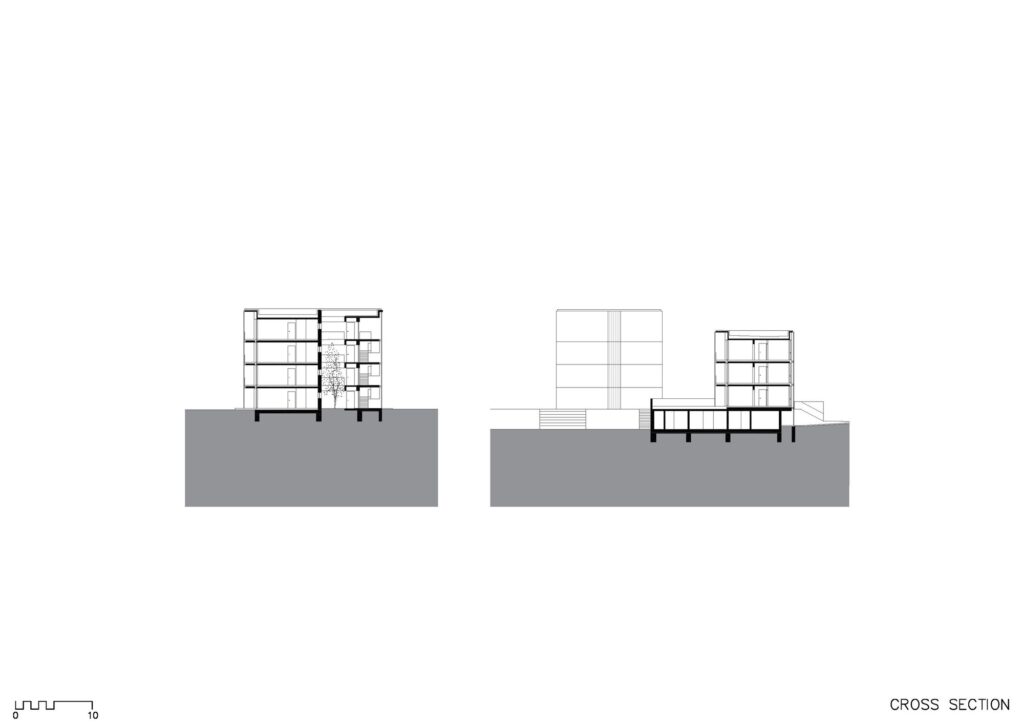
The Buildings are based on simple vertical sections of four floors, supported by transverse load-bearing walls. With the introduction of recessed loggias fitted with wooden shutters, a visual interplay emerges that combines openness and enclosure without structural complexity.
Facade Variation According to Function
Facades facing the courtyard are more open due to the loggias, while street-facing facades are more closed and contain only strip windows, due to the presence of circulation corridors and stair/elevator cores. This differentiation is a key consideration in Design for mixed-use contexts.
Transitional Spaces and Circulation Treatment
The apartments are shifted toward the courtyard, creating vertical voids interspersed with green spaces between corridors and units. This approach enhances the transition between movement and residential areas. Effective Construction methods are essential to realize such spatial nuances.
Apartment Orientation
Most apartments are oriented toward the southwest, maximizing natural daylight and improving the quality of the indoor environment.
| Field | Value |
|---|---|
| Architects | Kuba & Pilar architekti |
| Area | 2064 m² |
| Year | 2025 |
| Photographs | BoysPlayNice |
| Manufacturers | Rako, Cemix, Dols, Fermacell, Kone, Korado, PKS Okna, StoraEnso |
| Category | Housing |
| Author | Ladislav Kuba, Tomáš Pilař |
| Co Author | Radka Vašut, Ivona Uherková |
| Client | DBČS Žďár |
| City | Žďár nad Sázavou |
| Country | Czechia |


Courtyard as a Shared Living Space
The courtyard at the first-floor level of buildings B and C is designed to serve the daily activities of residents. It includes gravel seating areas under trees, along with planting beds and a pergola, reinforcing a sense of informal use. Such spatial strategies are often explored in Architecture to enhance community interaction. Furthermore, level differences are utilized by creating stepped seating along the slope, visually and functionally linking the courtyard with the front zone. The courtyard is also connected to a pathway leading to the public spaces on the western side, expanding movement and interaction within the site. This integration of landscape and circulation reflects current trends in Design for residential Cities.
Prefabrication as a Construction Strategy
The Buildings rely on a prefabricated structural system assembled on site, an approach aimed at accelerating Construction and improving precision. Walls and slabs are composed of cross-laminated timber (CLT) panels, providing relative lightness and structural efficiency. For detailed specifications, refer to Material Datasheets on engineered wood products. In contrast, glued laminated timber trusses are used to form the walkways, while key elements such as circulation cores and retaining walls are executed in precast reinforced concrete. This combination of timber and concrete reflects a functional distribution of Building Materials according to the requirements of each building component. Such innovative approaches are frequently documented in Research on hybrid construction.
Sustainability Emerging from Massing and Structure
Sustainability in the project is expressed through the compact massing of the building, in addition to a modular prefabricated structural system that combines timber and concrete. In this way, materials are not treated as an aesthetic choice, but as a direct response to performance and efficiency requirements. Ongoing Research supports such integrated approaches.
Passive Energy Strategies
In addition, the building relies on passive energy solutions, such as shading through facade shutters, as well as cross natural ventilation in all apartments between north and south. As a result, indoor comfort is improved without excessive reliance on mechanical systems.
Integrating Nature into the Architectural Fabric
Vegetation is also integrated on rooftops and within atriums, contributing to the improvement of both indoor and outdoor environmental quality. In parallel, the landscape design reinforces this approach through green areas and permeable surfaces, supporting natural stormwater management.
A Model for Multi-Storey Timber Housing
On the other hand, the project is considered one of the first examples of multi-storey timber housing in the Czech Republic, and is presented as an affordable rental housing solution. It was developed through a collaboration between the city of Žďár nad Sázavou and Česká spořitelna, with support from the Ministry of Regional Development, as part of a partnership that brings together the public and financial sectors to provide more sustainable housing solutions. Such initiatives are frequently covered in Architectural News and development updates.


✦ ArchUp Editorial Insight
The Klafar residential project emerges as a municipal response to housing pressure in the city of Žďár nad Sázavou, within a framework of partnership between the public sector, a regional financial institution, and development programs, where architecture is being reshaped as a tool for risk distribution rather than a purely design-driven decision. The primary driver is the affordability equation of rental housing under public funding constraints, which leads to the adoption of prefabricated CLT systems with precast concrete cores in order to reduce on-site labor and accelerate the construction cycle.
The spatial organization translates urban planning logic into a gradient of privacy from street to courtyard to private gardens, balancing density requirements with daylighting conditions. The courtyard itself becomes a spatial compromise between public housing objectives and regulatory code constraints, producing a model that stabilizes at the intersection of financing and regulation rather than direct architectural authorship. For more examples, browse the Archive or explore related Projects.