
Two-Volume House: Topography and Passive Design

Architectural Reading of the Overall Form Concept
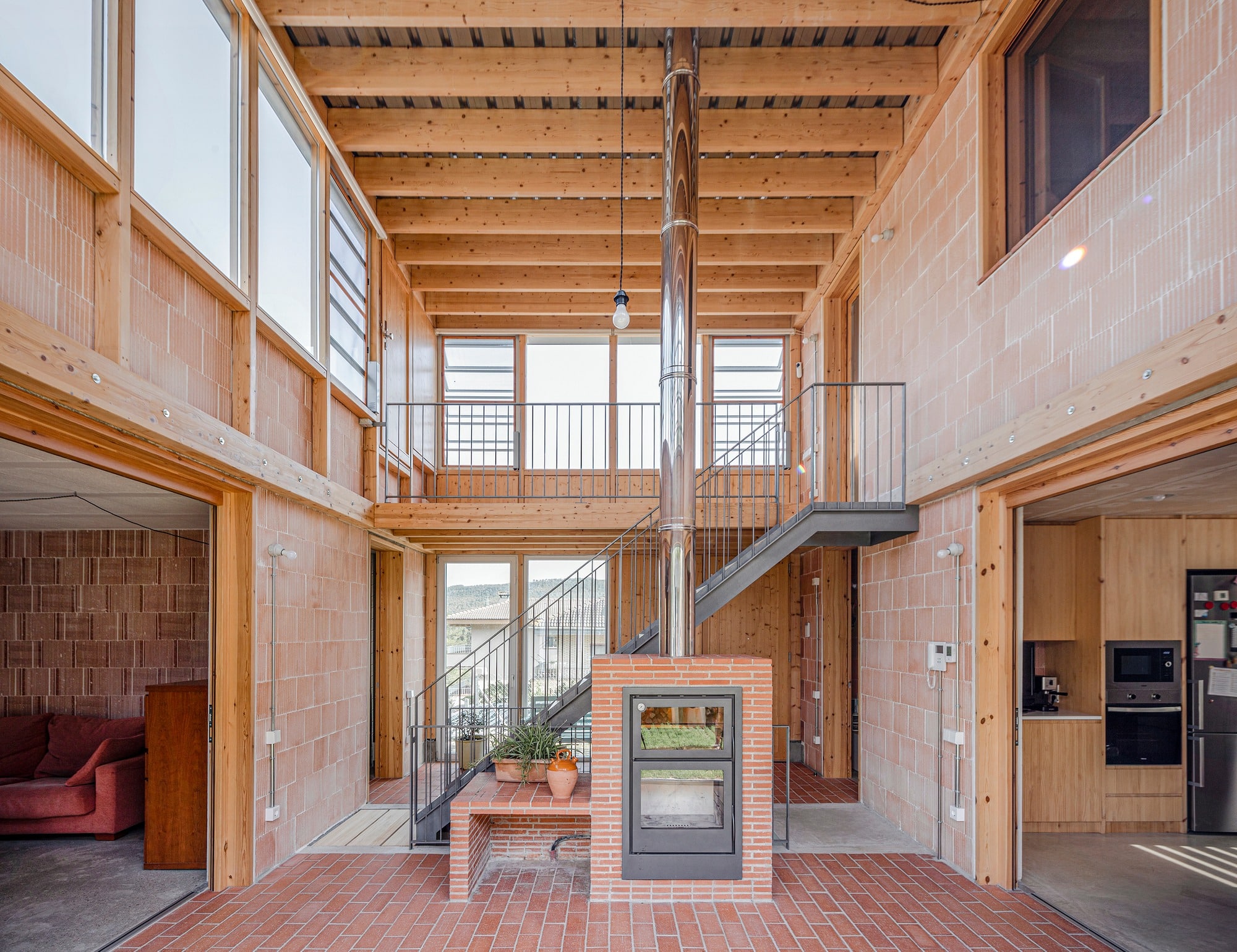
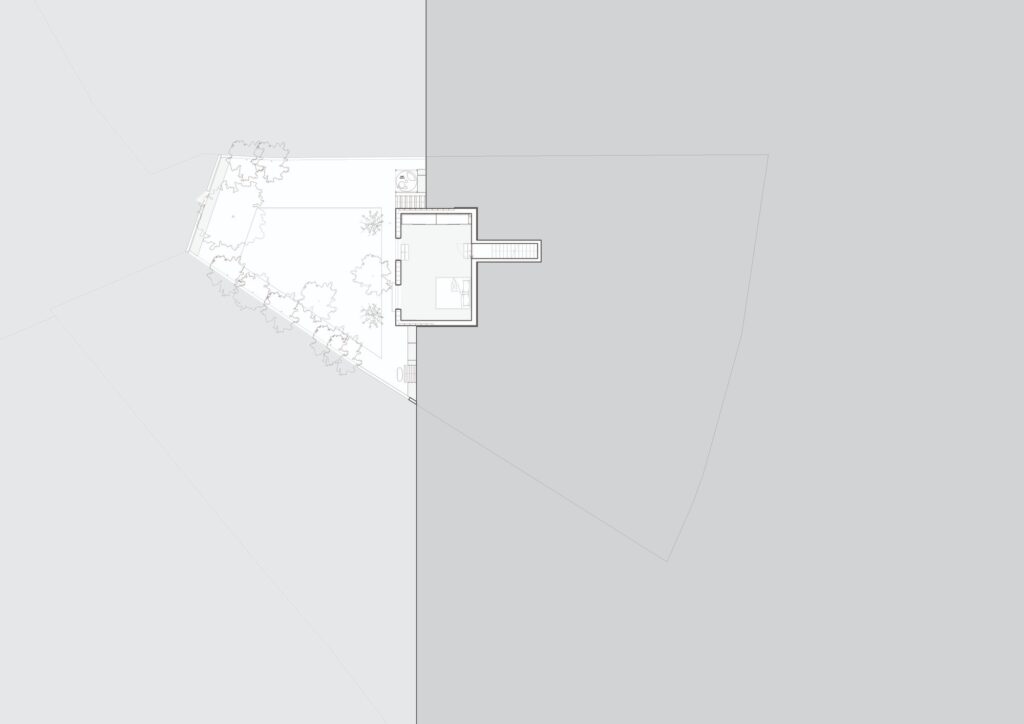
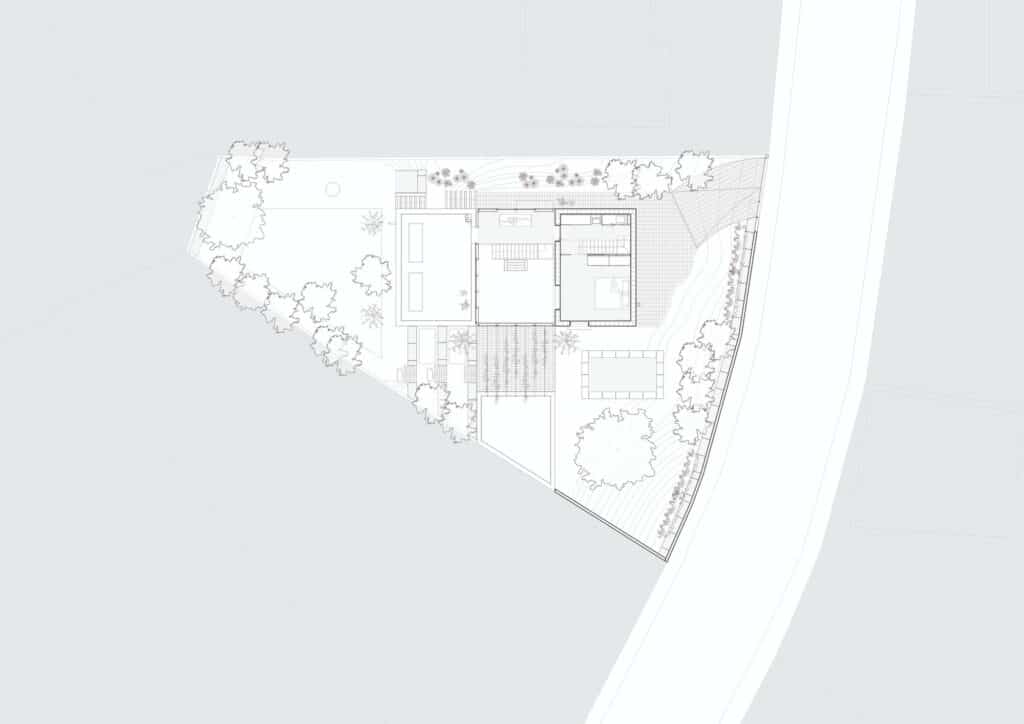
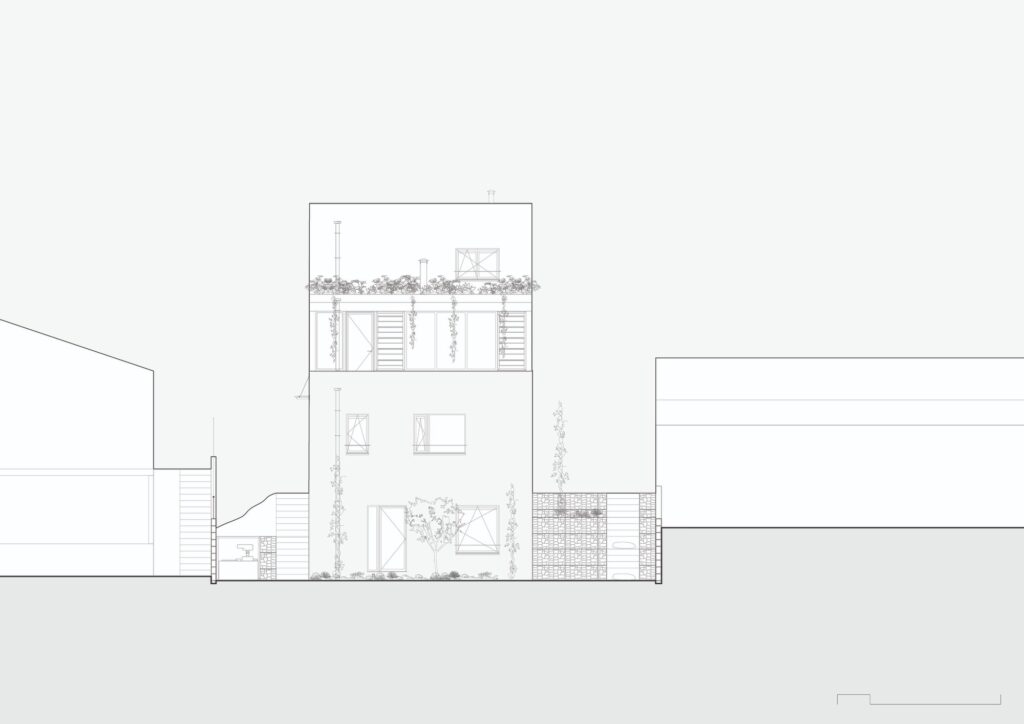
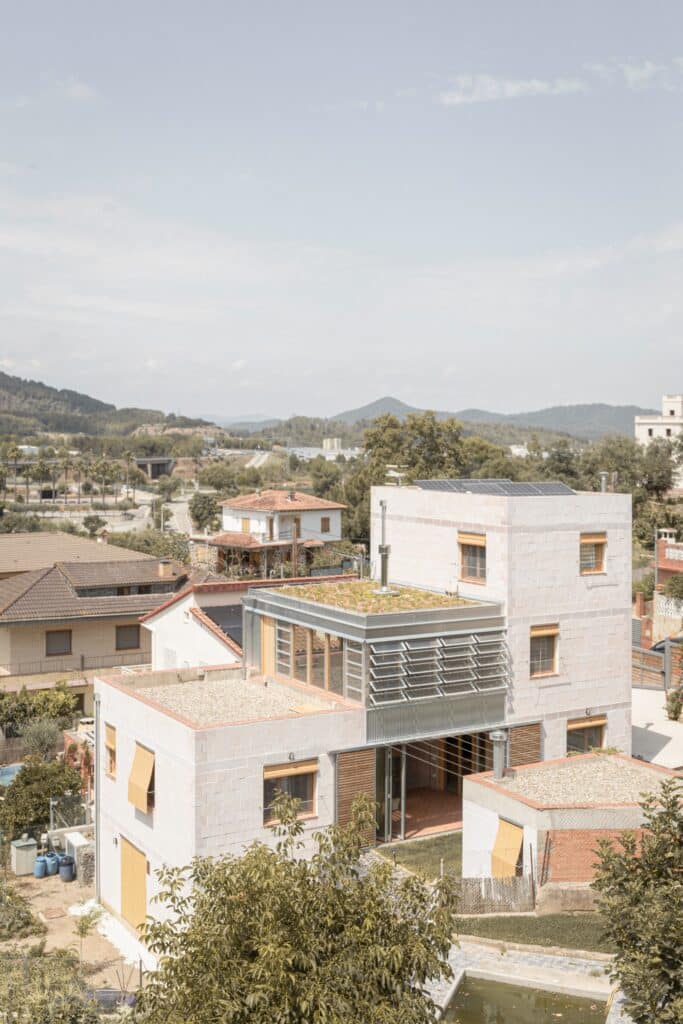
The project is presented as a family house composed of two separate volumes that adapt to the natural slope of the land. This distribution is not a formal gesture, but a direct response to the site’s Architecture topography, where the building rises gradually with the incline, giving the composition a dynamic character rooted in the terrain.
The Intermediate Space as an Organizing Element of Movement
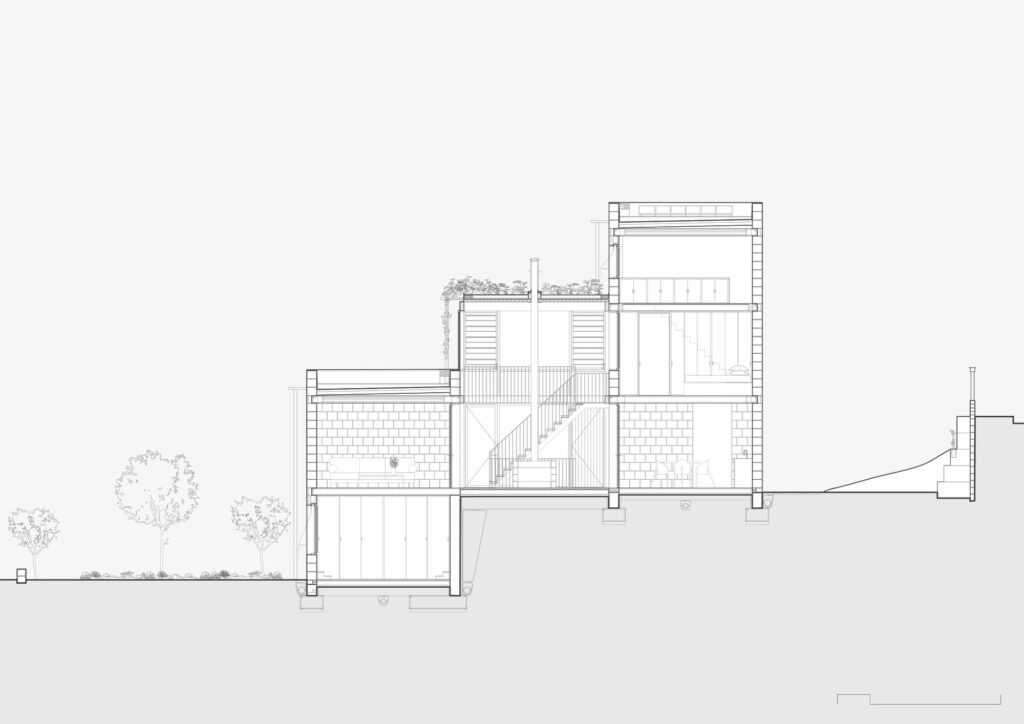
Between the two volumes, a central atrium space is formed, acting as an intermediate void that connects the different parts of the house. This space is not limited to being a corridor; it plays a functional role in organizing entrances and internal circulation paths, in addition to creating a multifunctional gathering point whose use can shift according to the daily needs of the residents.
Architectural Response to Climatic Conditions
In this context, the central void becomes an active climatic element, providing natural protection and contributing to improving indoor environmental quality. It thus becomes part of a broader Design system that relies on natural ventilation and daylight rather than artificial solutions.
Topography as a Architecture Competitions Opportunity
The steeply sloping terrain presents a clear structural challenge; however, the architectural approach treats it as an opportunity rather than an obstacle. By exploiting the differences in levels, the building’s climatic performance is enhanced, whether through utilizing the thermal inertia of the soil or by orienting spaces toward areas with greater exposure to sunlight and fresh air.
Towards a Reciprocal Relationship Between Land and Building
Ultimately, the site is not treated as a static backdrop, but as an active component in shaping the architectural idea. The project is founded on a reciprocal relationship between the building Buildings and the topography, where the final form emerges as a direct result of the interaction between the environment and the design response.
| Field | Details |
|---|---|
| Architects | arqbag |
| Area | 186 m² |
| Year | 2024 |
| Photographs | arqbag |
| Manufacturers | Poroton, Unknown (Removed) |
| Lead Architects | Arbqag |
| Category | Houses |
| Engineering & Consulting (Structural) | BBG Estructures i Rehabilitació |
| Landscape Architecture | Guillem de Pablo |
| Project Management | Emilio Sanchiz |
| City | Cervelló |
| Country | Spain |
Topographic Gradation as an Organizational Composition
The house is based on the concept of two separate volumes, arranged in a stepped configuration that follows the natural slope of the site. This gradation does not serve only the structural logic, but also re-establishes the project’s relationship with its surrounding Cities topography, allowing the building to act as a mediator between different ground levels rather than an isolated object.
Within this organization, the entrance is located at the upper level facing the street, while the garden and vegetable cultivation areas extend into the lower level. This arrangement reinforces a gradual transition between public and private realms, as well as between urban fabric and landscape.
The Atrium as a Spatial and Climatic Structure
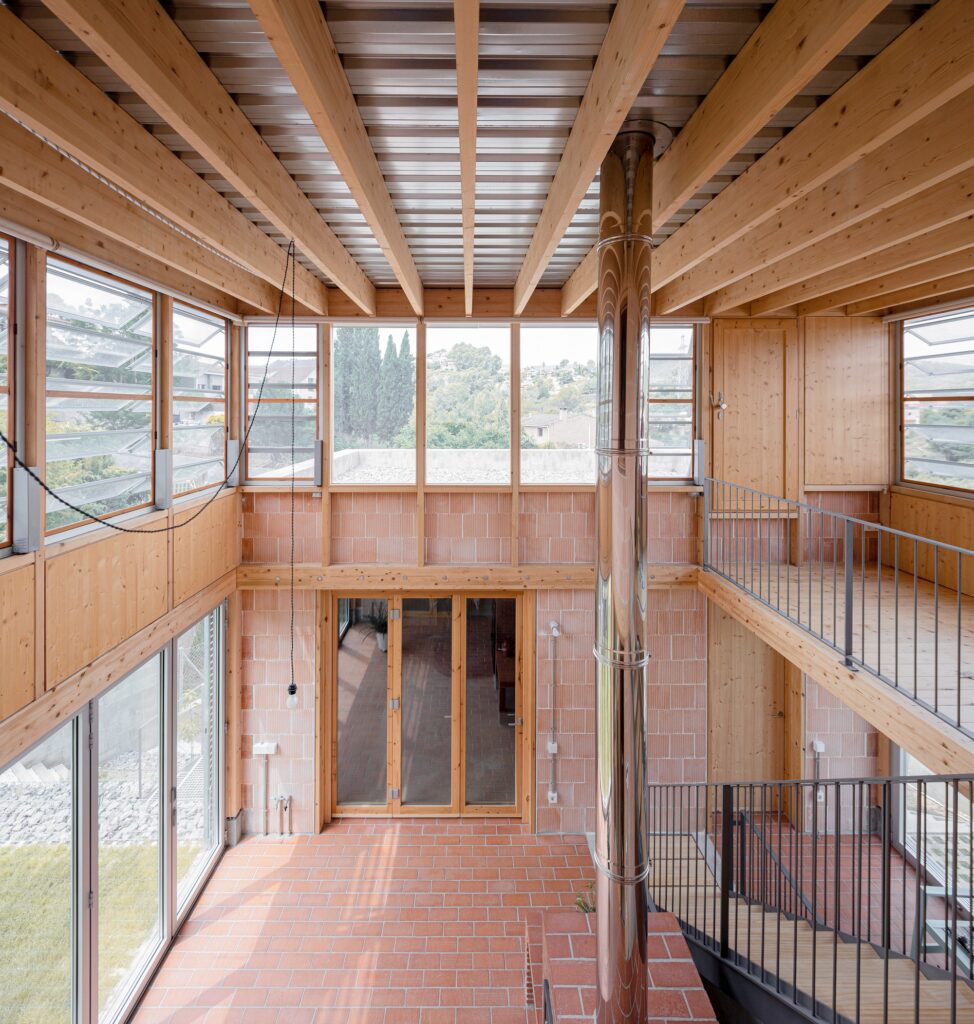
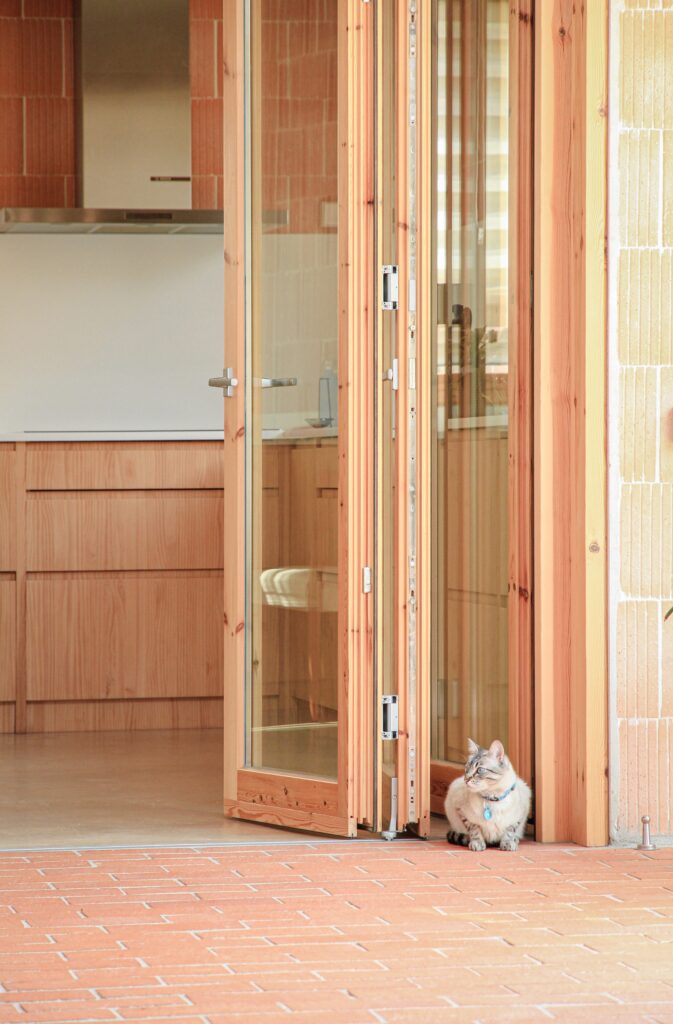
Connecting these levels is a central atrium void, whose role is not limited to organizing circulation and entrances, but extends to becoming an active climatic device. It functions as a link between the two volumes and contributes to regulating natural ventilation and indoor temperature levels, giving the project a passive environmental performance strategy.
Architectural Envelope and Thermal Mass
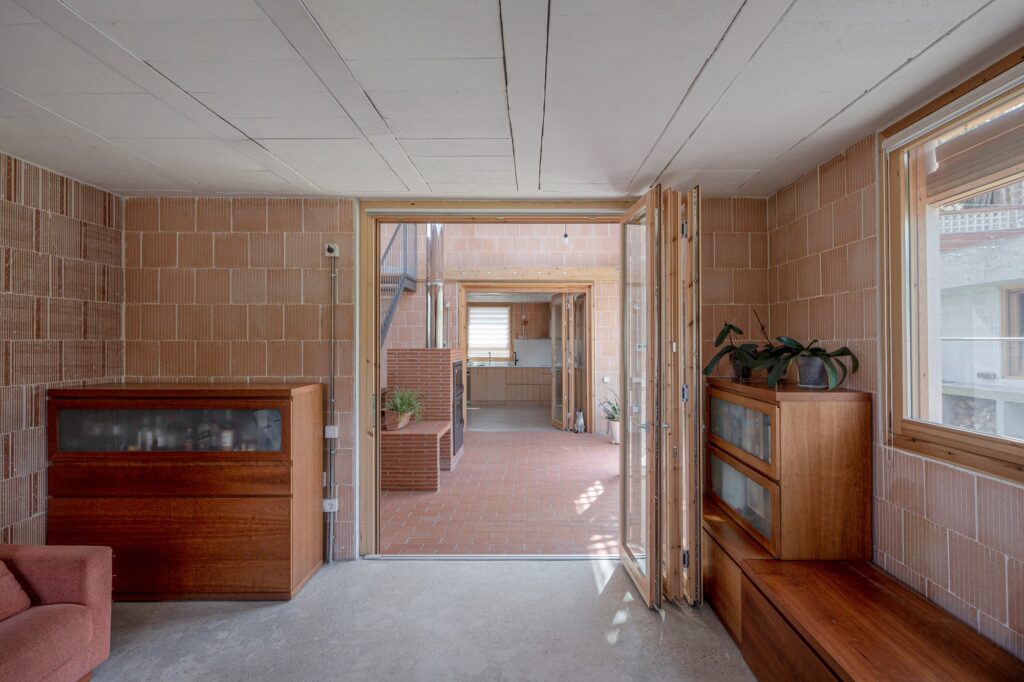
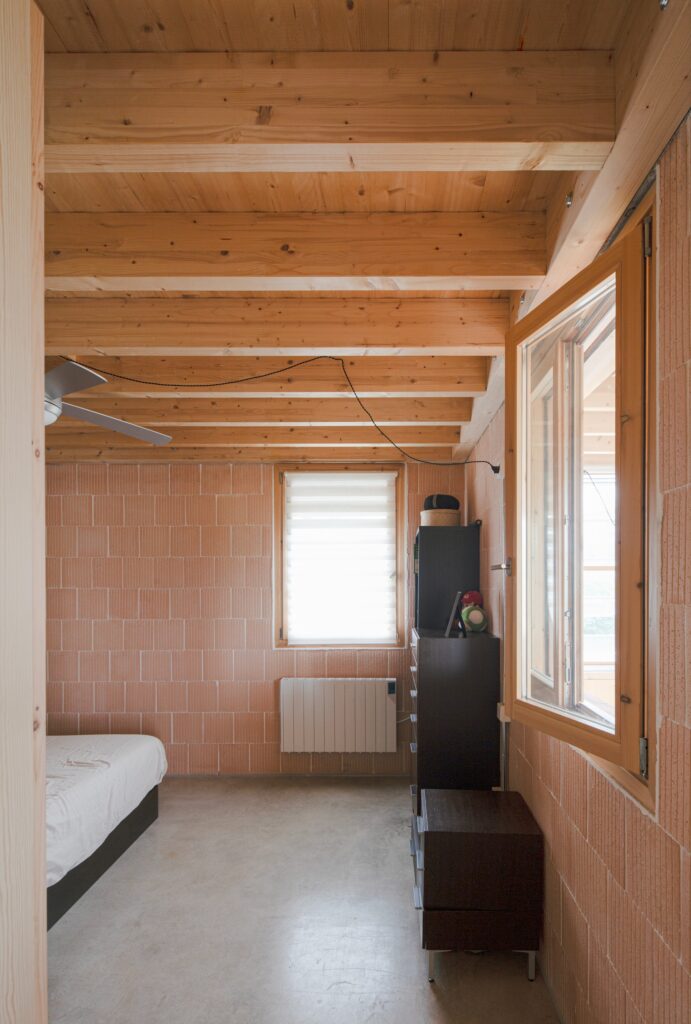
The main volumes rely on a single-layer envelope made of lightweight ceramic brick, providing a balanced capacity for thermal insulation and heat storage. This Building Materials choice is not isolated from the overall system, but rather integrated with the atrium’s climatic role in managing thermal energy within the building.
The Glazed Atrium as an Active Environmental Mechanism
The glazed atrium plays a central role in enhancing the environmental performance of the dwelling. In winter, it captures solar radiation and stores heat, while a wood-burning stove helps distribute warmth evenly across the two volumes.
In summer, the same space transforms into a natural ventilation chimney, drawing hot air outward and improving thermal comfort without reliance on mechanical systems.
Towards a Passive Comfort Living Space
Through this integrated system, environmental comfort is achieved across all living spaces using passive climate control strategies. At the same time, the atrium retains its role as a flexible social space used for gathering and relaxation, making it both the functional and architectural heart of the house. For similar Projects and Research, you can explore more case studies and Architectural News.
Passive Performance-Based Spatial Organization
The project concludes as a dwelling that operates entirely according to passive Design strategies, where spaces are distributed in a carefully considered manner that enhances both environmental efficiency and functional performance. This organization does not rely on complexity, but rather on a clear relationship between the different levels within the architectural composition.
The Central Level as the Core of Daily Life
At the heart of the design lies a central level that contains the kitchen and living areas, forming the focal point of everyday life. This level is directly connected to a multifunctional outdoor space that includes a small water pond, a barbecue area, and a separate studio, creating a seamless extension between interior and exterior and enhancing the diversity of use patterns.
Functional Hierarchy Between Levels
The spatial organization further expands to include a lower level directly connected to the ground, where a vegetable garden is located, reinforcing a practical relationship between dwelling and nature. In contrast, the upper level takes the form of a loft containing the bedrooms, achieving a balance between open views and the preservation of privacy.
Envelope Simplicity as a Performance Strategy
Reducing the layers of the building envelope and adopting a volumetric composition adapted to topography and climate contributes to simplifying the project’s structural system. This approach is not limited to aesthetics, but aims to improve overall performance efficiency, reduce Construction and maintenance costs, and enhance the daily living experience of the family by minimizing architectural complexity and increasing spatial clarity.
✦ ArchUp Editorial Insight
The project is read as a cost-reduced response to a sloping plot, where excavation demands, soil stabilization, and energy efficiency intersect within a single regulatory framework. The division of the mass into two separate volumes does not appear as a formal choice, but rather as a mechanism for load distribution and for minimizing excavation work by exploiting differences in ground levels. You can explore more Archive entries for similar case studies.
The central atrium operates as an organizing device for managing circulation, ventilation, and occupancy distribution, thereby reducing reliance on mechanical systems in favor of passive air flows. The functional gradation between the upper entrance, the lower garden, and the upper sleeping quarters reflects a stratified occupancy model tied to site values and the hierarchy of privacy. For further reading on Architecture and spatial strategies, visit the main section.
The selection of lightweight brick aligns with a logic of structural simplification and reduced construction costs, while the glazed atrium performs a seasonal function of capturing and releasing heat. Detailed Material Datasheets can provide insight into such material choices. Ultimately, the building becomes a spatial negotiation between the pressures of topography and the logic of minimizing long-term operational costs. Stay updated with the latest Top News in architectural innovation and Research.

★ ArchUp Technical Analysis
Technical and Documentary Analysis of a Residential House – Cervelló, Spain:
This article presents an architectural analysis of a residential house as a case study in topographic gradation and passive design. To enhance its archival value, we would like to present the following key technical and design data.
The project has a total area of 186 square meters and was completed in 2024 in the town of Cervelló, Spain. The house consists of two separate blocks that adapt to the natural slope of the land, with a central atrium space that serves as an organizing element for movement and entrances, as well as an effective climatic component.
The main blocks rely on a single-layer envelope of lightweight ceramic brick, providing a balanced capacity for thermal insulation and heat storage. The entrance is positioned at the upper level facing the street, while the garden and vegetable growing areas extend across the lower part.
The design is organized around a central level housing the kitchen and living areas, connected to a versatile outdoor space containing a small pool, a barbecue area, and an independent studio. The upper level contains loft-style bedrooms, while the lower level connects directly to the ground with a kitchen garden.
In winter, the glass atrium captures and stores solar radiation alongside a wood stove; in summer, it functions as a natural ventilation chimney, drawing hot air outward.
Related Insight: Please refer to this article to understand the context of modern architectural preservation:
Passive Design in Residential Architecture: Natural Ventilation and Thermal Storage Strategies.





✅ Official ArchUp Technical Review completed for this article.