Maison de la Pointe: Cottage Expansion and Renovation

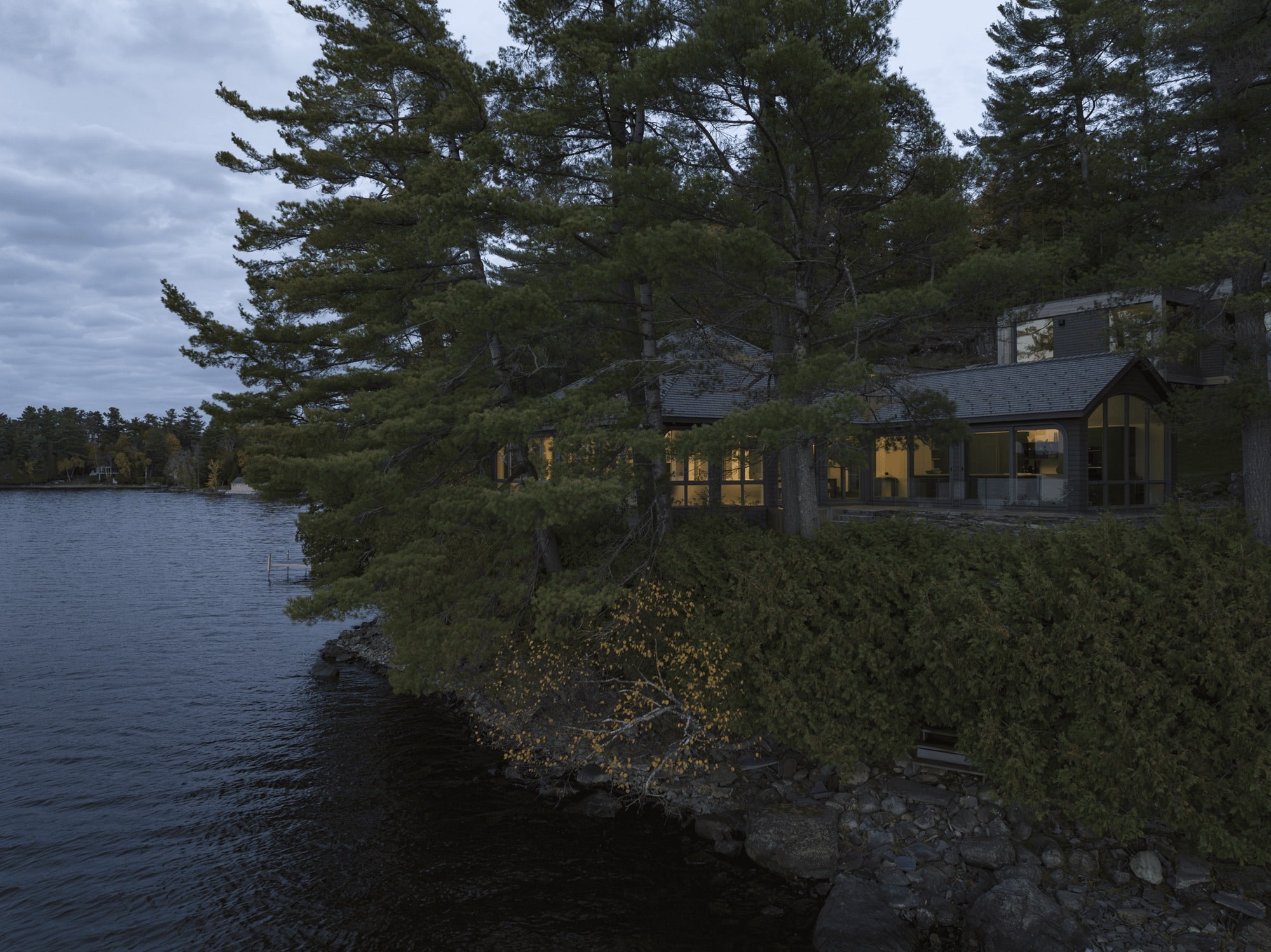
The Maison de la Pointe project was presented as a re-engagement with a small summer cottage built on a large plot of land that ends in a promontory extending into Lake Memphremagog. This cottage belongs to the first half of the twentieth century, reflecting a common typology of holiday homes along lakeshores.
| Field | Details |
|---|---|
| Architects | YH2 Architecture |
| Area | 3700 ft² |
| Year | 2022 |
| Photographs | Maxime Brouillet |
| Category | Residential Architecture, Houses |
| Design Team | Marie-Claude Hamelin, Loukas Yiacouvakis, Karl Choquette, Lisa Busmey, Maria Telemann |
| General Contractor | Finition de l’Estrie |
| Structural Engineering & Consulting | GénieX |
| Interior Design | Anne Tremblay |
| City | Magog |
| Country | Canada |
Existing Building Condition
At that time, such cottages were designed with limited functions and modest spaces, suited to seasonal use. Over the years, however, the cottage did not remain unchanged; extensions were added gradually, leading to a loss of order and coherence in its overall composition.
Architectural Challenge
As a result, the building no longer meets the current needs of its owners, whether in terms of space or modes of use. This raises the usual question in such cases: how can a traditional building, which evolved in an informal way, be developed to meet contemporary requirements without neglecting its original character?

Between Expansion and Demolition
When dealing with lakeside cottages, two main options emerge: expansion or demolition and reconstruction. In the latter case, the consequences go beyond the loss of the building itself, extending to the disappearance of its history, in addition to compliance with new regulatory constraints such as setback limits from Lake Memphremagog, which may alter the building’s position and its relationship with the water.
Preserving the Original Character
In contrast, the expansion approach allows the preservation of the cottage’s original residential character, while introducing improvements suited to current use. However, instead of direct extension, a more cautious strategy can be adopted, based on adding a relatively independent new volume.
Architectural Connection Strategy
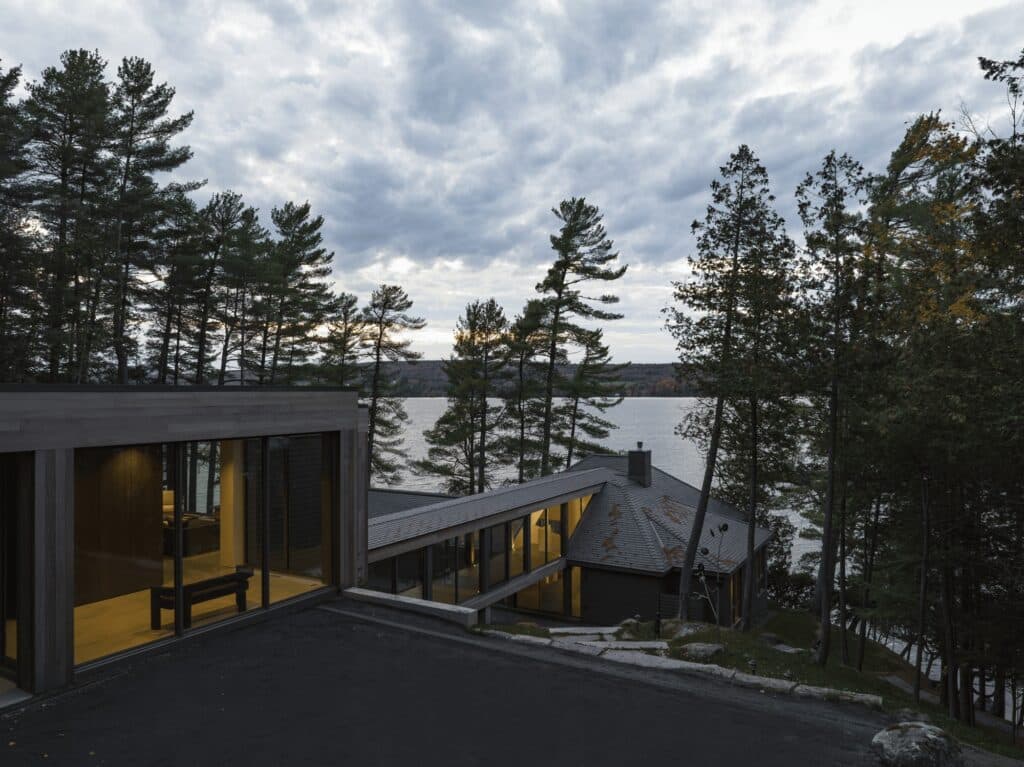
Within this approach, a new wing is constructed at the rear of the site, while the existing cottage is left largely untouched. The two parts are linked by a fully glazed corridor, enabling both functional and visual continuity without blurring the distinction between old and new.
Distribution of Functions Between Old and New
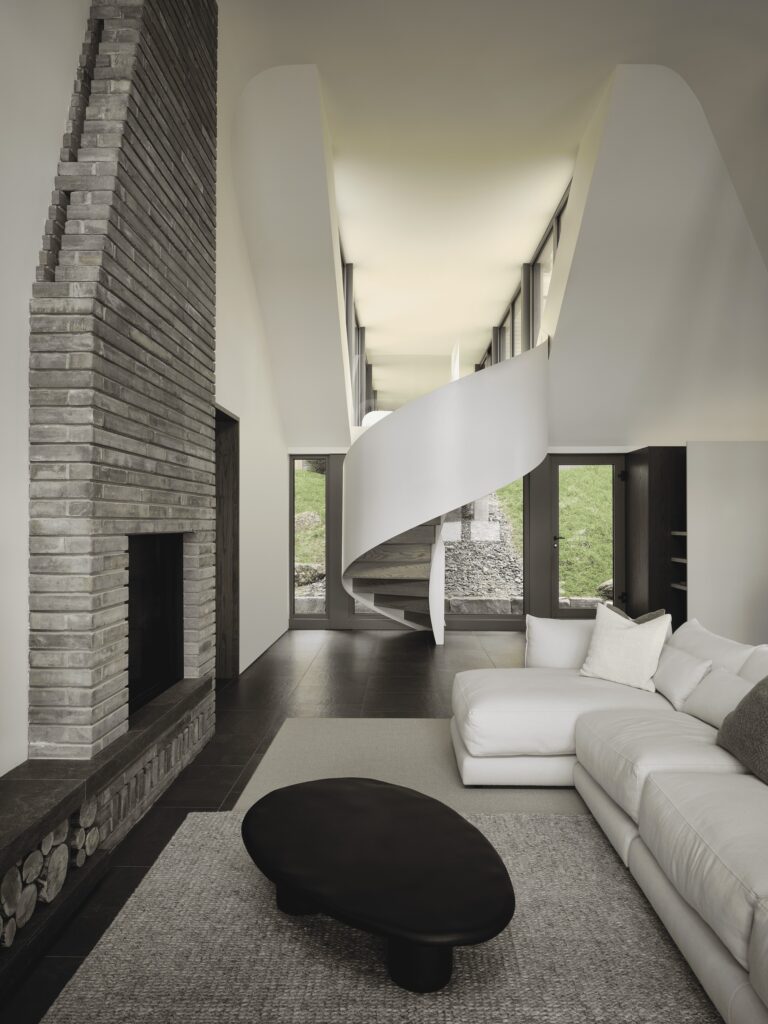
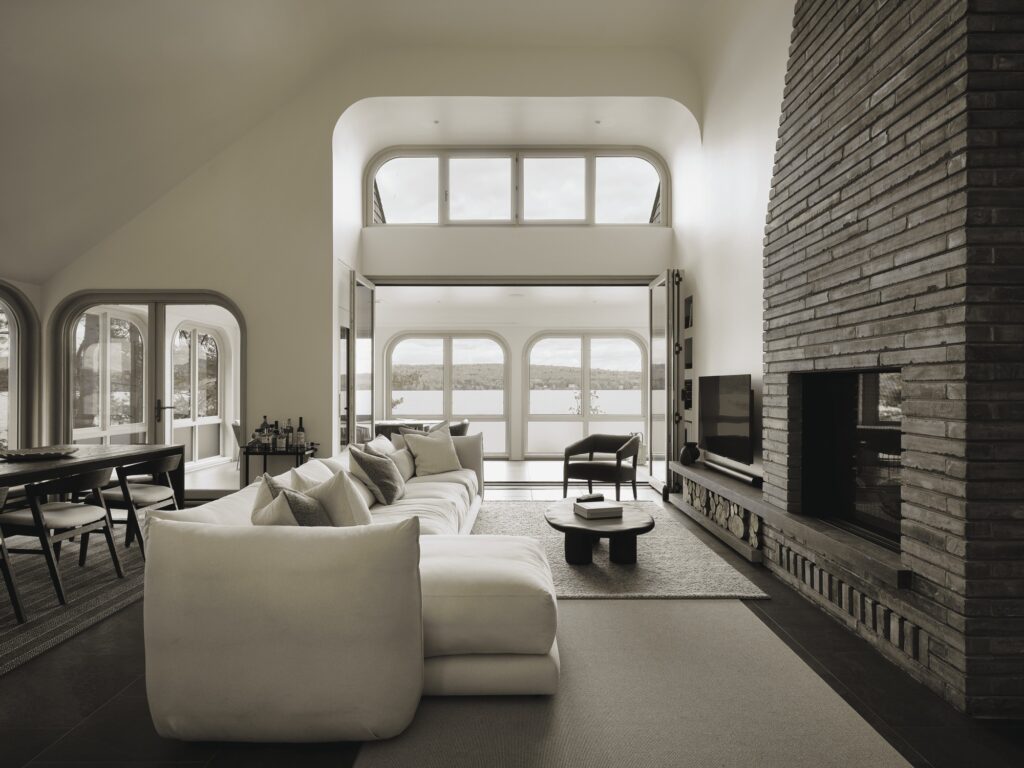
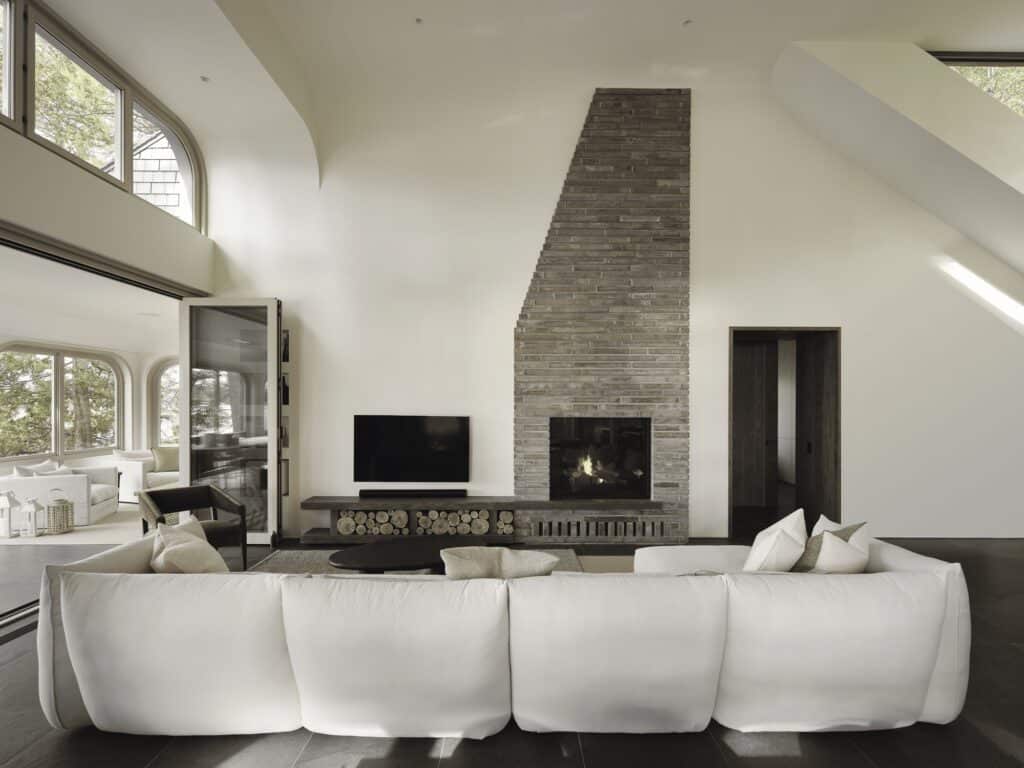
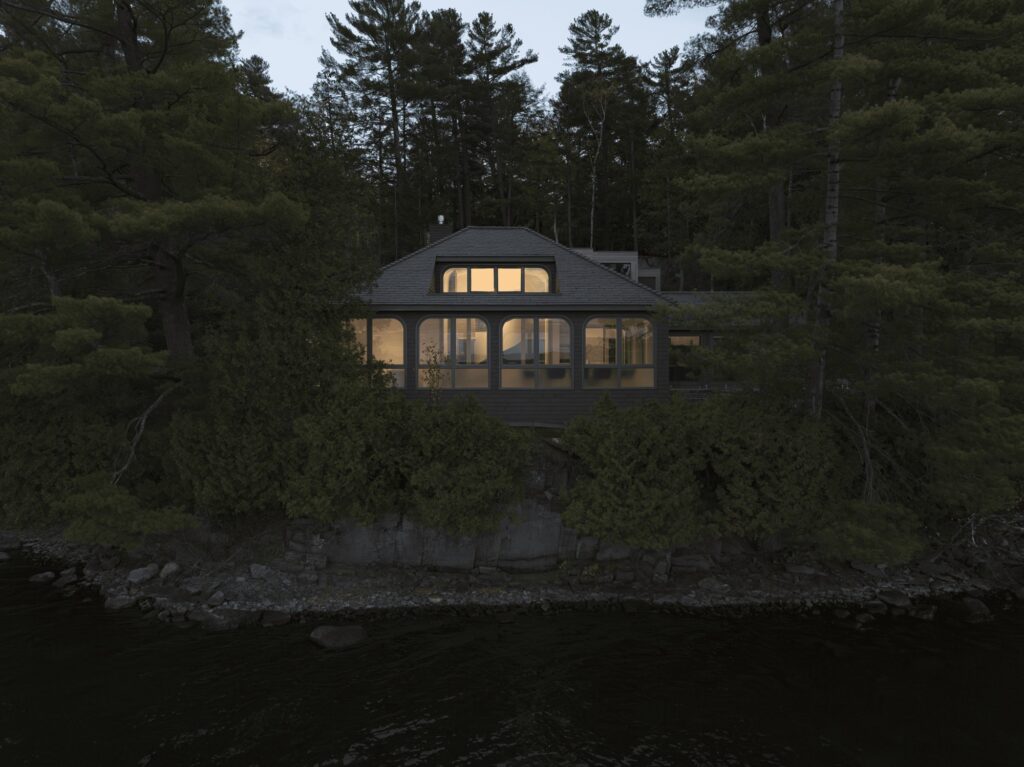
The lakeside wing overlooking Lake Memphremagog constitutes the original building, whose overall composition has been preserved without major alterations to its external form. In contrast, its interior has been completely reconfigured to accommodate the master bedroom and living spaces, while providing a more expansive interior volume beneath vaulted ceilings inspired by the arches of the original veranda.
The new wing, by comparison, takes the form of a compact volume set back into the natural slope of the land, reducing its visual presence in relation to the existing structure. This part of the project is dedicated to children and guests and includes bedrooms, a living area, a study, and a garage.
Balance Between Similarity and Difference
The project reflects an attempt to achieve a balance between two wings of comparable scale and materiality, yet differing in architectural composition and expression. While the existing part retains its traditional character, the new addition offers a more contemporary interpretation without creating a clear rupture.
Continuity Without Repetition
In this way, the project can be understood as an architectural approach that seeks to engage with the existing heritage rather than simply replicate it. The building thus becomes a dialogue between what already exists and what has been added, rather than a mere replacement.
✦ ArchUp Editorial Insight
The Maison de la Pointe case functions more as a regulatory and economic negotiation process than as a purely formal design decision. The original cottage reflects a seasonal housing model tied to early twentieth-century patterns of land use along lakeshores, where low density served as a means of maximizing access to waterfront property. Over time, gradual additions led to a fragmentation of interior space, a common outcome of incremental expansions carried out without a strict compositional framework.
The current intervention is governed by regulatory setback requirements from the lake, legal liability considerations, and the inefficiency of full demolition due to the loss of historical value and the complexity of relocation. The resulting spatial solution separates the program into two volumes connected by a glazed corridor, distributing functions across different residential uses while preserving the logic of the existing structural footprint.
In this way, the project becomes a functional redistribution shaped by compliance constraints rather than a formal act of creation, where continuity is maintained only to the extent allowed by structural and regulatory limitations.