Mycelium Door Project: Rethinking Construction Materials

Rethinking the Concept of the Traditional Door
At first glance, the question may seem simple: what if the interior door we pass through every day were made from fungi instead of traditional wood? Yet this idea opens a much broader reconsideration of construction materials themselves, and how nature can become an active component in producing architectural elements rather than relying entirely on extracted and industrially processed resources.
In this context, a prototype of an interior door has been developed using bio-based materials, as part of a research direction aiming to test more sustainable alternatives for modern living environments.
Mycelium as an Emerging Structural Element
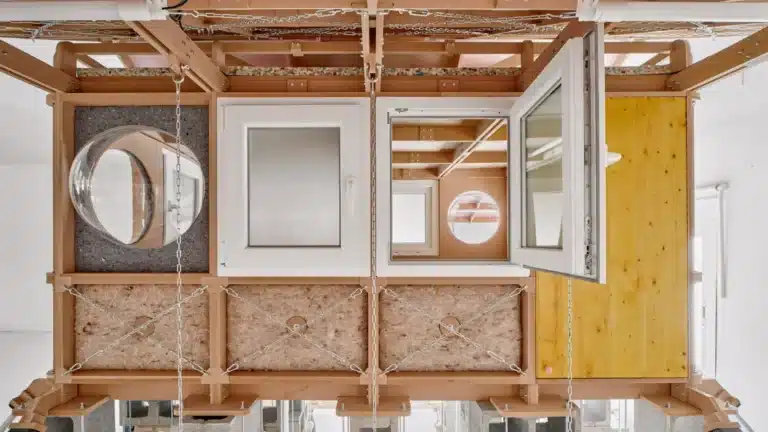
This approach is based on the use of mycelium, the root-like structure of fungi, which is guided to grow within predefined molds to form lightweight, rigid panels.
This natural growth process does not only shape the material, but also grants it functional properties such as sound absorption, adding a performance dimension alongside its environmental one.
Rather than being extracted as a raw material, it is “grown” under controlled conditions, reflecting a shift in thinking from manufacturing to cultivation.
Material Integration and Waste Reduction
After the mycelium core completes its growth, it is integrated into a wooden frame made from reclaimed timber and leftover by-products of previous production processes. This integration is not only structural but also aimed at minimizing the use of new raw materials as much as possible.
Through this approach, the door becomes the outcome of a low-waste production chain, where wood scraps are repurposed instead of discarded, reinforcing the concept of a circular economy in architectural materials.
A Prototype for a New Architectural Direction
This door was developed through a collaboration between specialists in bio-based materials and architectural design, as part of a broader experiment still at the prototype stage. Although it has not yet reached full-scale production, it raises a fundamental question about the future of materials used in interior construction, and the boundaries between nature and industrial design.


The Challenge of Relying on Traditional Wood
From a materials development perspective, this type of innovation is presented as a direct challenge to the traditional reliance on slow-growing hardwoods in the construction industry. Instead of treating wood as the primary option, mycelium is introduced as a renewable alternative that can be produced within a shorter timeframe and with customizable properties.
In this context, one of the project contributors suggests that fungi-based materials could open the door to new structural components that may be scaled up for industrial production, rather than remaining limited to experimental applications.
Short Production Cycle and Scalability Potential
The manufacturing process of these materials is characterized by a manufacturing process growth period of approximately two weeks, which is relatively short compared to traditional construction materials.
More importantly, this process was designed from the outset to be scalable, meaning it could potentially transition from an experimental model into a stable industrial production system.
In this sense, these doors are not viewed merely as individual experimental products, but as part of a possible production pathway that could be integrated into broader manufacturing chains in the future.
Design Flexibility During the Growth Phase
One of the most distinctive aspects of this approach is that the material’s properties are not fully fixed after production, but can instead be influenced during the growth phase itself.
Rather than relying on post-production finishing processes, color and texture can be adjusted from the beginning, reducing the need for additional treatment steps.
The material can also be guided toward different color tones or even coated with natural layers such as clay, giving the final surface a warmer character and strengthening its connection to organic materials.
As a result, design shifts from being a post-material process to becoming an integrated part of the material’s formation itself.

Structural Performance as a Design Priority
The development of this type of door is not limited to material or environmental considerations alone; structural performance was given clear priority as well. During the growth phase, a bio-based layer was introduced to increase the rigidity of the structure and improve its fire resistance.
This technique relies on what can be described as “bio-welding,” where the internal structure is reinforced without the need for conventional adhesives or additional manufacturing stages. This reduces industrial complexity and redefines the concept of strengthening materials from within.
Compliance with Real Building Standards
In addition, the door was designed to comply with established construction standards for private residential construction, particularly in relation to fire and moisture resistance.
This positioning places it outside the realm of purely experimental prototypes and brings it closer to real-world application in contemporary building projects.
Thus, the door is not presented as a theoretical concept alone, but as an element that can be integrated into built environments governed by clear regulatory frameworks within the architecture sector.
First Real-World Application in a Low-Impact Housing Project
This prototype is expected to see its first practical application in a low-impact housing project known as Kaerhytten, located in Ramloese, Denmark, and being developed under the supervision of architect Jens Martin Suzuki-Hjogroup, with completion targeted for 2026.
This direction reflects an attempt to test bio-based materials within real architectural contexts rather than confining them to laboratories or isolated prototypes.
Sensory Details and Expansion of Future Applications
The prototype also includes carefully designed components, including a door handle designed by architect Bianer Hammer for the Danish brand Randi. This handle, known as Moom, is cast from recycled seashells, adding a sensory layer that aligns with the philosophy of sustainable materials used in the door’s interior spaces.
On a broader level, the two developing companies are working to expand this technology to include wall panels and mycelium-based acoustic ceiling systems, in an effort to extend the use of bio-based materials within interior environments and design applications.
Redefining the Experience of Space
In this context, natural materials are viewed not only as an environmental alternative, but as an active element capable of reshaping human experience within space. As one of the participating architects suggests, the question is not limited to form or function, but extends to how these materials can transform our perception of space visually, acoustically, and perhaps even in terms of our overall sensory experience of the surrounding environment within contemporary architecture.

✦ ArchUp Editorial Insight
The mycelium door appears here not as a design proposal but as an administrative outcome produced by the intersection of material governance policies, carbon reporting pressures, and research frameworks for low-emission bio-based materials. The primary driver is not formal intent but institutional requirements to reduce carbon footprints and demonstrate compliance within building certification systems.
Regulatory constraints related to fire resistance, moisture performance, and insurance liabilities enforce a hybrid configuration that combines grown mycelium with a recycled timber frame as a mechanism for achieving structural legitimacy without violating established construction industry standards.
The final output represents a material compromise between laboratory-scale scalability and the inertia of conventional industrial systems, where the production cycle is reduced to a biological growth timeline rather than mechanical manufacturing processes. What appears as a material experiment is, at its core, a reallocation of wood waste streams within a standardized compliance framework that enables its integration into low-impact housing units without disrupting the prevailing regulatory infrastructure.