
Narxoz University College of Business Administration: Rethinking the Relationship Between Historic Architecture and Contemporary Education

Reimagining University Buildings: From the Past to a Contemporary Learning Experience
A university in Central Asia has undergone an intriguing architectural transformation, converting a campus building dating back to 1978 into a College of Business Administration. This transformation went beyond mere space renovation; it redefined the executive education experience in the region by leveraging previously neglected architectural elements and turning them into a core part of the new college’s identity.
Architectural and Environmental Challenges
The building is located within an active campus and originally housed administrative offices and a cafeteria. In the early 2000s, rooftop modifications added new proportions to the structure, resulting in a visually heavy form that felt disconnected from the original fabric of the building. Designers thus faced a dual challenge: updating the building to meet the demands of modern education while preserving its structural stability and strictly adhering to seismic regulations, a critical factor in an earthquake-prone region.
Design Objectives
The vision focused on creating a College of Business Administration that aligns with international standards for executive education while distinguishing itself from the traditional academic style of campus buildings. Achieving this required a careful balance between the institution’s new identity and structural design constraints, including height and load-bearing capacity, ensuring a modern and safe learning experience simultaneously.


Structural Rehabilitation Challenges
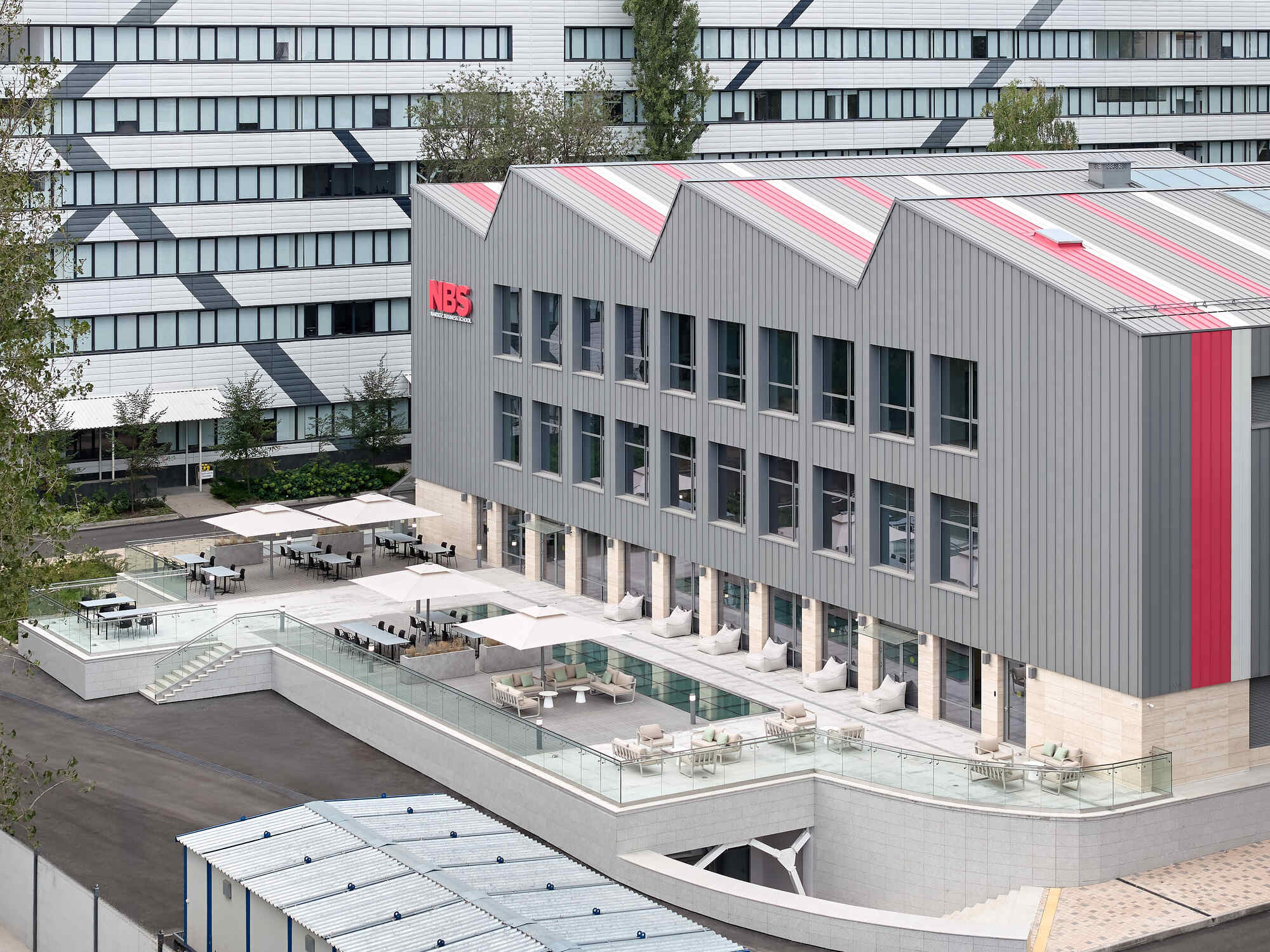
During the technical assessment of the building, it was revealed that the upper floor was structurally unsafe, necessitating its complete dismantling. This raised concerns about the potential loss of the original sawtooth roof, which had been hidden behind façade panels and was not visible in the campus’s overall landscape.
Archival Research and the Importance of Preserving Architectural Elements
The architects relied on archival research and on-site investigations to understand the original roof geometry. Based on these findings, they made a deliberate decision to reconstruct it using modern structural systems, allowing for a combination of structural sustainability and preservation of the building’s historical identity.
Architecture as Cultural Heritage
In a context where many Soviet-era buildings in Kazakhstan are routinely demolished, this decision is viewed as a cultural statement. It reflects a perspective that sees existing architecture as a resource to be developed and utilized, rather than as an obstacle to modern urban development.


Enhancing Architectural Identity and Campus Presence
To give the building a clear presence and a contemporary identity within the campus, a new annex was designed housing the main entrance, reception, and a double-height lobby, along with a panoramic elevator. This addition serves as a hub for circulation and interaction, enhancing the autonomy of the College of Business Administration within the broader campus context, while improving accessibility and wayfinding throughout the building.
Interior Organization and User Experience
The spatial organization within the building unfolds as a continuous sequence of academic and social spaces across all levels. This includes technologically equipped classrooms, collaborative work areas, informal meeting spaces, coffee points, and video studios, providing a diversity of learning and interaction modes. For specialized spaces, interior design considerations were carefully applied to enhance usability and comfort.
Adaptive Reuse and Enhanced Natural Light
Former storage rooms in the basement were converted into multi-purpose halls for events and exhibitions. These new spaces are flooded with natural light through full-height glass façades, complemented by a horizontal ceiling integrated into the terrace above. Throughout the building, abundant daylight, open views, and carefully designed acoustics contribute to focus, foster dialogue, and encourage collaboration among users.


Architectural Expression and Materials
Metal was employed in shaping the roof and façades through interlocking panels that flow seamlessly along the building. This design highlights the rhythm of the original sawtooth roof, giving the building a clear architectural unity. A restrained color palette of grays and whites further supports visual harmony with the surrounding campus while maintaining the distinctive identity of the College of Business Administration.
A Flexible Educational and Social Platform
The building now functions as a flexible platform that integrates educational and social functions, supporting both academic programs and public activities. By uncovering and reinterpreting previously hidden architectural elements, the project provides a practical model for adapting historic buildings for contemporary use, preserving their cultural values, and presenting a renewed public façade aligned with the campus’s aspirations.


✦ ArchUp Editorial Insight
The rehabilitation project of the College of Business Administration building at Narxoz University can be seen as a rich example of how historic university buildings can be adapted for contemporary educational uses while highlighting their key architectural elements. On one hand, the project provides a model for balancing historical identity with modern functionality, demonstrating how smart additions and interventions can enhance user experience, improve natural lighting, and facilitate internal circulation.
On the other hand, the project raises questions about the extent to which the original structure is preserved versus the demands of contemporary design. Major structural interventions, such as the reconstruction of the upper floor and the sawtooth roof, may reduce some of the building’s original historical features to mere formal representations, limiting its value as a case study of historic architecture. Additionally, the intensive focus on modern academic and social functions imposes changes on the original spatial organization, potentially diminishing the architectural complexity that once existed.
Nevertheless, the project remains an opportunity to understand how existing buildings can be treated as an architectural resource rather than an obstacle. It provides a knowledge base for future generations regarding strategies for integrating architectural heritage with the requirements of modern education. From a broader perspective, lessons can be drawn on the importance of phased planning, testing structural and technical solutions before implementation, and ensuring a balance between new functions and the preservation of historical character.
project location

★ ArchUp Technical Analysis
Technical Analysis of the Narxoz University Business School Rehabilitation:
This article provides a technical analysis of the rehabilitation of a 1978 university building at Narxoz University, as a case study in adaptive preservation and structural modernization for a modern educational function.
The structural challenges lay in the original upper floor failures and the necessity of complying with stringent seismic regulations. This necessitated the complete dismantling of the unsafe upper floor and the reconstruction of the hidden original sawtooth roof using modern structural systems.
The architectural intervention includes a contemporary extension housing the main entrance, a double-height lobby, and a panoramic elevator, serving as a circulation hub and giving the school a clear identity.
In terms of educational performance, the building was converted from offices and a canteen into a business school with tech-equipped classrooms, co-working spaces, and multi-purpose halls, utilizing abundant natural light and open views.
Related Insight: Please review this article to compare another project that preserves a historical element and transforms it into a contemporary design focus:
Narxoz University Business School Project Reinterprets the Relationship Between Historical Architecture and Contemporary Education



✅ Official ArchUp Technical Review completed for this article.