

A Green Urban Home Rises in Miami and Redefines the Experience of Natural Living

An Entryway that Reimagines the Relationship Between City and Human
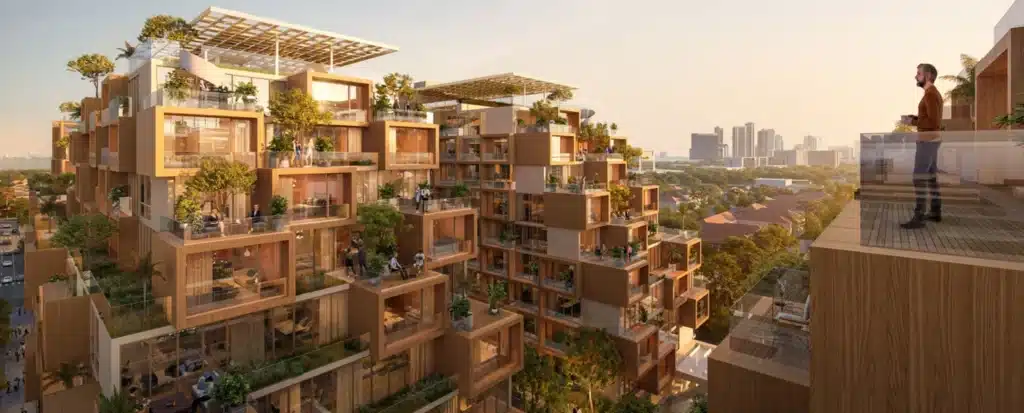
Natural living returns to the heart of Miami through a project that introduces an urban vision grounded in direct connection with air, light, and vegetation. The experience begins the moment a visitor approaches the building’s stepped volumes, where wooden and glass façades shift in a clear rhythm that brings a calm, light presence to the street. Planted terraces blend with the exterior lines, creating a direct relationship between residents and their surroundings.
Light slides through multiple openings, revealing natural materials that give interior spaces a warm texture, while exterior platforms appear like suspended gardens within an active urban context. Here, natural living reframes the idea of residential density and offers each occupant a private outdoor extension that recalls the intimacy of a house with its own yard within a unified architectural mass.

An Urban Mass That Responds to Its Setting
The project breaks the large structure into smaller units that shift inward and outward across the façade. This approach creates a visual scale closer to the surrounding neighborhood, which historically consists of low-rise homes.
The wooden and glass boxes move in a pattern that forms depth, shade, and clear contrast between light and shadow. These forms support the concept of natural living by embedding planted areas directly into the façade, expanding the relationship between interior spaces and the street while reducing the perceived mass of the building.
Vertical and Horizontal Paths That Guide the Visitor
Visitors move between levels that follow the rhythm of the exterior composition. Circulation paths lead toward private terraces, shared gardens, and open air walkways that frame views of the city.
Residents pass through shared nodes positioned across several floors, reinforcing visual and spatial connection. Outdoor pools, edible gardens, and communal kitchens extend around the building and create daily interactions between movement, activity, and landscape.
Each resident experiences a different spatial character depending on the position of their unit and the orientation of its terrace. Every home maintains a distinct presence within the overall composition without relying on decorative expression. Here, natural living becomes a functional driver of movement and spatial organization rather than a visual motif.
Architectural Details That Highlight Materials and Support Sustainability
The project emphasizes materials in their raw, untreated form. Exposed concrete poured using wooden formwork appears throughout the building’s core, preserving the grain and imprint of the formwork on its surface. This concrete meets stepped wooden façades and stone flooring, creating a balanced relationship between natural materials and structural clarity.
Materials and Construction Techniques Used
- Natural wood cladding covering approximately 40% of exterior surfaces
- Board-formed concrete representing nearly 30% of visible structural elements
- Stone flooring for around 25% of shared interior areas
- Planted terraces integrated into more than 70% of residential units
- Layered façade projections reducing solar glare by roughly 35%
- Rooftop solar panels exceeding 35,000 ft² for energy generation and shading
This combination of natural materials and stepped geometry strengthens environmental comfort, reduces cooling demand, and creates self-shaded zones shaped by terraces and vegetation.

Clear Integration Between Architecture and Environment
The project builds upon a central principle: maximizing the presence of vegetation across all building levels. Terraces transform into planting areas that support trees and herbs, forming small ecological systems within each residence.
These green pockets improve air quality, provide natural thermal insulation, and soften noise levels within the building. Solar panels reinforce an energy-conscious strategy, while the stepped façade reduces direct heat gain and glare. Together, these elements frame a coherent model of natural living within a dense urban landscape.
A Documented Vision for the Future of Urban Housing
The project offers a documented model for a renewed relationship between people and their built environment in a high-density city. Every unit interacts with its surroundings through planted terraces and generous outdoor extensions, while shared paths encourage social engagement as part of daily life.
The design provides the qualities of a private home yet operates within a collective urban system. This approach positions natural living not as an aesthetic direction but as an organizing principle that reshapes how residents experience life within the city through light, air, and vegetation embedded directly into their homes.
ArchUp provides an encyclopedic database featuring updates on major events and exhibitions, with regular updates to competitions and official results.

✦ ArchUp Editorial Insight
The project presents an urban experience shaped through stepped volumes that break down the building’s height and create a visually balanced façade. Planted terraces merge with wood and glass to form readable layers of light and shadow, generating continuous movement across the exterior. The design strategy prioritizes fragmentation over a singular mass, offering residents more privacy while potentially introducing long-term maintenance and coordination challenges. Even so, the project strengthens the role of natural living within a dense urban fabric and provides a scalable model for similar future developments.


