
NestOff Micro Cabin: Redefining Minimal Living in Nature

The Micro Cabin and the Context of Limited Dwelling
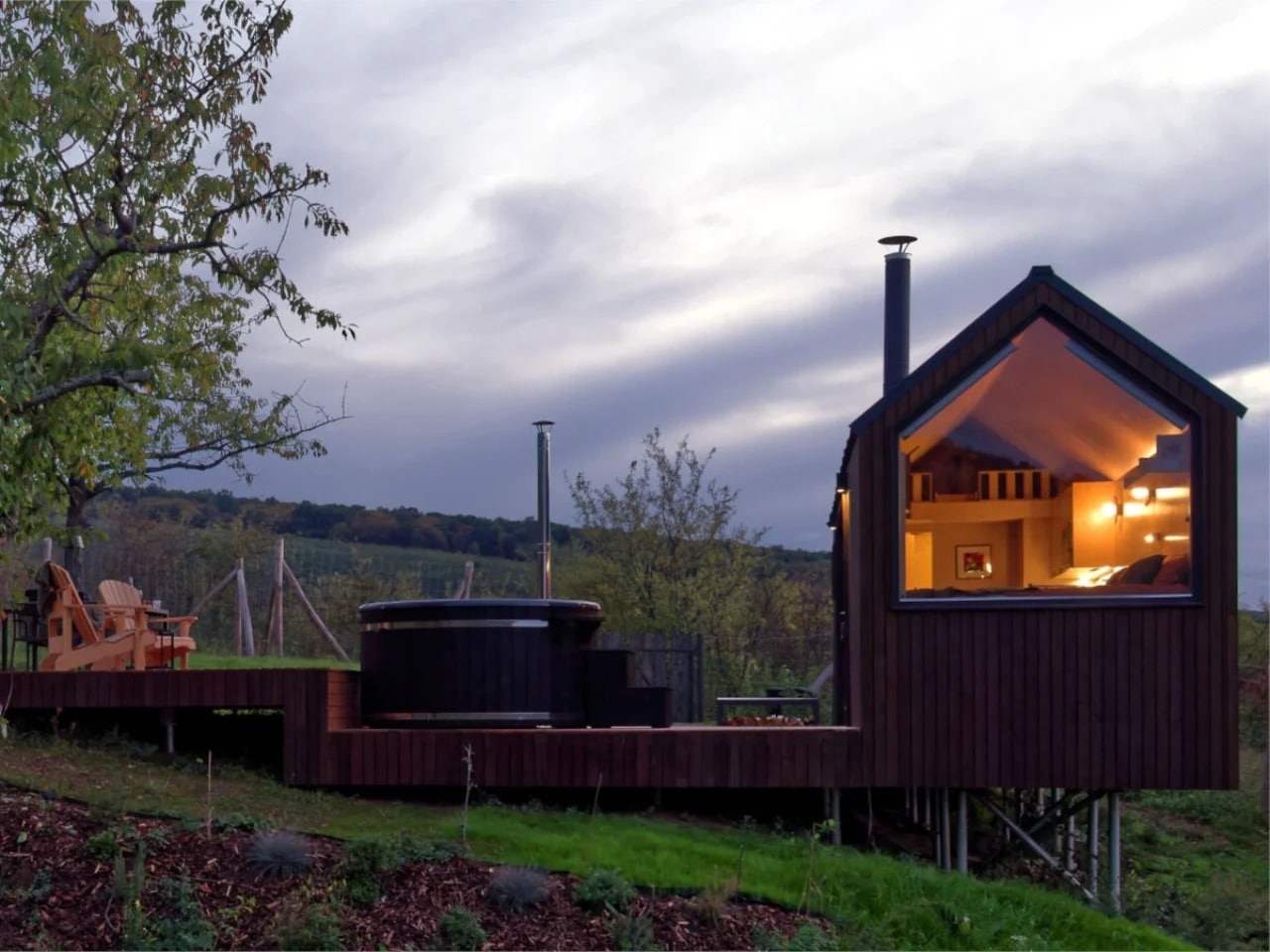
This cabin is located in the forested hills of northern Hungary and is presented as a compact retreat measuring 20 square meters within the NestOff project, designed by Architecture and interior designer Péter Kotek. In terms of size, the project may appear on paper as a sharp reduction of conventional housing requirements; however, the actual experience reopens the question of how much space an individual truly needs.
Within the broader discourse on “micro living,” the narrative typically oscillates between two opposing perspectives: one leans toward an idealized view that considers small spaces sufficient for all functions, while the other offers a historical critique linking limited space to constrained economic conditions. This project emerges as a case that moves beyond this direct dichotomy, as it does not present itself as a permanent residence, but rather as a temporary retreat within a natural setting, without adopting a rhetoric of reducing life to its bare minimum.
Execution Methodology and Environmental Impact
Part of the structure was prefabricated off-site in collaboration with a cabin manufacturer, allowing for greater precision in Construction, reduced material waste, and a faster on-site assembly process. The cabin relies on ground screw foundations instead of poured concrete, a structural choice that enables the structure to be removed or relocated in the future without leaving a permanent mark on the land.
This approach minimizes direct intervention in the natural site and renders the relationship between the building and the ground less fixed and more reversible. In this context, the project is not presented as a fully comprehensive environmental solution; rather, it demonstrates a practical commitment to reducing its immediate impact on the soil, making it an example of a Buildings approach that operates with minimal material intervention on its site.

Interior Treatment and Architectural Materiality
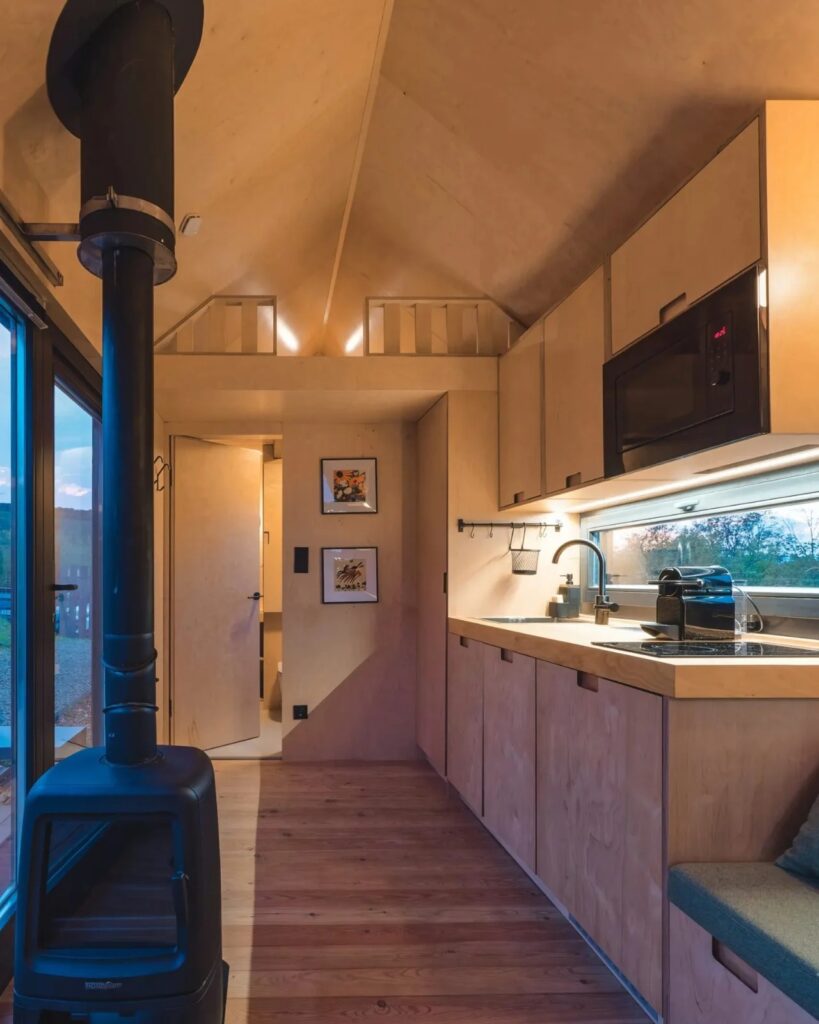
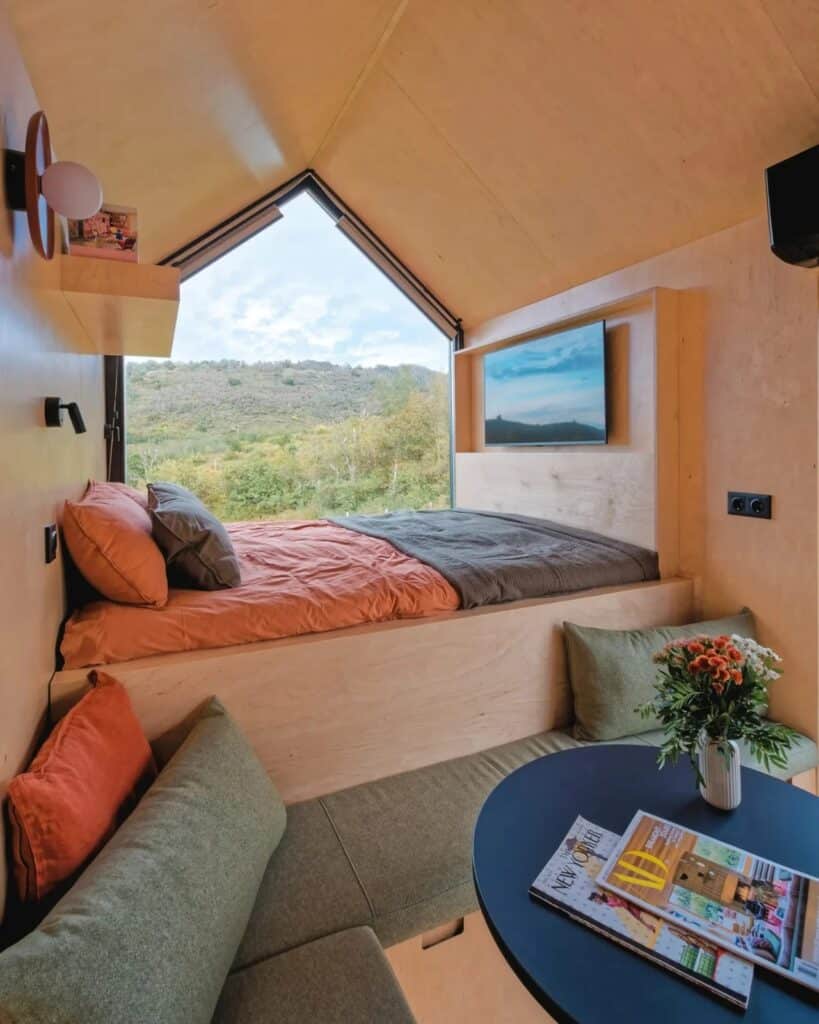
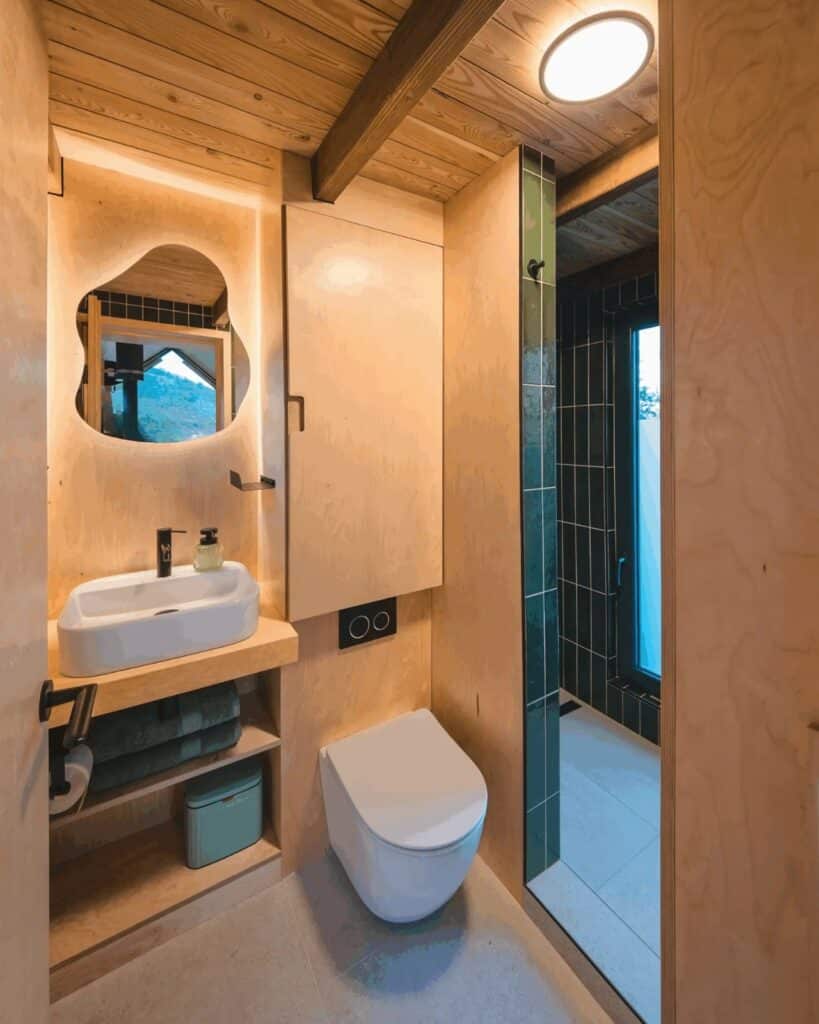
Inside, birch plywood panels are used to clad the walls, ceilings, and built-in furniture, creating a material continuity across the spatial elements. This unified application reduces visual fragmentation and reinforces the perception of the space as a cohesive whole rather than a conventional room composed of separate parts. For more technical specifications on such materials, you can refer to Material Datasheets.
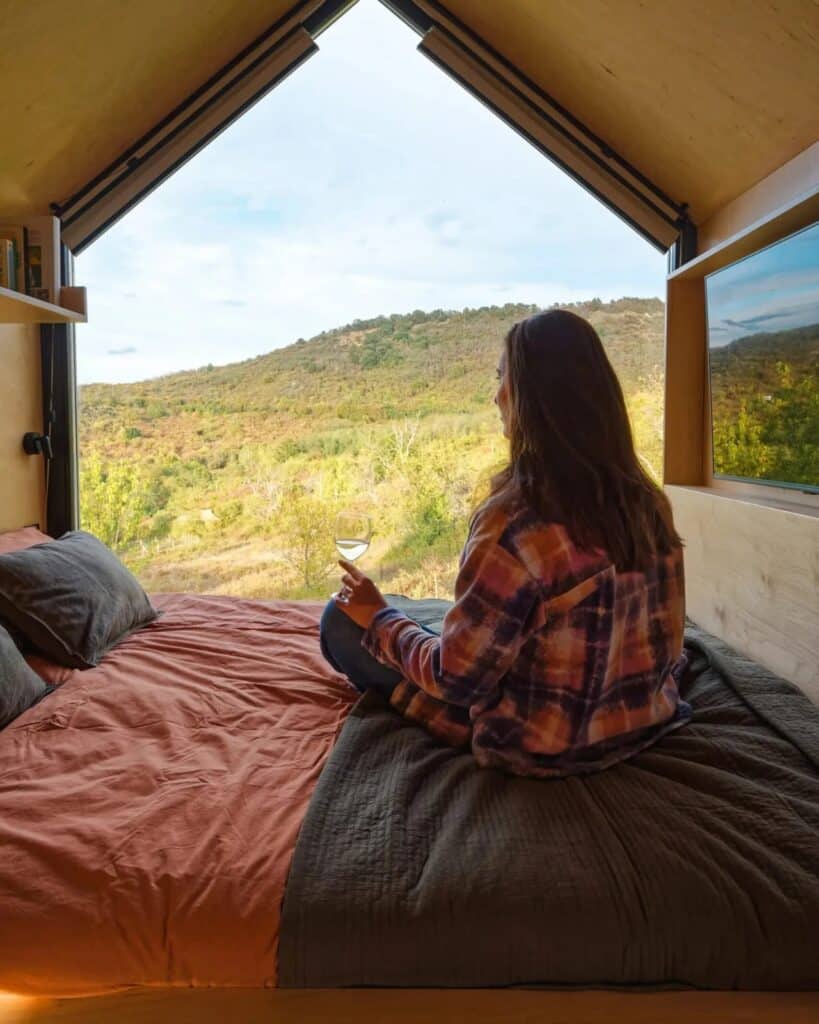
The panoramic opening plays a critical role as an integral component of the interior experience, bringing the natural landscape into the space without dissolving its boundaries. In this sense, the view is not treated as an addition element, but as a visual extension that contributes to shaping the perception of space itself, while maintaining the functional separation between interior and exterior. This approach is deeply rooted in Interior Design principles.
External Organization and Spatial Sequence
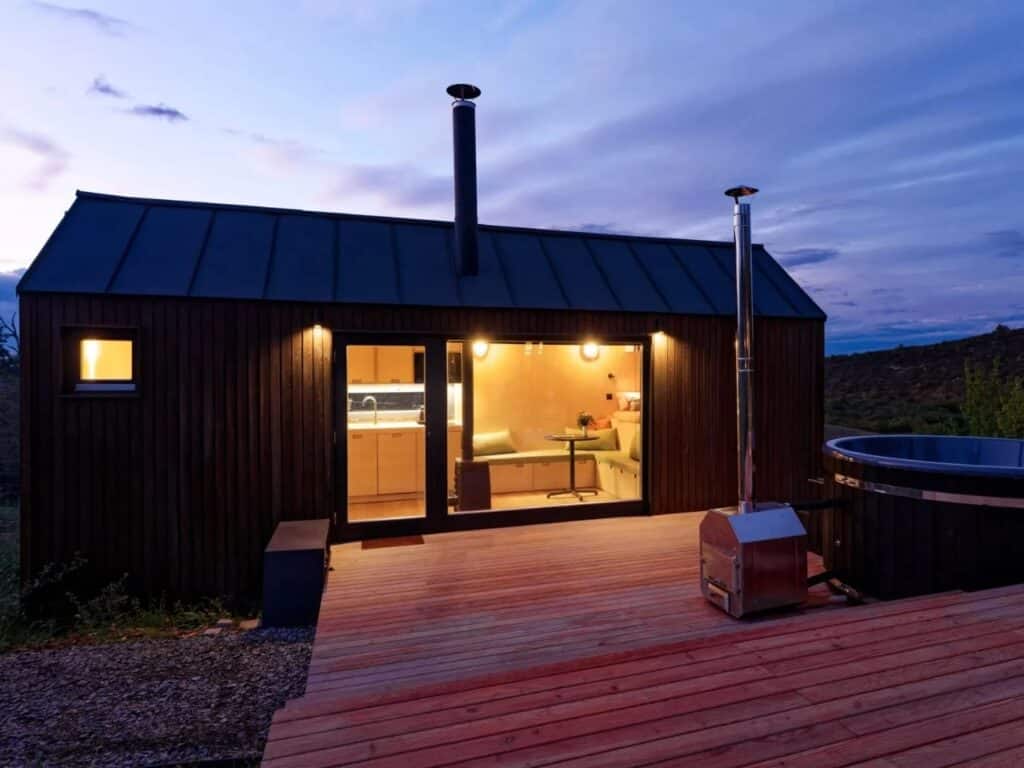
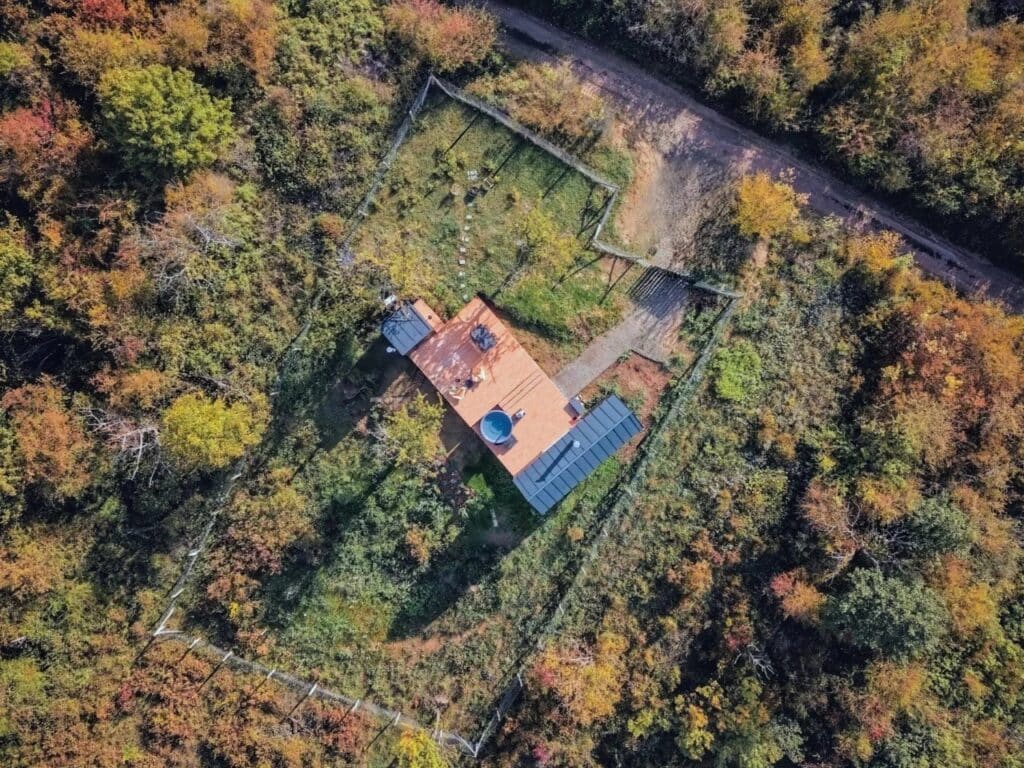
The external program consists of two vertical wooden volumes clad in dark panels, one designated for primary use and the other for a sauna, connected by a multi-level outdoor deck made of larch wood. This arrangement establishes a clear functional relationship between the different masses within the site. To see how other architects have handled similar site organizations, browse the Archive.
In addition, a hot tub is integrated into the external composition, adding another layer of use to the open space. This configuration produces a defined spatial sequence that begins indoors, moves across the deck, continues to the sauna, and then returns again to the interior. This rhythm does not rely on complexity, but rather on a direct yet calculated organization that structures the daily use of the space in a sequential and orderly manner.


The Concept of “Retreat” and the Redefinition of Need
This type of project raises a direct question about the nature of what we actually require from a “retreat.” Rather than adhering to the conventional notion of a vacation, associated with travel and structured itineraries, it presents a more reduced model based on minimizing essential elements to their core: a bed, a view, hot water, and a space that allows for temporary disconnection from everyday digital use. This aligns with current discussions in Discussion forums about minimal living.
In this context, the NestOff project offers an architectural configuration that consolidates these elements within a footprint not exceeding 20 square meters, accompanied by an external larch deck. This configuration does not rely on addition or expansion, but rather on organizing necessity within a limited and clearly defined scope, without attempting to justify this reduction or frame it as an exception.
The Project’s Position Within the Context of Micro Cabins
The project belongs to the category of micro cabins, a typology that has seen widespread proliferation in contemporary Design, both in Scandinavian contexts and across various commercial initiatives worldwide. This expansion has generated a high level of visual and conceptual competition around the idea of the “micro dwelling.”
Within this landscape, NestOff does not depend on a performative narrative or excessive functional density. Instead, it maintains a focused objective: to provide short-term accommodation in a natural environment with minimal complexity. This direction positions it closer to a direct functional solution, where the experience is reduced to temporary habitation without interpretive additions or superfluous design elements. You can find similar innovative concepts in the Projects section.

✦ ArchUp Editorial Insight
NestOff emerges as a low-density hospitality unit within the short-term rural accommodation market in northern Hungary, driven by direct investment demand for micro-hospitality assets that convert land value into temporary experiential value rather than long-term urban transformation. The operative framework here is an off-site prefabrication chain tied to production efficiency and reduced reliance on on-site labor, coupled with a screw foundation system that bypasses the requirements of poured concrete and mitigates regulatory constraints associated with soil intervention. For more insights on market trends, check the latest Top News.
Insurance and urban planning preferences further incentivize removable, seasonally operated structures, resulting in a spatial configuration optimized for rapid installation, minimal maintenance, and relocatability. The outcome is not a design statement but a negotiated resolution between financial and regulatory constraints, where the micro unit is translated into a compact functional infrastructure for managing flows of temporary occupancy. This represents a unique niche within the broader Architectural Jobs and development market.

★ ArchUp Technical Analysis
Technical and Documentary Analysis of the NestOff Project – Northern Hungary:
This article presents an architectural analysis of the NestOff project as a case study in redefining the concept of limited-nature accommodation within the micro-cabin category. To enhance its archival value, we would like to present the following key technical and design data.
The cabin has an area of 20 square meters and is located in the forested hills of northern Hungary, designed by architect Péter Kotek. Part of the structure was prefabricated off-site in collaboration with a cabin manufacturer, with foundations consisting of ground screws rather than poured concrete to allow for future removal or relocation of the structure without leaving a permanent trace.
The interior design relies on birch plywood panels covering walls, ceilings, and built-in furniture, creating material continuity between the spatial elements. The exterior program consists of two vertical wooden units clad in dark panels (one for primary use and the other for a sauna), connected by a multi-level larch wood deck, with a hot tub integrated into the outdoor composition.
The panoramic opening brings the natural landscape into the interior as a visual extension.
Related Insight: Please refer to this article to understand the context of modern architectural preservation:
Micro-Cabins in Natural Environments: Low-Impact Design and Construction Strategies.




✅ Official ArchUp Technical Review completed for this article.