
The Leaf House in the Cotswolds: A Model of Organic Architecture and Off Grid Residence

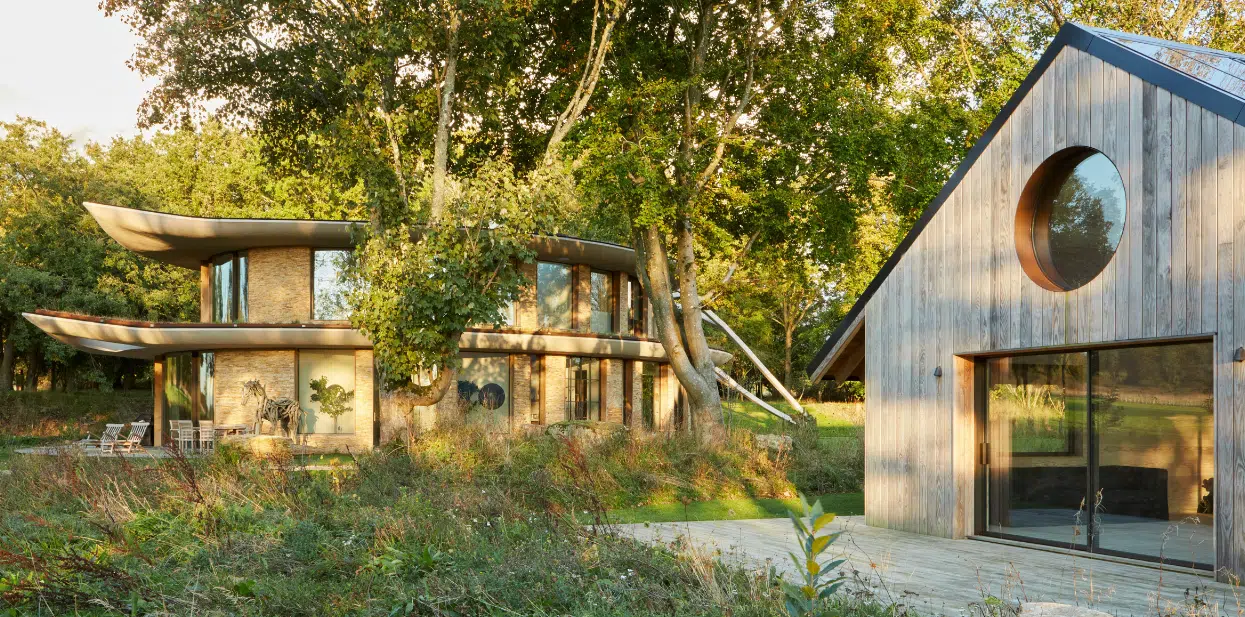
At the heart of a protected natural beauty area, a residential structure emerges. Its form entirely derives from its site’s essence. The design is not merely a geometric projection. It is a direct response to the surrounding forest, embodying the Off Grid Residence as the core idea of the project. The building adopts the shape of two adjacent leaves creating an integrated oval plan. This organic shape arose for two reasons. The first is a poetic nod to nature, and the second is the need for 360-degree panoramic views of the landscape. This principle, based on Self-Sufficiency, reflects the essence of Organic Architecture.
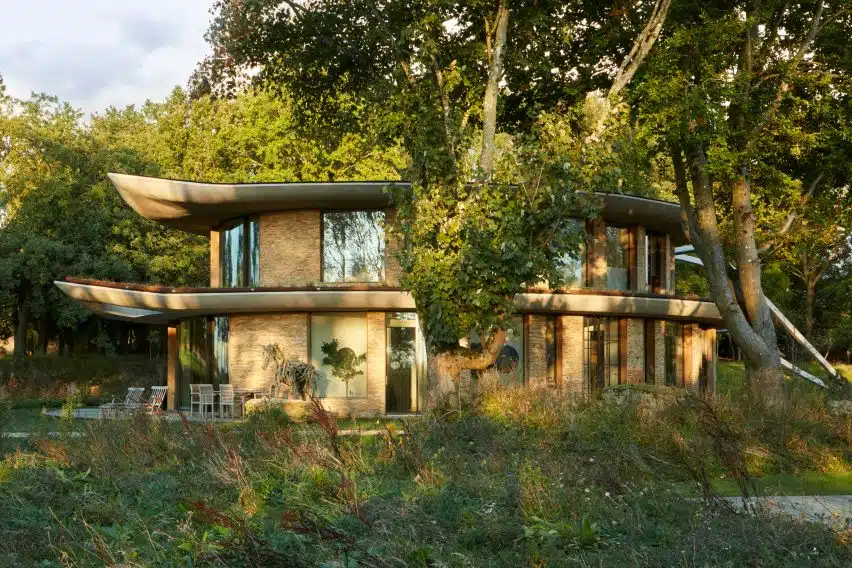
The Fusion of Form with Environment and Symbolic Anchoring
Locally sourced stone clads the two-story building. This deeply connects the structure to the land’s history. The roof surfaces have gentle contours. They resemble real leaves. They will receive the vegetation that forms on them over time.
To reinforce this connection, twin steel stems extend from the eastern base. These stems are not just structural elements. They are a symbolic anchor. Climbing plants will gradually wrap around them. They appear like veins drawing life from the earth. This enhances the concept of Organic Architecture.
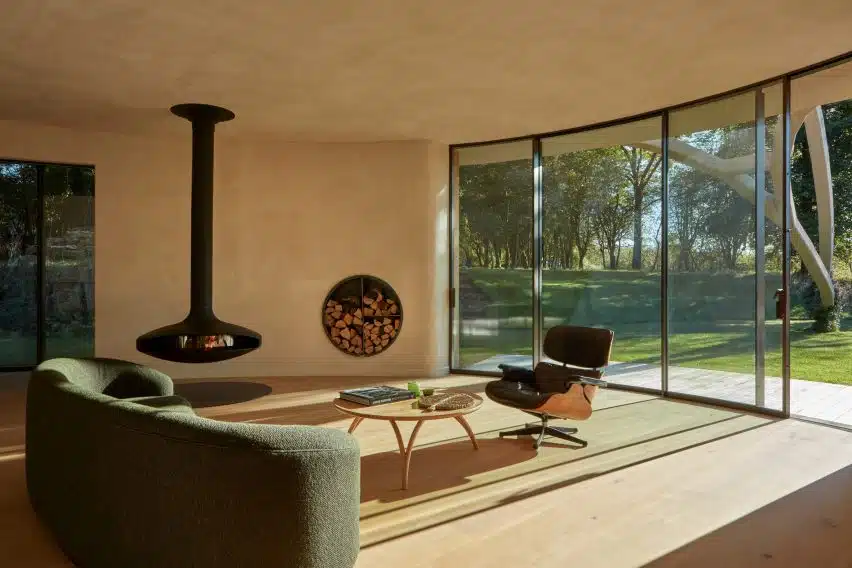
Light Paths and the Flow of Internal Space
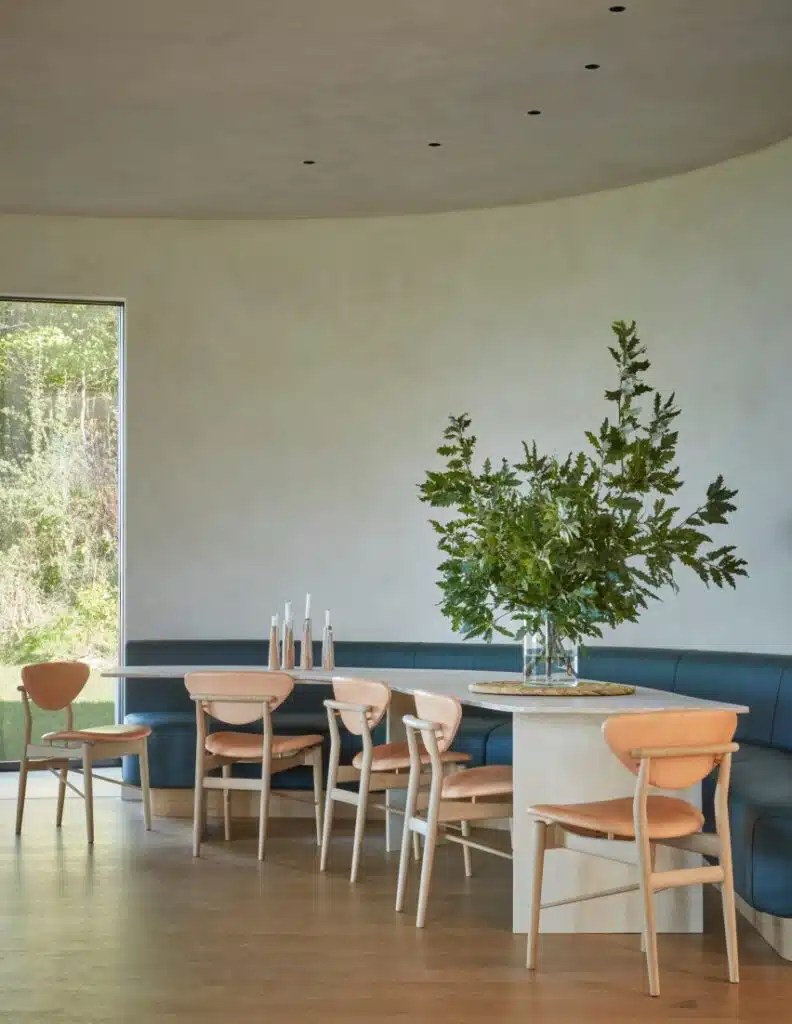
The visitor experience begins in a double height entrance corridor. A skylight floods this passage with sunlight. This central corridor acts as a natural separator. It divides the ground floor into two equal wings. The east wing is the spacious living area. The west wing hosts the kitchen and dining area.
Full-height glass windows open these spaces directly to the outside. This effectively eliminates the boundary between the interior and the green landscape. Small glazed rooms appear at the edges of the design. They serve a crucial function: the buffer zones. Their purpose is to regulate the home’s thermal exchange. They reduce heat loss in cold weather. They temper heat gain in summer. Lemon trees occupy the sunnier south side. Ferns thrive on the north side. This ensures a balanced thermal response.
Complete Self-Sufficiency: The Philosophy of the Off Grid Residence
The structural system utilizes a local stone structure supporting an oval roof with a main diameter of 24 meters, functionally supported by twin steel stems, 30 cm in diameter. The total area covers 280 m² distributed over two floors. Environmental performance features an autonomous power system (Off-Grid Residence), including 15 kW solar panels on the annex roof, an 8 kW Air Source Heat Pump, and a borehole 80 meters deep. The design
achieves thermal balance via planted buffer zones, reducing the heat load by 40%. A central double-height corridor (6 meters) divides the house into two wings, while the adjacent annex (120 m²) houses offices and a yoga studio lined with Douglas fir timber
, completing the cycle of full Self-Sufficiency.
The Annex and the Warmth of Materials and Construction Details
The annex structure stands next to the main house. Its layout traces the footprint of a former old barn. This preserves the site’s memory. The annex contains different functional areas. These include a home office with a mezzanine and a yoga studio. It also houses two guest suites.
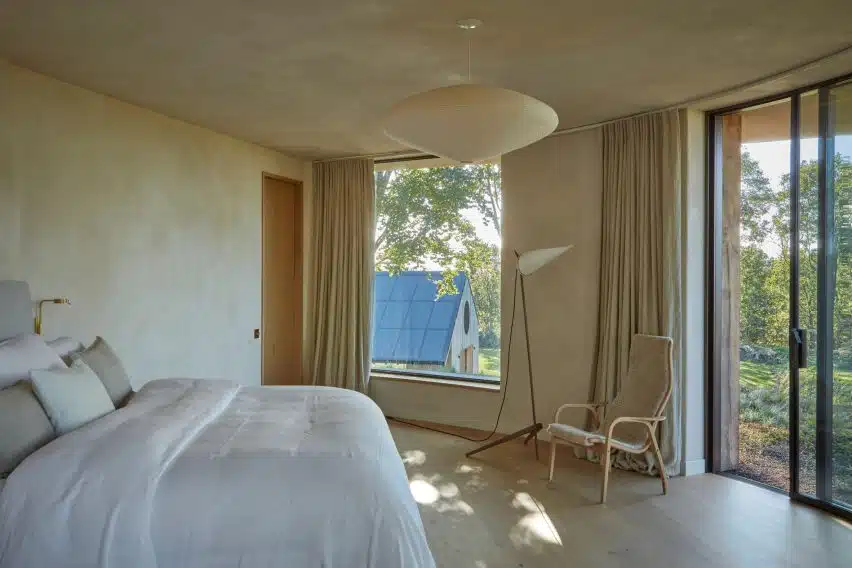
A clear and simple materials palette defines the interior. This enhances the feeling of warmth and harmony with nature. The project uses these materials and techniques:
- Internal Surfaces: Clay plaster (Clayworks plaster) coats the walls and ceilings. This provides a soft finish and eliminates sharp edges.
- Living Area Floors: Wide oak panels (Dinesen wide panel oak) cover the entire ground floor. They offer a rich texture and warm tone.
- The Annex: Douglas fir timber lines the entire interior. This unifies the workspace and accommodation areas.
- Windows: Minimal frames define the windows. This highlights the aesthetic curves and the panoramic view outside. It affirms the principles of Organic Architecture underpinning the concept.
This project, with its inspired form and advanced Off Grid Residence technologies, constitutes an important case study. It illustrates how the team achieved environmental integration without sacrificing contemporary functional needs.
✦ ArchUp Editorial Insight
The Leaf House project offers a literal embodiment of Organic Architecture, adopting an oval plan resembling adjacent leaves and achieving complete visual transparency through panoramic glazed façades. The design achieves a notable technical feat in Off Grid Residence through an integrated energy and water system, setting a practical standard for self-sufficiency. However, critique points to the reliance on a literal form that favors aesthetic abstraction over a deep, contextual response to the specifics of the Cotswolds site. Nevertheless, the overall experience signals an important evolution in integrating technological sustainability within a fluid

ArchUp: Technical and Structural Analysis of the Paper House in Cotswolds
This article examines the Paper House residence as a case study in organic architecture and self-sufficiency. To enhance its archival value, we would like to present the following key technical and environmental data:
The structural system utilizes local stone masonry with an elliptical roof spanning 24 meters, supported by dual 30 cm diameter steel “stems” as symbolic attachments. Total area spans 280 m² across two levels, featuring panoramic glazing (triple-glazed) constituting 70% of external perimeter.
The environmental performance features an off-grid energy system including 15 kW solar panels on the annex roof, an 8 kW air source heat pump, and an 80-meter deep artesian well. The design achieves thermal balance through buffer zones planted with lemon trees and ferns reducing thermal load by 40%.
In terms of functional efficiency, the central double-height corridor (6 meters) divides the house into symmetrical wings, providing 360-degree forest views. The adjacent annex (120 m²) accommodates offices and yoga studio with full Douglas fir lining, completing the site’s complete self-sufficiency cycle.
Related Link: Please review this article for a comparison of off-grid living techniques in contemporary architecture:
Self-Sufficient Architecture: Energy and Water Independence Technologies
https://archup.net/noventa-vicentina-kindergarten-architecture/