

The Porto Novo Cultural Square: A Journey Across the Riverbanks

Concrete Meets Shadow at the Capital’s Threshold
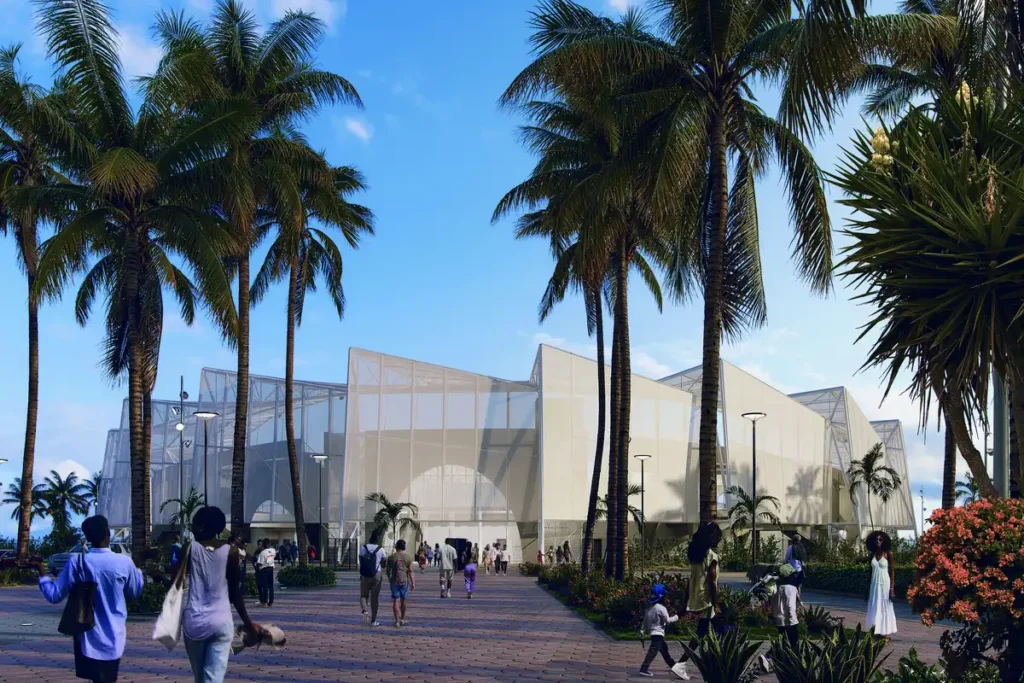
Visitors leave the bridge connecting to Porto Novo. They then start the visual journey toward the Porto Novo Cultural Square. This building is not just a city destination. It serves as a landmark announcing entry into the Beninese capital itself. The site transcends its direct function. It becomes a symbol of social and vital interaction in West Africa.
Upon approach, an architectural language greets us. This language uses material honesty and calculated contrast. Concrete terraces rest on a regular grid of exposed concrete walls and arches. They form a solid, rooted base. This weight expresses permanence. It also prepares the way for a lighter experience.
The Visitor’s Path: Flowing Towards the Gathering’s Heart
Designers created the Porto Novo Cultural Square to offer movement paths. These paths do not just focus on reaching performance spaces. They celebrate crossing and interacting. Visitors can wander through open spaces. These spaces extend beyond the building’s limits. The view includes the river and its banks.
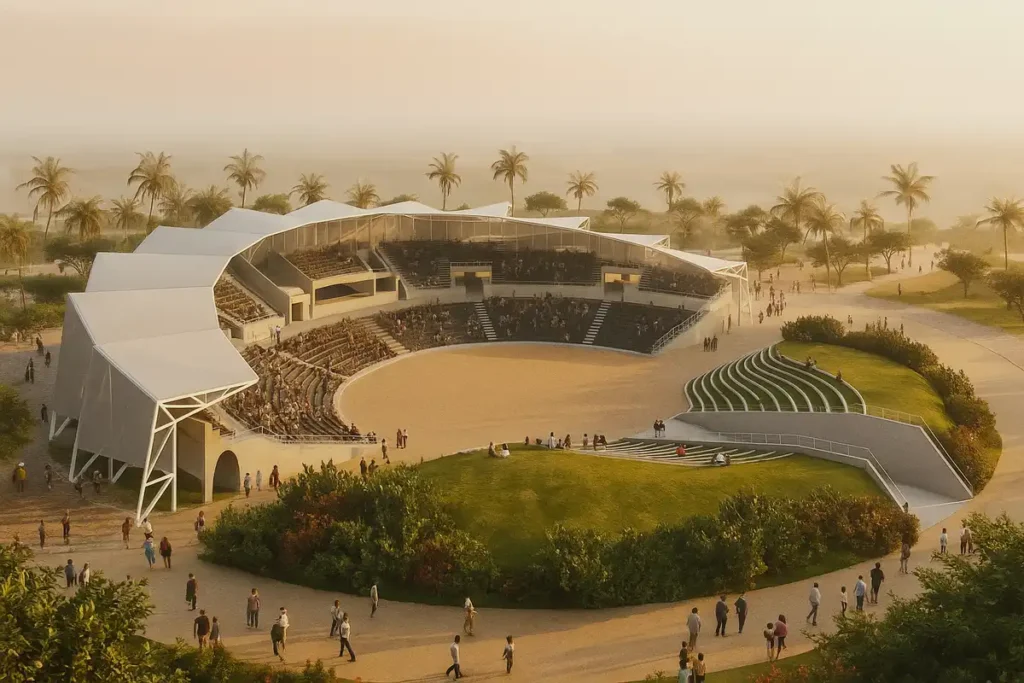
The square functions as more than an amphitheater. It is an extension of the city. It accommodates multiple functions. Events range from large scale gatherings for up to 6,000 people to intimate meetings. This flexibility allows for hosting art performances, concerts, civil occasions, and religious rites. It truly makes the square a comprehensive cultural intersection.
Climate Adaptive Engineering: A Façade Moving with the Wind
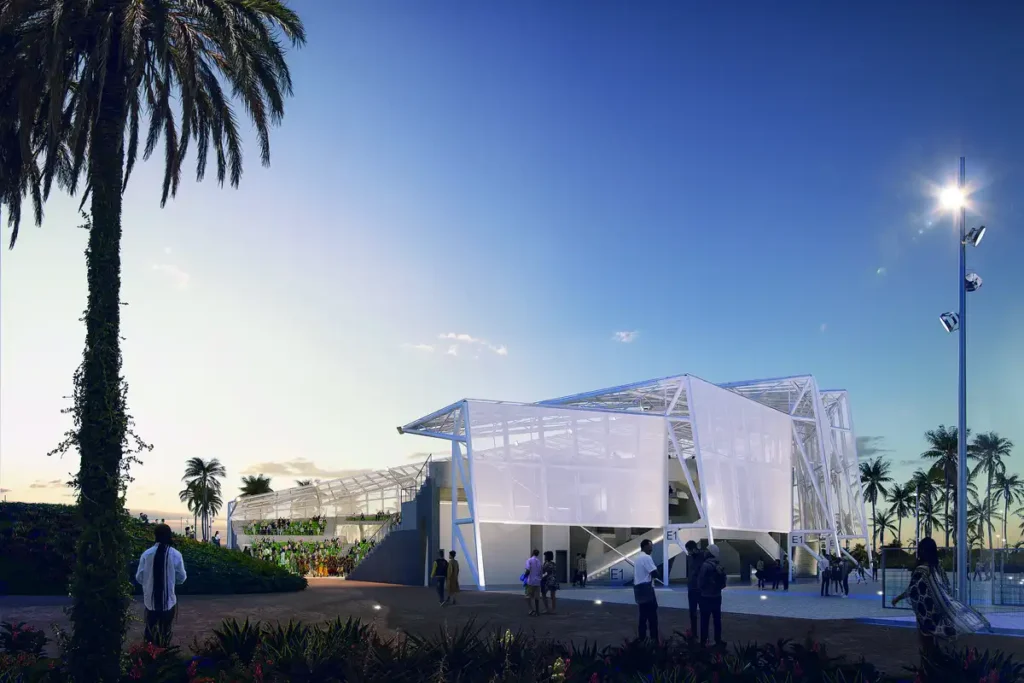
The design handles local climate challenges. It uses an intelligent upper structure. This structure contrasts with the concrete base. This section features lightweight construction techniques. These techniques ensure sustainable environmental comfort.
Key Materials and Technologies:
- Terraces and Arches: Exposed, precast Concrete forms about 55% of the lower mass. This emphasizes stability.
- Supporting Structure: A technical steel system (double columns) supports the upper structure. It makes up roughly 20% of the upper materials.
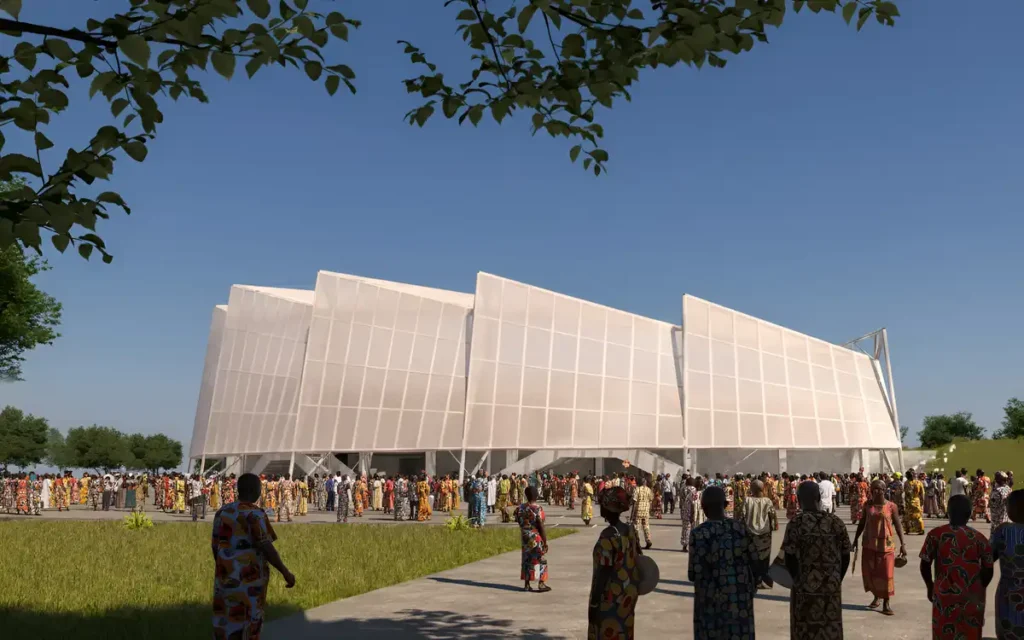
- Façade and Roof: A lightweight textile fabric covers the cantilevered surface. This surface extends up to 25 meters. It provides shade and sun protection.
- Ventilation System: Large openings integrate into the curved façade. They enhance natural cross-ventilation. This feature adapts to the weather; it is a vital design element.
The steel supports create a kinetic visual effect. The appearance of the Porto Novo Cultural Square façade changes. It changes based on the viewer’s angle and movement. This movement adds vitality to the building.
Integrating with Nature: The Green Hill and Open Field
An artificial hill, covered in dense greenery, completes the main amphitheater’s engineering. This hill perfectly and circularly closes the square’s perimeter. It offers informal seating for 360-degree performances.
The hill plays two roles. First, it serves as a green recreational space in the foreground. Second, it acts as a vegetative backdrop. People in the main terraces see this backdrop. This creates a necessary, seamless transition. The built environment flows into the riverbanks’ tranquility. This blend highlights the Porto Novo Cultural Square‘s role. It acts as a catalyst for sustainable urban development and contextual awareness in Benin. This project cost an estimated €12 million. It represents a future investment in the region’s cultural infrastructure.
✦ ArchUp Editorial Insight
The design of the Porto Novo Cultural Square creates an inspiring visual dialogue between mass and lightness. Exposed concrete terraces form a solid, rooted base, conveying permanence, while a steel structure and lightweight textile façade system provide dynamic shade and climate adaptation. The design successfully transcends its traditional amphitheater function; by embracing the green hill and open squares, it delivers a smart approach to urban and climate adaptation. A constructive critique centers on the required maintenance and durability of the textile membrane against harsh weather. Nevertheless, the project stands as a vital investment and a catalyst for cultural and civic interaction in West Africa.





ArchUp: Structural and Climatic Analysis of Porto-Novo Cultural Plaza
This article examines the Porto-Novo Cultural Plaza as a case study in climate-responsive architecture. To enhance its archival value, we would like to present the following key technical and structural data:
The structural system relies on a precast concrete base constituting 55% of the mass, supporting an upper steel framework (double-column system) at 20%. The cantilevered roof extends 25 meters using lightweight steel panels covered with durable PVC membrane, providing 85% shade coverage over the main stage.
The climatic system features cross-ventilation through dynamic openings in the serpentine facade, reducing dependence on mechanical cooling by up to 60%. The artificial green hill (covered with native vegetation) absorbs approximately 3,000 tons of rainwater annually, while providing additional seating for 1,200 people.
In terms of functional performance, the design achieves flexible capacity ranging from 500 to 6,000 people through movable space partitioning. The estimated cost reached 12 million euros while delivering community cultural programming exceeding 45 annual events.
Related Link: Please review this article for a comparison of natural ventilation techniques in African architecture:
Hot Climate Architecture: Passive Cooling Strategies in West Africa
https://archup.net/the-bahrain-pavilion-at-the-venice-biennale-examines-the-nature-of-refrigeration-infrastructures/