Restoration of Vejrhøj Summerhouse explores heritage, material and modern living

The project is taking on the thorough restoration and expansion of a summerhouse from the 1960s that is called Vejrhøj. Architects Studio Marshall Blecher and an Henrik Jansen reimagine the original design of Ole Meyer while at the same time keeping its character. The outcome is a reflection of the history and the current time in a very sophisticated manner.
Design Concept
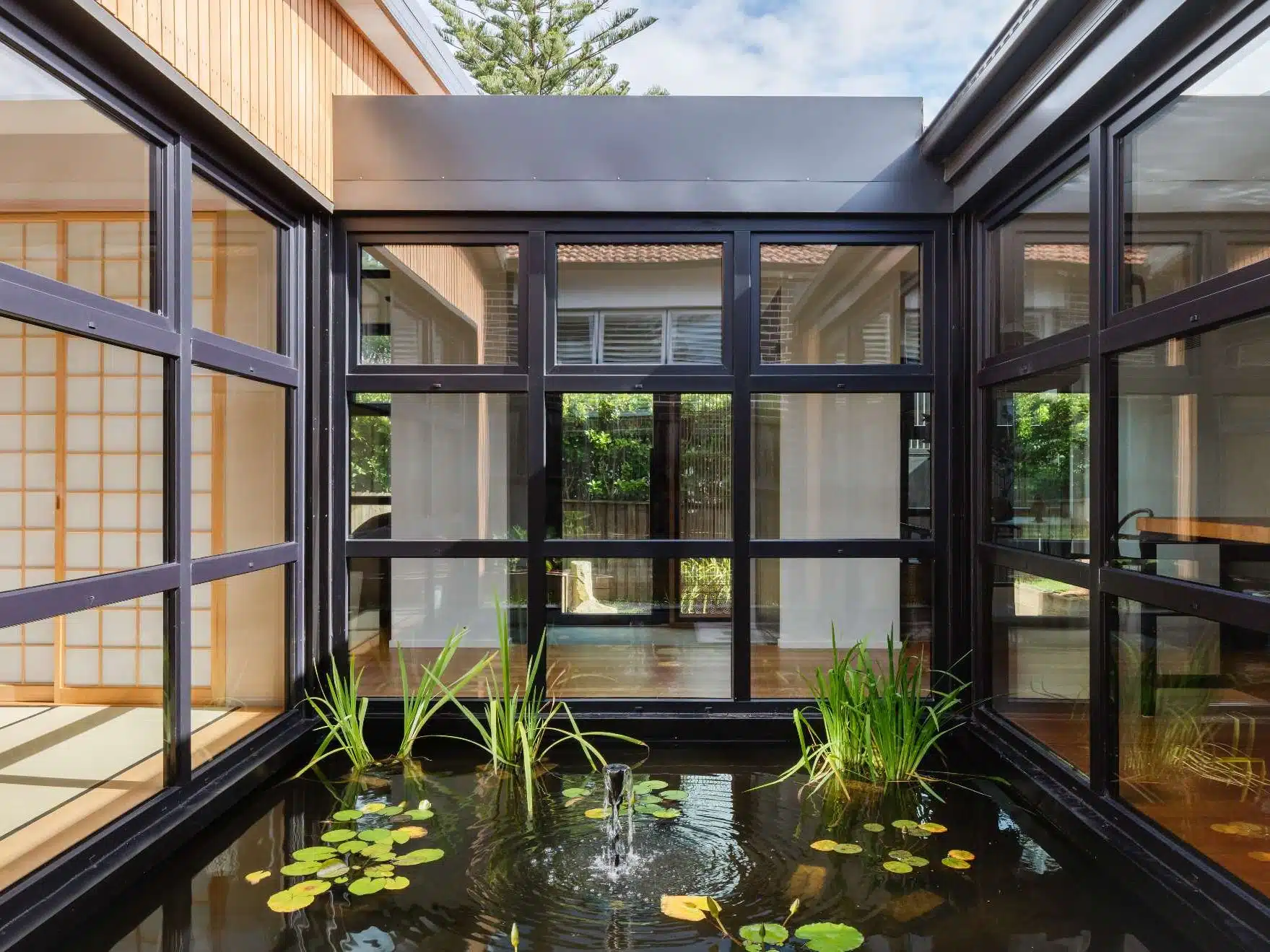
The house has been restored and this has been done with great care to its timber that is exposed and the straw thatched roof. The old house has a new volume next to it which is partly buried into the ground. This extension somewhat mirrors Meyer’s unaccomplished sketches, yet it remains within the original’s manner and at the same time offers new spatial qualities. The two masses are joined by a sheltered courtyard whose calming effect facilitates the new interaction and transition paths.
Material Expression
The architects employ timber, concrete and thatch while making use of an unpretentious color and material palette. The original frame has been rebuilt with timber craftsmanship, while the extension has been made in board-marked concrete that mimics the wood grain of the old structure. This combined use of materials shows the connection of preserving the old and the new. It can be said that the materials have been the link to the past and present.
Spatial Organisation and Experience
The plan consists of two volumes: the restored original and the new extension. They are separated by a courtyard that protects from the wind and is a place for people to gather. Minimal sliding timber doors, large windows, and detailed joinery work done on the inside all contribute to the continuity between inside and outside. The design has somehow brought back the old summerhouse spatial qualities but has also met the modern performance standards.


Context and Cultural Significance
Vejrhøj is located in a rural area that features a coast. The architects keep in mind the site’s past, especially the local building traditions, and thus respect the setting’s heritage. By very cautiously rebuilding and extending the existing structures they make the cultural memory that is very much part of both the design and the craft last longer. The whole project leads to the discussion of how architectural restoration can be both respectful and progressive at the same time, thus setting a precedent for future works that visualize the fusion of memory and modern needs.
Architectural Interpretation
This restoration, viewed from a theoretical angle, is a significant source of insight into the summer house architecture typologies. Also, it brings up and discusses the issues of authenticity, craft and adaptation: How much change can be done before the heritage becomes non-existent? How can the new construction be in line with the original intention? The project is a vehicle through which architectural research on conservation and longevity takes place.
Lessons for Designers
- Conservation can be a derivative process, an idea can be made into space and at the same time, the legacy can be protected.
- Material continuity is of significant importance, the past and the present can be linked through the referencing of original textures.
- Embedded extensions are a non-intrusive and discreet means to enhance the volume of the historical buildings.
- The use of courtyards and transitional spaces promotes the existence of both privacy and the interaction among the occupants.
- The use of craftsmanship and attention to detail is the way to go for obtaining the balance between historical fidelity and modern performance.
✦ ArchUp Editorial Insight
Marshall Blecher and Jan Henrik Jansen’s restoration of Vejrhøj Summerhouse provides a good perspective of how heritage architecture could be developed and still keep its essence. The project showcases a delicate balance between preservation and innovation, with meticulous material choices linking the past with the present. The new volumes, courtyards, and spatial transitions have been integrated to show how modern interventions can respect the context, enhance experience, and support both private and communal life. For architects and designers, Vejrhøj is a standard in architectural restoration, typological adaptation, and the subtle interaction between memory, material, and modern living.


Conclusion
The restoration of Vejrhøj by Marshall Blecher and Jan Henrik Jansen is an architectural meditation on place, memory and materials. It proves that heritage architecture can evolve gracefully, retaining its soul while adding new life. This project serves as a reference for architects working on restoration, adaptation and sensitive expansion, pointing to a future where tradition and innovation coexist.
The photography by Andrea Gatzke.
Explore the Latest Architecture Exhibitions & Conferences
ArchUp offers daily updates on top global architectural exhibitions, design conferences, and professional art and design forums.
Follow key architecture competitions, check official results, and stay informed through the latest architectural news worldwide.
ArchUp is your encyclopedic hub for discovering events and design-driven opportunities across the globe.
Brought to you by the ArchUp Editorial Team
Inspiration starts here. Dive deeper into Architecture, Interior Design, Research, Cities, Design, and cutting-edge projects on ArchUp.