Rural Housing and Lodging: Private vs. Shared Spaces


Architecture in a Rural and Elevated Context
The Rural Housing and Lodging complex is located at an altitude of 3,100 meters above sea level in the Sacred Inca Valley. It represents an example of how architecture can interact with the surrounding landscape and terrain. This site, surrounded by mountains and agricultural terraces, offers a unique environment where cultural memory intertwines with cyclical natural rhythms, such as seasonal changes and patterns of light and weather.
The Role of Buildings as a Connection Hub
The Dormis Donata buildings play a central role in the structure of the complex, acting as a connecting link between the different residential components. Through this design approach, two types of housing are integrated: permanent housing and temporary lodging, reflecting the diverse needs of both residents and visitors.
Intermediate Spaces Between the Private and the Collective
These buildings are designed to function as intermediary spaces that connect the private core of each home with the adjacent collective core, such as traditional gathering courtyards or areas for community interaction. These architectural mediators help create a balance between privacy and openness to the community, allowing architecture to interact organically with the topography and the daily activities of residents.

Spatial Organization of the Complex
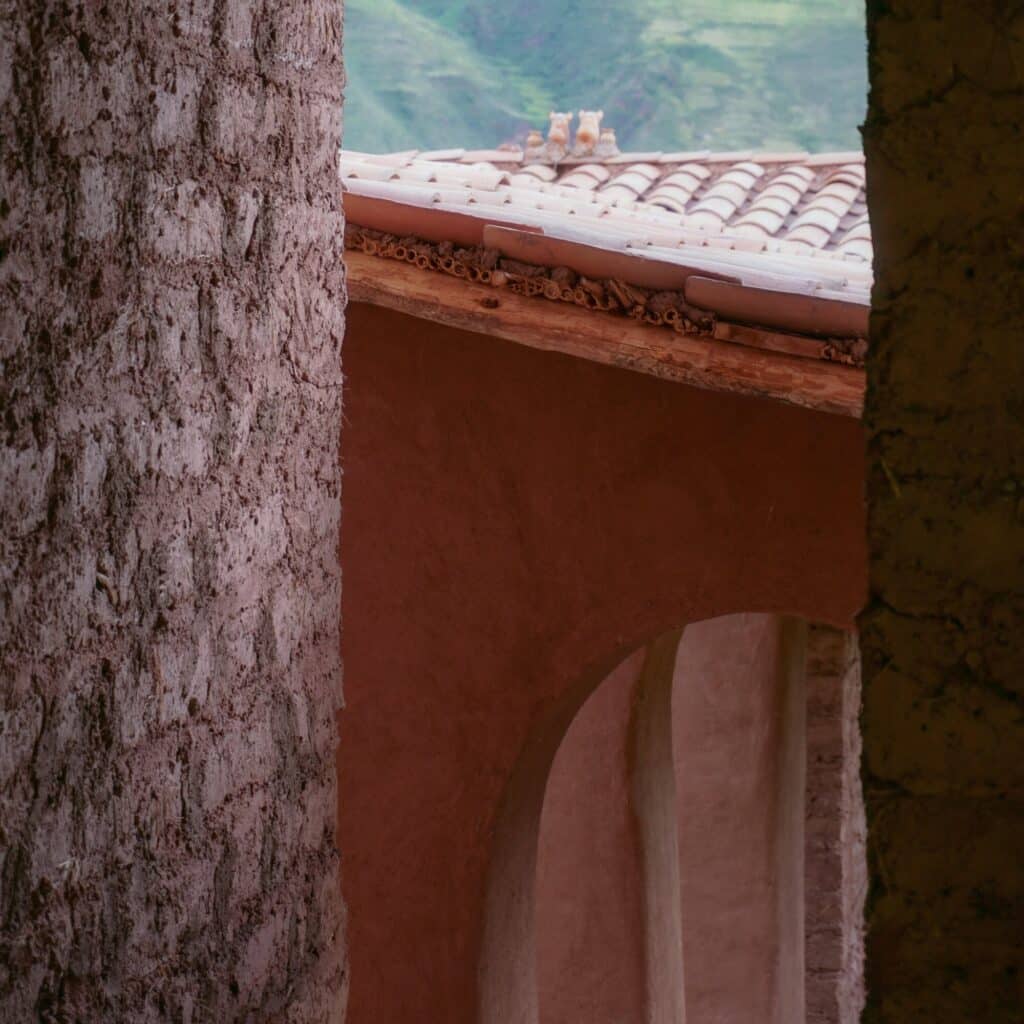
The Rural Housing and Lodging complex consists of three main linear spaces: a unit dedicated to residents, a unit for visitors, and an arched hall connecting the two. This hall functions not only as a passageway between the buildings but also as a link with Quincho, facilitating the transition between private and collective spaces and enhancing interaction between users and the surrounding environment.
Interaction Between Interior and Exterior
Movement within the Dormis Donata buildings is characterized by continuous interaction between different scales and between interior and exterior spaces. Occupants are guided through thresholds and framed views of the natural landscape, enhancing the spatial experience and creating a strong sense of connection with the surroundings.
Roof Variety and Its Impact on Space
The treatment of roofs varies in each unit to reflect its function: the residential and visitor units feature gabled roofs, while the connecting hall has a single-sloped roof exposed to sunlight, providing a sense of openness and natural light. The ridge lines of the resident and visitor units are perpendicular to each other, while the visitor unit follows the slope of the terrain, creating a rich spatial diversity despite the similarity in the basic dimensions of the floor plan.

Design of Residential and Guest Units
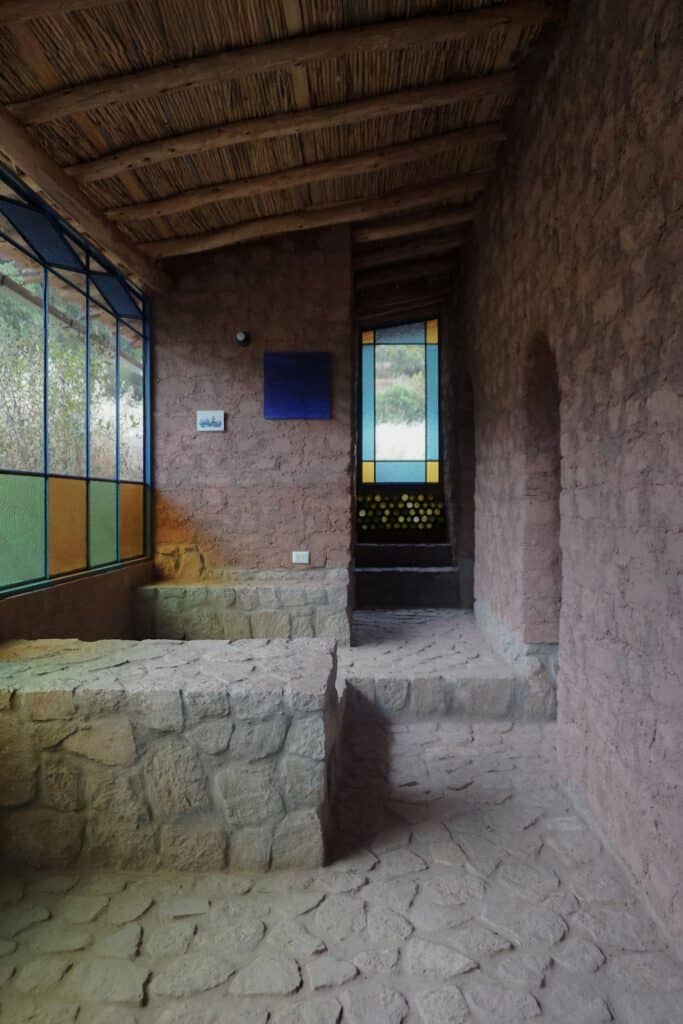
The resident unit is situated at a lower elevation near the main house and includes a bedroom and bathroom, making it an independent unit in terms of use, while remaining connected to the rest of the complex through shared circulation paths. The guest unit consists of three shared rooms, two doubles and one quadruple, along with a shower, toilet, and a semi-enclosed covered courtyard, which serves as a space for gathering and social interaction.
Integration of Functions Within the Building
Both units feature built-in earthen furniture designed to support activities such as sleeping, storage, work, and contemplation, allowing the integration of essential functions within the building elements themselves. This design reflects the traditional philosophy of rural architecture, where the structure naturally and efficiently accommodates the daily needs of its users.
Courtyard and Seating Areas
The stone seating integrated into the walls of the courtyard and the adobe structural hall enhances the user experience by providing additional seating and opportunities for social interaction or solitary contemplation. This approach demonstrates how architecture can combine structure and function to meet diverse needs while maintaining a strong connection with the surrounding environment.


Orientation of Facades and the Role of Natural Light
The facades of the Rural Housing and Lodging buildings are designed at a 30° angle from the east-west axis to optimize sunlight penetration and enhance the thermal performance of interior spaces. The southeast facade of the guest unit receives morning light through glass and colored panels, creating shifting hues within the interior. As the day progresses, light enters from an adjacent facade between the southeast and the main facade, providing a gradual distribution of sunlight throughout the interior spaces and generating a dynamic interaction with natural light.
Water Management and Sustainability
The complex relies on a dual system for collecting rainwater, supplying an elevated tank and a cocha, a reflective pool inspired by traditional Andean practices, to ensure water availability during the dry season. Greywater is filtered using biofilters, while blackwater is treated in a biodigester, reflecting the integration of technological solutions with the environment in a sustainable manner.
Energy and Nighttime Lighting
The semi-covered spaces benefit from solar-powered nighttime lighting, enabling energy self-sufficiency and supporting the continued use of spaces after sunset. This strategy highlights how architecture can combine natural resource management with environmental design to enhance comfort and sustainability in a high-altitude rural context.

✦ ArchUp Editorial Insight
Rural Housing and Lodging can be seen as an example of how architecture can be integrated with topography and the natural environment. The project offers specific advantages, such as attention to natural light, smooth circulation between private and collective spaces, and the adoption of sustainable solutions for water and energy management. These elements provide a practical framework for studying the relationship between design and the surrounding environment.
However, some caveats emerge when attempting to generalize this model to other contexts. The heavy reliance on elevated terrain and natural resources may not be replicable in lowland or densely populated areas, while circulation between units and open spaces might require more flexible designs to accommodate the changing needs of diverse users. Moreover, the emphasis on traditional solutions, such as earthen furniture and local materials, may limit adaptability to modern demands related to comfort or technology.
From an architectural perspective, the project provides an important opportunity to study how architecture can balance privacy and community, modernity and tradition, as well as environmental performance and daily functionality. This experience can inspire the development of flexible design strategies adaptable to different sites and environments while maintaining strong connections between users and the natural surroundings.