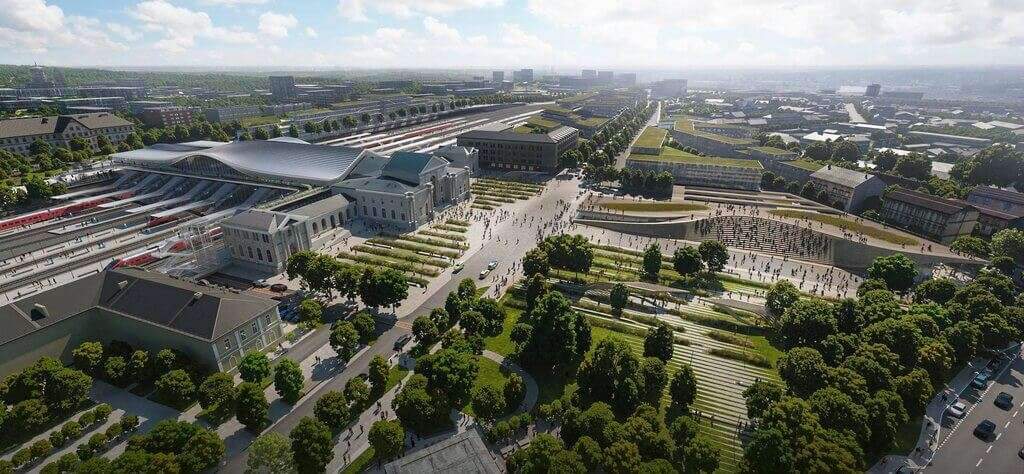
San Pellegrino Future Factory Construction Begins in Brembo Valley, Italy

San Pellegrino Factory of the Future is rising in Italy’s Brembo Valley.
It will house offices, public spaces for locals, and visitor facilities.
The design follows core principles of architectural design.
Recent photos confirm active work on site through construction.

Reinterpreting Classical Elements
The project reworks Italian forms like the arcade, viale, piazza, and portico.
It shows how buildings can echo regional identity while serving modern industry.
Experts have added it to the archive as a model of contextual industrial planning.
The factory does not sit on the land it grows from it.
Nature Integration as Core Strategy
The San Pellegrino Factory of the Future embeds into the valley instead of dominating it.
This approach meets current sustainability benchmarks.
Designers selected building materials based on local climate and terrain.
Researchers now cite the project in research on adaptive production sites.

Multifunctional Civic Role
The facility opens shared zones to the public beyond its industrial function.
This aligns with new thinking in cities planning.
Industrial sites now act as social anchors, not just economic engines.
The San Pellegrino Factory of the Future demonstrates this shift clearly.

Human-Centered Industrial Space
Designers applied interior design strategies to improve daily experience for workers.
They prioritized light, flow, and connection over pure efficiency.
This reflects the curatorial focus of the architecture platform.
Editors also highlight the scheme in critical editorial reviews on post-industrial space.
Industry and community share the same ground here not separate zones, but one continuum.
Architectural Snapshot
The factory is not a barrier but a bridge between production and community.
✦ ArchUp Editorial Insight
The piece documents construction at San Pellegrino Factory of the Future in Brembo Valley.
It frames the project through reinterpretations of Italian architectural motifs.
It presents the facility as a blend of industry, nature, and civic space without naming designers or using promotional language.
Yet it avoids deeper critique of the factory as public realm idea.
This concept risks turning function into aesthetic gesture.
The tone remains restrained, which is commendable.
Beneath it all lies a quiet question:
Will this architecture matter in ten years?
Or will it be remembered only as a stylish moment?