
When the Built Environment Becomes a “Vaccine” Against Trauma

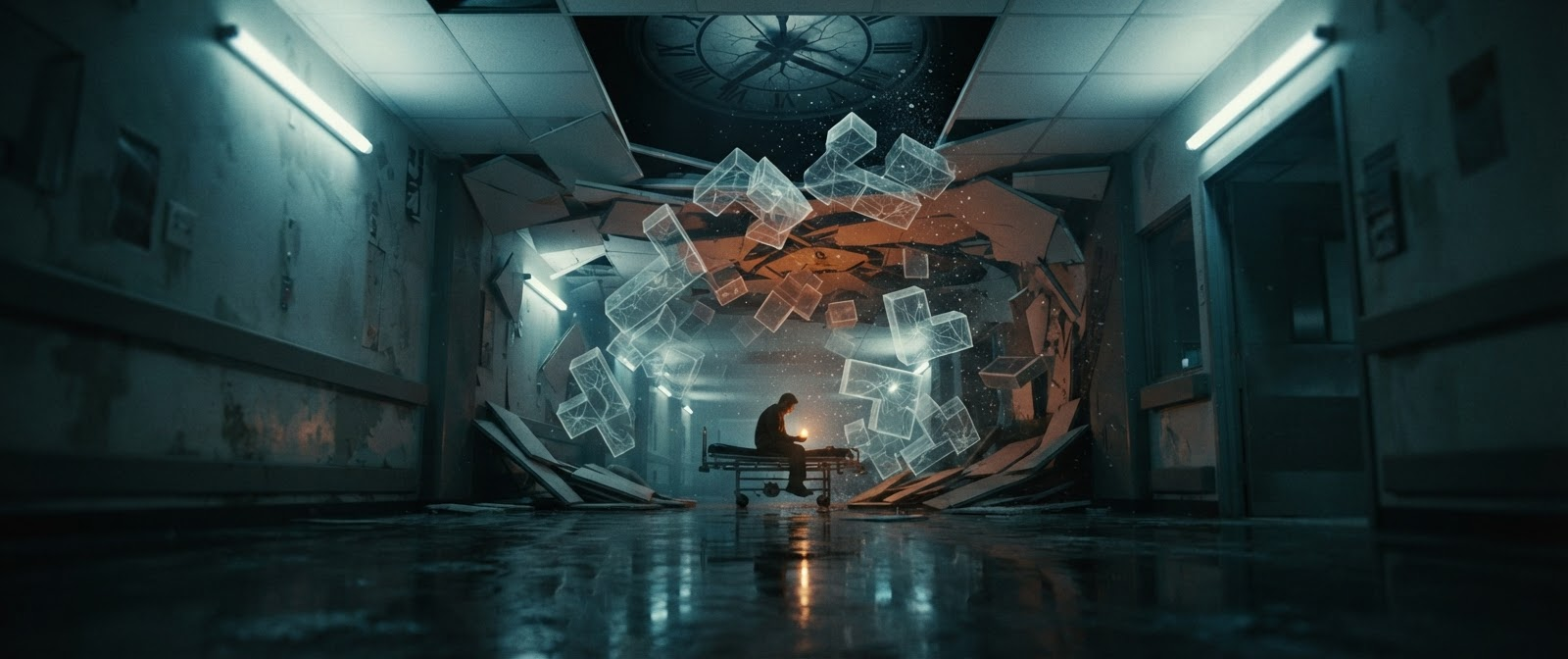
What the cognitive Tetris research reveals about designing recovery centers and emergency rooms
In a crowded emergency department in Oxford, survivors of severe car accidents sat before small screens playing Tetris for just twenty minutes. The outcome was no passing diversion: intrusive trauma memories dropped by more than sixty-two percent over the following week compared with those who did not play. This figure, produced by a randomized controlled trial led by Emily Holmes and her colleagues at John Radcliffe Hospital and published in Molecular Psychiatry, poses a fundamental question that architecture has yet to confront: if engaging visuospatial memory can reshape the experience of trauma inside the brain, should the built environment itself — its walls, angles, and visual flows — become part of the treatment protocol?
Spatial Memory as a Battlefield Inside the Skull
To grasp what this finding means for the architect and the urban planner, one must unpack the mechanism that Holmes’s team first revealed in their 2009 foundational study published in PLoS ONE. The core idea is at once simple and remarkable: trauma memories are not verbal narratives stored in a quiet mental library but vivid sensory-visual snapshots that intrude upon consciousness as involuntary flashes. During a window of no more than six hours after the traumatic event, these snapshots remain in a “consolidation” phase — still pliable, still malleable. This is where the visuospatial task enters, a game like Tetris that demands the mental rotation of geometric forms and their assembly within a confined space: it drains the same limited cognitive resources the brain needs to fix those traumatic snapshots in place, causing their intensity to fade before they harden into long-term memory.
For the architectural designer, this means that spatial perception is not an aesthetic luxury appended in the final stages of a project but a finite cognitive resource that competes with deeper mental processes. The space we inhabit is not merely perceived; it is processed through the same neural channels that handle painful memories. This discovery opens a door that had remained closed to hospital designers and emergency shelter planners: can we engineer spaces that compel the brain to engage in intensive spatial processing, thereby lessening the weight of trauma during its critical first hours?
Not Every Visual Interaction Helps — Lessons from Failed Experiments
Caution is warranted, however, and the research itself warns against the oversimplification an enthusiastic designer might embrace. Subsequent studies have demonstrated that mere “visual distraction” is insufficient. When Holmes’s team tested the verbal game “Pub Quiz” on survivors of comparable trauma in 2010, intrusive memories did not decrease — they worsened. In a separate experiment led by Jeroen Asselbergs and his colleagues, a digital application mimicking Tetris with paper-plane shapes and simplified geometric rotations failed to produce any positive effect across two consecutive trials. The precise reason, as a replication study by Emma Marks and her team indicated, is that these tasks did not demand genuine “mental rotation” of forms in three-dimensional space; they were merely superficial visual exercises that failed to occupy visuospatial working memory with sufficient depth.
Here lies the most consequential architectural lesson: not every interactive space or colorful digital wall in a hospital lobby qualifies as a therapeutic tool. The decisive component is “spatial transformation” — the cognitive operation that requires a user to rotate a form in the mind’s eye or predict the trajectory of a moving object through three-dimensional space. This also explains why aerobic exercise alone failed to reduce intrusive memories, as research by E. E. Bernstein and Richard McNally in the Journal of Behavior Therapy and Experimental Psychiatry demonstrated, despite its well-documented physical benefits. The body moves, but spatial memory remains untouched.
From Screen to Wall — When the Building Becomes a Cognitive Instrument
If we accept that mental rotation and intensive spatial processing hold the key, the architectural question becomes practical and urgent: how do we translate this cognitive principle into a real built space? Imagine a waiting room in a post-disaster emergency department where the walls do more than serve as passive white-painted surfaces — they become interactive fields that require the seated occupant to track moving geometric patterns or complete complex spatial compositions projected across broad surfaces. The idea is not to convert the hospital into a video-game arcade but to embed spatial-challenge tasks into the visual fabric of the space in a way that leaves the user feeling not subjected to “treatment” but surrounded by a visually rich environment that naturally and unobtrusively draws out their spatial attention.
Research led by Muriel Hagenaars and her colleagues in the European Journal of Psychotraumatology has further indicated that even complex verbal games — such as forming words from scattered letters — can reduce intrusive memories when applied days after trauma through a “reconsolidation” mechanism, in which the memory is first reactivated by a reminder cue and then exposed to cognitive interference. This considerably broadens the designer’s toolkit: therapeutic spaces need not be exclusively visual but can integrate compound verbal-spatial challenges, particularly in the later stages of recovery that extend weeks beyond the disaster.
Architecture Without Visual Imagination — The Challenge of Aphantasia
But what about those who possess no visual imagination at all? Aphantasia — the inability to summon voluntary mental images — affects a significant proportion of the population. It is reasonable to ask: do spatial Tetris interventions benefit them if they cannot “see” shapes in their minds to begin with?
The paradox that recent research reveals is compelling and reshapes the concept of inclusive design. A large-scale study led by Adam Dawes and his colleagues in Scientific Reports found that individuals with aphantasia reported fewer intrusive memories after stressful events than their peers, suggesting that the absence of visual imagination may reduce the intensity of sensory snapshots intruding upon consciousness. Yet the same study found that their overall PTSD symptom scores were comparable to controls, with a greater tendency toward negative cognitive and mood symptoms. In other words, aphantasia does not shield against trauma; it redistributes its symptoms across different perceptual channels.
From an inclusive-design perspective, this means that recovery spaces must move beyond a single visual paradigm. If individuals with aphantasia retain visuospatial working-memory capacities despite the absence of visual imagery — as the cognitive literature suggests — then tangible spatial tasks, such as manipulating physical objects in space or interacting with three-dimensional material assemblies integrated into walls and furniture, may prove more effective for them than abstract visual screens. The architect versed in these neurological distinctions will be better equipped to design recovery spaces that exclude no one based on their mode of cognitive perception.
Toward a Spatial Protocol for Emergencies
What this accumulated body of research tells us — from Holmes’s foundational experiments to the reconsolidation studies led by Elizabeth James and her colleagues in Psychological Science, through to the cognitive-flexibility research published by Raphael Zabag and his team — is that cognitive interference is not a digital trick confined to a phone screen but a perceptual principle that can be embodied in built space. The conditions, however, are strict and allow no compromise: the interference must be spatially and visually deep rather than superficial, it must be delivered within the correct temporal window or after memory reactivation through a specific cue, and it must account for the neurological diversity of its users, including those without visual imagination.
For designers of hospitals, post-disaster shelters, and mental-health facilities, this means the earliest design phase must incorporate a question that no conventional design guideline has yet posed: how can this space occupy the visuospatial working memory of its inhabitants during the critical hours following trauma? The answer may not lie in a Tetris screen mounted on the wall but in the geometry of the space itself — its visual complexities, its kinetic flows, and the cognitive challenges embedded in every corner and surface.
✦ ArchUp Editorial Insight
The institutional sterility of emergency departments is not an aesthetic default; it is the spatial consequence of healthcare procurement models that prioritize sanitation protocols, patient throughput, and liability mitigation over neurocognitive outcomes. By treating waiting areas as passive holding pens for physiological triage, clinical governance structurally excludes the neurological window of memory consolidation from spatial programming. Incorporating visuospatial interference into architectural design forces a shift in healthcare financing and regulatory standards, reframing spatial depth, surface manipulation, and visual friction from decorative overhead into active preventative infrastructure. The absence of therapeutic spatial geometries in acute clinical environments remains a direct symptom of hospital accounting systems that price immediate physical containment while externalizing the long-term psychiatric costs of post-traumatic pathology.
References
Holmes, Emily, Elizabeth James, Thomas Coode-Bate, and Catherine Deeprose. “Can Playing the Computer Game ‘Tetris’ Reduce the Build-Up of Flashbacks for Trauma? A Proposal from Cognitive Science.” PLoS ONE, 2009.
Holmes, Emily, Elizabeth James, Emma Kilford, and Catherine Deeprose. “Key Steps in Developing a Cognitive Vaccine against Traumatic Flashbacks: Visuospatial Tetris versus Verbal Pub Quiz.” PLoS ONE, 2010.
Dawes, Adam, Rebecca Keogh, Thomas Andrillon, and Joel Pearson. “A Cognitive Profile of Multi-Sensory Imagery, Memory and Dreaming in Aphantasia.” Scientific Reports, 2020.
Hagenaars, Muriel, Emily Holmes, Femke Klaassen, and Bernet Elzinga. “Tetris and Word Games Lead to Fewer Intrusive Memories When Applied Several Days after Analogue Trauma.” European Journal of Psychotraumatology, 2017.
James, Elizabeth, Michael Bonsall, Laura Hoppitt, Elizabeth Tunbridge, John Geddes, Alison Milton, and Emily Holmes. “Computer Game Play Reduces Intrusive Memories of Experimental Trauma via Reconsolidation-Update Mechanisms.” Psychological Science, 2015.
Marks, Emma, et al. “Do Cognitive Tasks Reduce Intrusive-Memory Frequency after Exposure to Analogue Trauma? An Experimental Replication.” Clinical Psychological Science, 2020.
Iyadurai, Lali, et al. “Preventing Intrusive Memories after Trauma via a Brief Intervention Involving Tetris Computer Game Play in the Emergency Department: A Proof-of-Concept Randomized Controlled Trial.” Molecular Psychiatry, 2017.
Bernstein, E. E., and Richard McNally. “Preventive Efforts in the Aftermath of Analogue Trauma: The Effects of Tetris and Exercise on Intrusive Images.” Journal of Behavior Therapy and Experimental Psychiatry, 2019.
James, Elizabeth, Alex Lau-Zhu, Ian Clark, Rosemary Visser, Muriel Hagenaars, and Emily Holmes. “Playing the Computer Game Tetris Prior to Viewing Traumatic Film Material and Subsequent Intrusive Memories: Examining Proactive Interference.” Journal of Behavior Therapy and Experimental Psychiatry, 2016.
Asselbergs, Jeroen, Marit Sijbrandij, Erik Hoogendoorn, Pim Cuijpers, Laura Olie, Karen Oved, and Hans Riper. “Development and Testing of ‘TraumaGameplay’: An Iterative Experimental Approach Using the Trauma Film Paradigm.” European Journal of Psychotraumatology, 2018.
Zabag, Raphael, et al. “Cognitive Flexibility Moderates the Efficacy of a Visuospatial Intervention Following Exposure to Analog Trauma.” Journal of Behavior Therapy and Experimental Psychiatry, 2023.




![Bathroom Bundle Kit [Flat End] – Walnut / Walnut / Steel Ring & Screws](https://archup.net/wp-content/uploads/2021/12/13200-bathroom-bundle-kit-flat-end-walnut-walnut-steel-ring-screws-scaled.jpg)