Foucault’s Architecture of Power

The Building Foucault Never Designed
How a French philosopher who never held a drafting ruler became one of the most cited theorists in the critique of built space and urban planning
Michel Foucault never designed a single building in his life, and never worked a day in an architectural office. Yet no architecture student today can pass a course in design theory or urban planning without running into his name. The word “Panopticon”—a circular prison design proposed by the English philosopher Jeremy Bentham in the eighteenth century—has become a term architects and planners now use to discuss airports, open-plan offices, and even smart surveillance applications in contemporary cities. The irony is that Foucault never wrote about architecture as an aesthetic art form. He treated it as a machine: a structure capable of programming bodies and shaping consciousness in silence, without requiring a single guard standing at the door. Tracing the arc of his thought—from his early phenomenology, through the archaeology of knowledge, to the genealogy of power, and finally to the ethics of the self in his last years—reveals how built space became, without Foucault necessarily intending it, his favored laboratory.
From the Dream Chamber to the Hospital Bed: Humanist Beginnings
Before becoming the philosopher who declared the “death of the subject,” Foucault was a young man committed to an optimistic phenomenological humanism. In his 1954 introduction to Binswanger’s work on dreams, Foucault celebrated the dream as a disclosure of human freedom, a prelude to a world in which that freedom would find real embodiment—a utopian, Hegelian vision he later abandoned, as researcher Jerome Seigel notes in his reading of Foucault’s intellectual trajectory. This early phase matters for understanding what followed: when Foucault turned to studying asylums and clinics, he was not attacking the idea of “man” out of nowhere. He was settling accounts with an earlier version of himself, trading his enthusiasm for freedom for a colder determination to dismantle the mechanisms that produce this “subject” in the first place—within specific institutions, the first of which were institutions defined by walls.
Walls That Manufacture Truth: Architectural Confinement as a Sorting Instrument
In Madness and Civilization, published in 1961, Foucault did not write a progressive history of the mad being freed from their chains. He told the opposite story: when reformers like Pinel and Tuke removed the iron shackles from the insane in European asylums, they did not liberate them so much as imprison them in a deeper cell—a psychological one. The madman “freed from chains” became, in Foucault’s words, “responsible for what he knew of his own truth,” and ended up “chained to the humiliation of being his own object.” Here emerges the first implicit architectural lesson in Foucault’s thought: the design of the asylum—its corridors, its observation halls, its spatial arrangement—was never a neutral shell for medical treatment. It was part of the very machinery that produced “madness” as an epistemic category.
This method, which Foucault called “archaeology”—excavating the historical conditions that made a given statement “true” in one era and not another—recurred in The Birth of the Clinic and The Order of Things. In the latter, Foucault advanced his most famous claim: that “man,” as both an object of knowledge and a knowing subject, is a relatively recent invention, one that emerged around 1800 and may well be approaching its end. Researcher Michael Power, in his review of Foucault’s relationship to sociology, notes that archaeology relied on a unit of analysis called the “statement” (énoncé), viewing knowledge as an anonymous system of rules that determines who is authorized to speak rather than what any speaker intends. But this static, descriptive method drew sharp criticism from Jean-Paul Sartre, who accused Foucault of replacing “cinema with a magic lantern”—substituting movement with a series of disconnected still frames, incapable of explaining how a shift from one epistemic era to another actually occurs.
The Panopticon: When a Building Is Designed to Be the Warden in Your Head
The response to this shortcoming arrived with Discipline and Punish in 1975, the book that transformed Foucault from a historian of knowledge into an analyst of power through what he called “genealogy.” Foucault opens the book with a shocking scene: the public torture of the condemned Damiens in the eighteenth century, set against the rigid timetable of a nineteenth-century prison. The transition between these two scenes encapsulates his central thesis: modern power no longer targets the body through direct punishment; it targets the “soul” through techniques of surveillance, examination, classification, and training, inside enclosed institutions architecturally designed for precisely this purpose.
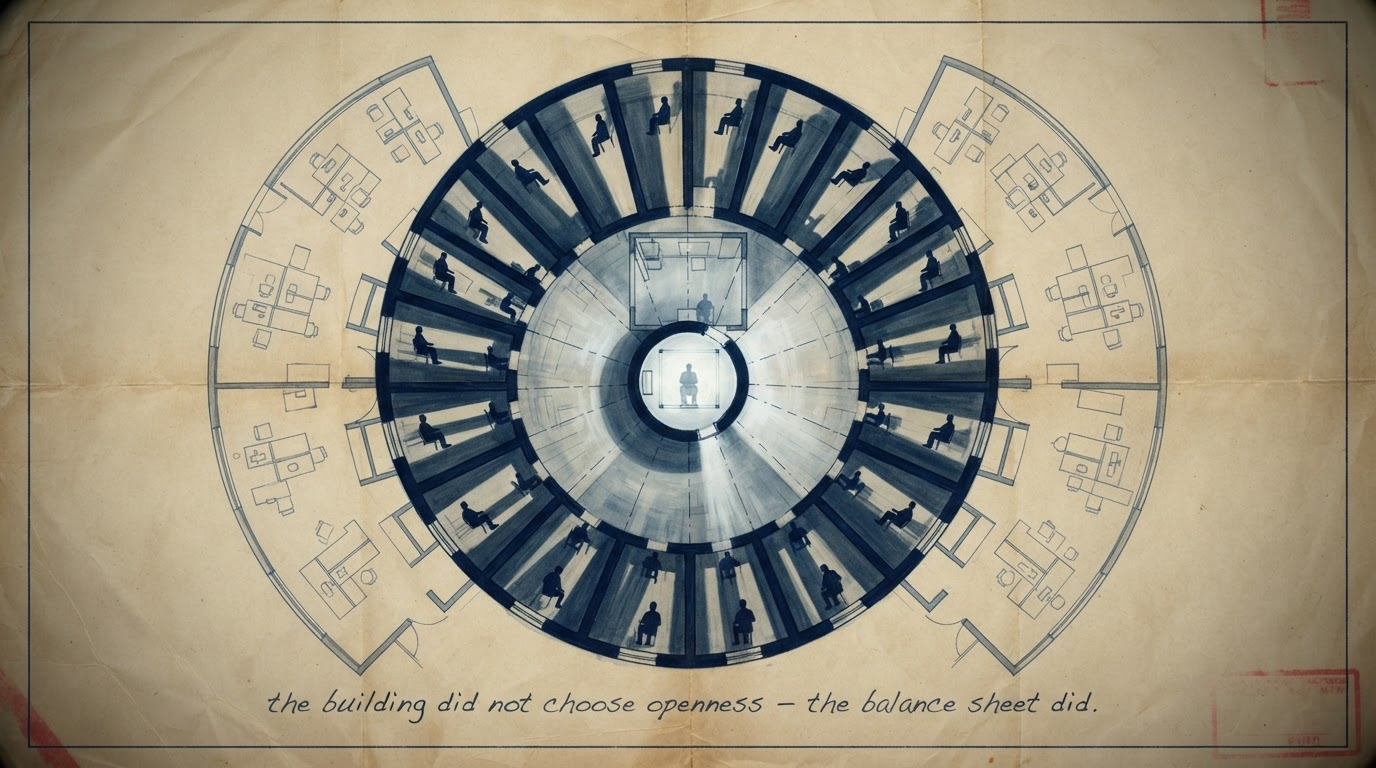
Here the Panopticon emerges as the clearest architectural symbol of Foucault’s entire thesis: a circular building whose cells surround a central watchtower, arranged so that an inmate can never know whether he is being observed at any given moment. The result, as Foucault precisely formulates it, is that “he who is subjected to a field of visibility… assumes responsibility for the constraints of power” and becomes, himself, “the principle of his own subjection.” The guard becomes unnecessary; it is enough for the inmate to believe surveillance is possible for self-discipline to become automatic. This architectural design, as Power observes, transforms examination into a network of records, files, and comparative classifications that “make up people” and fix norms of behavior. Power, in this account, is not primarily repressive but productive: it generates knowledge, sorts behavioral patterns, and circulates through everyday practices more than it flows from a single sovereign center. This is the concept later known as “power/knowledge,” which Foucault argued cannot be separated: there is no power relation without an accompanying field of knowledge, and no knowledge that does not presuppose power relations.
From the Wall to the City: The Birth of Urban Planning as a Science of Flows
Had Foucault stopped at analyzing the prison and the clinic, his legacy would have remained confined to a critique of closed institutions. But his lectures at the Collège de France between 1977 and 1979, later published as Security, Territory, Population, expanded the vision to encompass the city and the state as a whole. Researcher Mike Gane observes that Foucault repeatedly announced his intention to address “biopolitics,” then redirected his lecture course twice—first toward a history of “governmentality,” meaning the art of managing population behavior through a combination of institutions, calculations, and security techniques, and then toward a genealogy of liberalism.
Here Foucault offers, according to Keith Tribe’s reading of these lectures, a distinction of fundamental importance to urban planners: while the Prince’s concern in Machiavelli’s thought was securing his territory, the concern of modern government became securing “flows”—the flow of goods, populations, disease, and information. The city is no longer managed according to the logic of a closed fortress but according to the logic of an open network whose movement must be regulated, not stopped. This is precisely the logic underlying the tools of modern urban planning: zoning classifications for residential and commercial use, transportation networks, and epidemiological monitoring systems within cities. Researcher Alex Means adds that the concept of “biopolitics” itself—treating populations as a biological species measurable and manageable through birth rates, mortality, and health—intersects directly with every planning decision related to population density or the distribution of health services within the urban fabric.
When the City Becomes a Market: The Architecture of the “Entrepreneur of the Self”
The most striking part of Foucault’s lectures from this era, and perhaps the most prescient, is his analysis of neoliberalism, a subject he addressed in depth in The Birth of Biopolitics. Gane clarifies that Foucault distinguished between two schools: German ordoliberalism (the Freiburg School), which concluded from the Nazi experience that the market economy itself must become the organizing principle of the state, producing “a state under the supervision of the market rather than a market supervised by the state”; and American neoliberalism (the Chicago School), which generalized market logic into a “grid of intelligibility” for all social conduct, including marriage, crime, and education.
The result, as Foucault summarizes it, is the birth of a new version of “economic man”: no longer a partner in commercial exchange, but an “entrepreneur of himself,” a unit of human capital requiring continuous investment. This shift carries a direct architectural echo that no observer of the transformation of workspaces over the past two decades can miss: from the traditional enclosed office to co-working spaces designed to incentivize individuals to market themselves and build a “personal brand,” and from fixed collective housing to flexible short-term rental housing models, in which the property itself becomes a mobile investment asset rather than a stable shelter. Researcher Keith Tribe considers this analysis one of the earliest and most precise intellectual genealogies of neoliberalism, published decades before such policies would reshape Western cities.
On the Studio and Criticism: Can an Architect “Care for the Self”?
In his final years, Foucault turned again, this time away from power and toward ethics. The original project of The History of Sexuality shifted from a study of modern sexuality to a return to ancient Greek and Roman texts, in search of what he called “care of the self” (epimeleia heautou). Here Foucault distinguishes, as researchers Katarzyna Kosmala and John McKernan explain, between “ethics as an externally imposed code of rules” and “ethics as a relationship with the self” that an individual builds through disciplined practices—a distinction deeply relevant to studio culture in architecture, which perpetually oscillates between compliance with external jury standards and the search for an authentic personal design voice.
Foucault found in ancient Greek philosophy, prior to what he called the “Cartesian moment” that separated knowledge from the spiritual transformation of the self, a model for an “aesthetics of existence”—shaping one’s life as a personal work of art, rather than submitting to a ready-made moral code, as researcher Herman Westerink explains. In his final lectures in 1984, Foucault devoted his courses to the concept of “parrhesia,” or “frank speech,” tracing its transformation from a political virtue—confronting the ruler with the truth—into a personal ethical virtue: the courage to interrogate oneself and render an honest account of one’s own life, as researcher Thomas Flynn details. These last lectures reveal the “triangle” through which Foucault’s entire career can be read: knowledge, power, and the formation of the self—a triangle no practicing architect can avoid engaging with daily, caught between what they know, what institutions of licensing, funding, and juries impose on them, and the professional self they attempt to construct.
An open question continues to haunt Foucault even in his final works: if the subject is entirely a product of power and knowledge relations, where does the possibility of resistance or free creativity come from? His late insistence that “where there is no possibility of resistance, there is no power relation at all” was part of his attempt to answer this question through an ethics of self-formation. Historians specializing in classical antiquity have also criticized his oversimplification of the history of Greek and Roman medicine in his books on sexuality, warning against collapsing a millennium of intellectual diversity into a single narrative of “austerity.” Nevertheless, the impact Foucault has left on the social sciences—from sociology to criminology, from institutional studies to urban planning theory—remains immense, serving as a conceptual toolkit for understanding how subjects are manufactured and how cities and bodies are governed together, within walls originally built to make us who we are.
✦ ArchUp Editorial Insight
Foucault’s Panopticon is not a design idea; it is a labor-cost solution. Continuous human supervision in eighteenth-century asylums, prisons, and factories was administratively expensive and structurally fragile—guards tire, shifts change, attention lapses. The institutional response was not to hire more staff but to relocate the function of surveillance into geometry itself, making visibility permanent so that monitoring no longer required a monitor. What reads today as “disciplinary architecture” is simply the spatial absorption of a management problem. The same logic resurfaces, unattributed, in the open-plan office and the hot-desking floor plate: when labor becomes precarious and self-managed under market pressure, architecture again removes walls not for transparency’s sake but because self-surveillance is cheaper than supervision. The building did not choose openness. The balance sheet did.
References
Seigel, Jerome. “Avoiding the Subject: A Foucaultian Itinerary.” Journal of the History of Ideas, 1990.
Koopman, Colin. “Foucault’s Historiographical Expansion: Adding Genealogy to Archaeology.” Journal of the Philosophy of History, 2008.
Power, Michael. “Foucault and Sociology.” Annual Review of Sociology, 2011.
“Archaeologizing Genealogy: Michel Foucault and the Economy of Austerity.” Economy and Society, 1989.
Gane, Mike. “Foucault on Governmentality and Liberalism.” Theory, Culture & Society, 2008.
Tribe, Keith. “The Political Economy of Modernity: Foucault’s Collège de France Lectures of 1978 and 1979.” Economy and Society, 2009.
Means, Alex J. “Foucault, Biopolitics, and the Critique of State Reason.” Educational Philosophy and Theory, 2021.
Flynn, Thomas. “Foucault as Parrhesiast: His Last Course at the Collège de France (1984).” Philosophy & Social Criticism, 1987.
Westerink, Herman. “The Obligation to Truth and the Care of the Self: Michel Foucault on Scientific Discipline and on Philosophy as Spiritual Self-Practice.” International Journal of Philosophy and Theology, 2020.
Kosmala, Katarzyna, and McKernan, John F. “From Care of the Self to Care for the Other: Neglected Aspects of Foucault’s Late Work.” Accounting, Auditing & Accountability Journal, 2011.