
Staggered Cabin: Architecture, Landscape, and Mountain Context


The Relationship Between Architecture and the Natural Landscape
In many traditional models of mountain cabins, the natural landscape is treated as a fixed backdrop surrounding the building, without actively participating in its formation. However, the “Staggered Cabin” project by Mork-Ulnes Architects redefines this relationship, where the site itself becomes an active component of the Design process rather than merely a visual frame.
Direct Response to the Site Slope
The project was completed in the summer of 2024 and is located at an elevation exceeding 6,000 feet, in the area where South Lake Tahoe meets the foothills of the Sierra Nevada. Rather than resisting the natural slope of the terrain, the design embraces it as a fundamental driver of its Architecture logic, moving with it instead of imposing an independent system upon it.
A Stepped Composition that Preserves Natural Elements
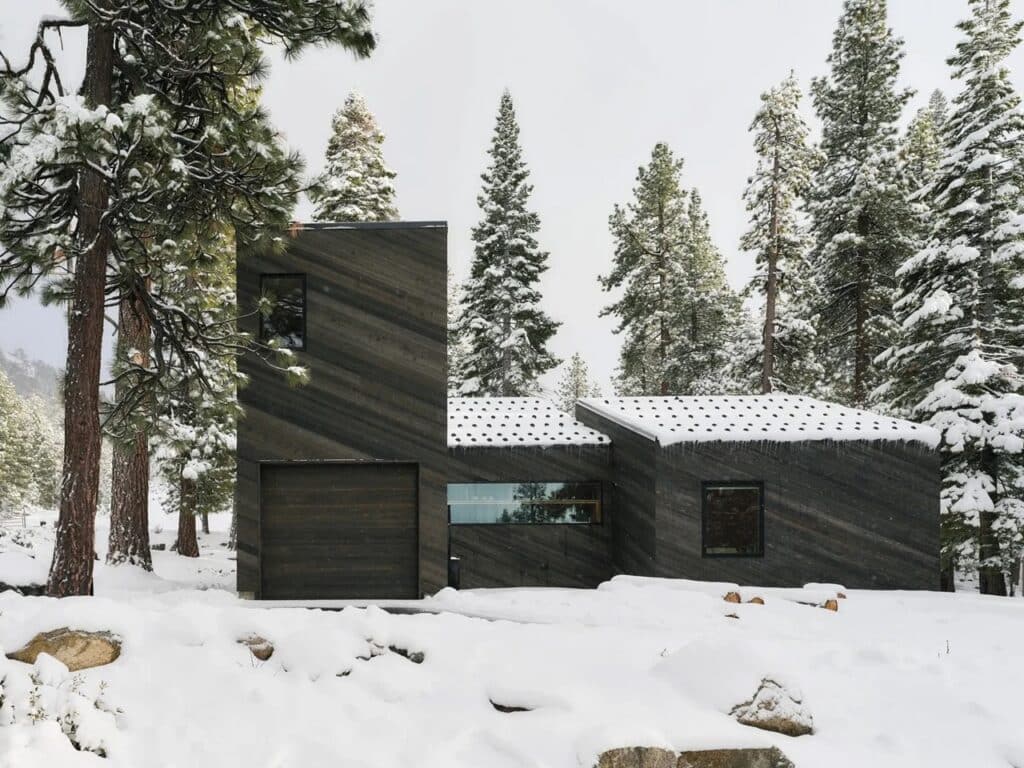
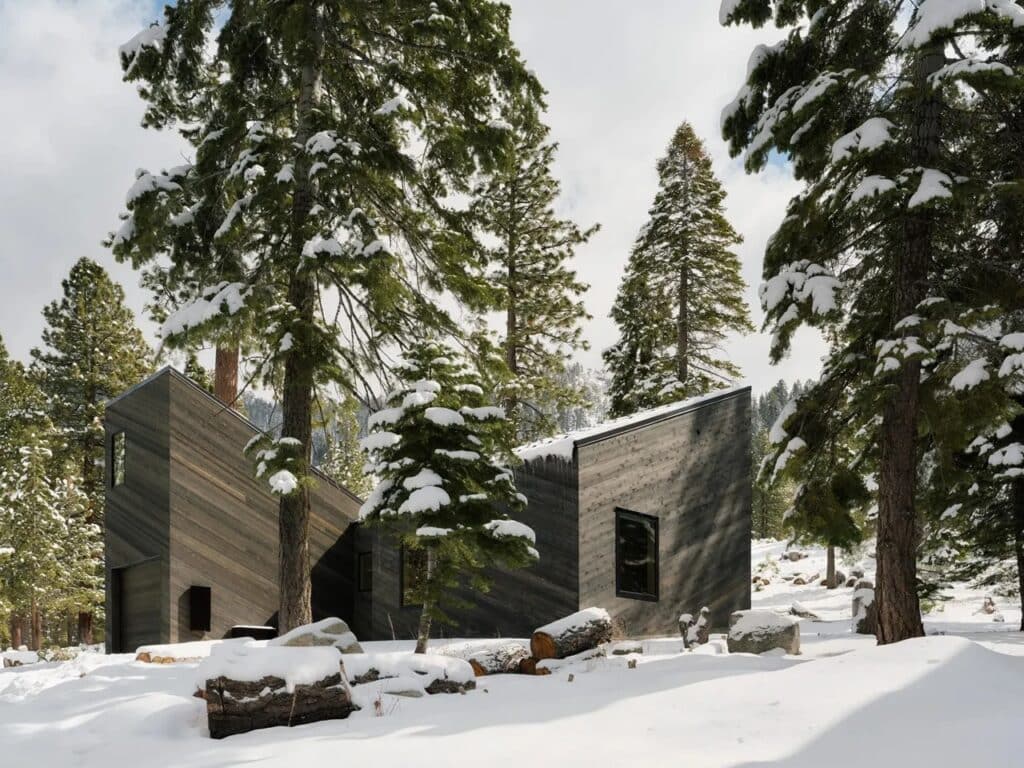
The project consists of four cedar-clad Buildings volumes, staggered in a stepped formation that follows the topography of the mountain. Importantly, this configuration does not come at the expense of the natural site, as existing granite boulders and Jeffrey Pines were preserved rather than removed or reshaped. In this way, the preservation of natural elements becomes a core design decision from the earliest stages of the project.
Interstitial Spaces Redefining Outdoor Use
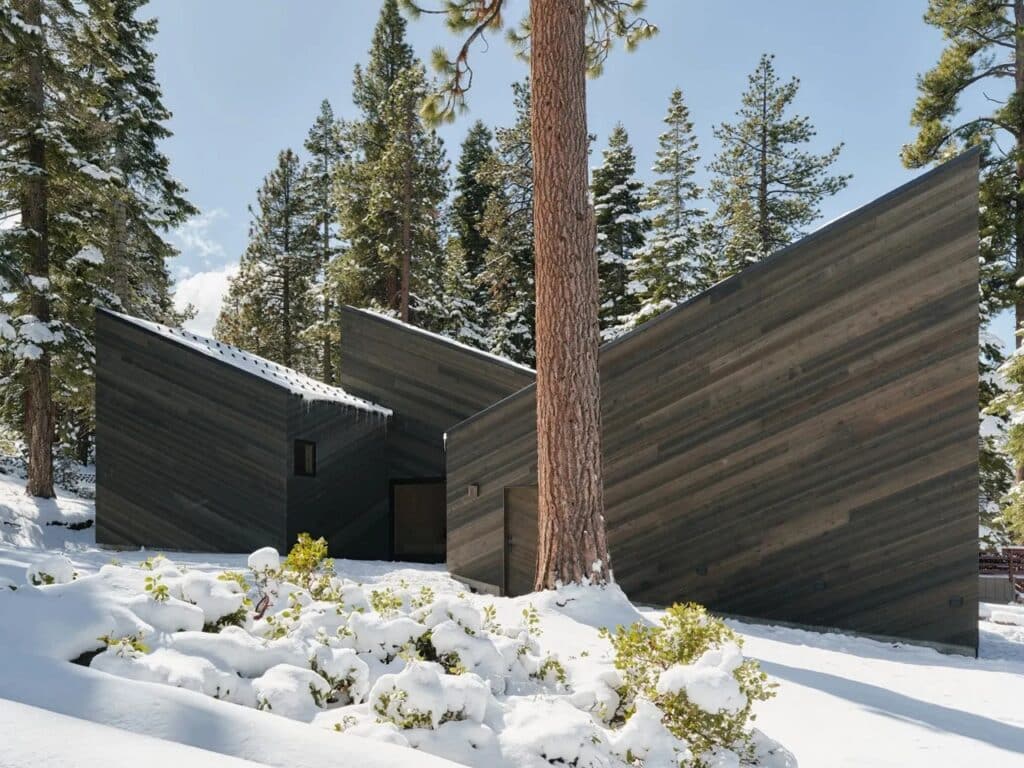
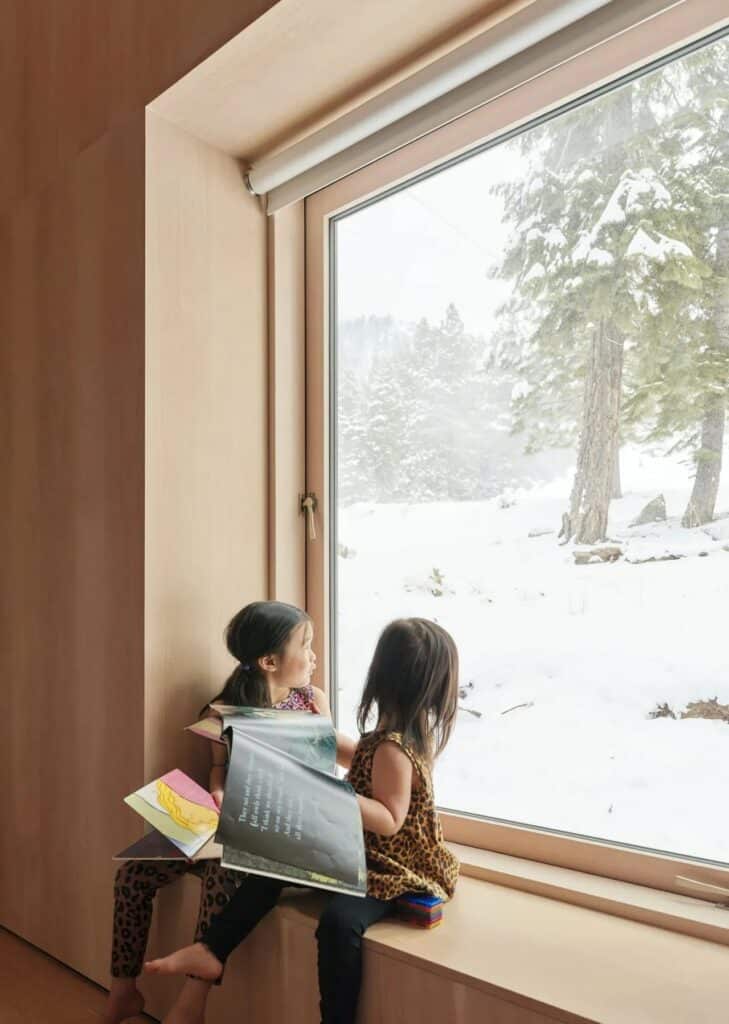
Furthermore, this stepping strategy does not only respond formally to the terrain; it also generates a series of small, sheltered exterior voids between the separated volumes. These spaces function as intermediate courtyards that capture natural light and provide protection from wind, creating an outdoor environment that remains usable throughout all seasons. Consequently, these spaces are not treated as residual or secondary voids, but as a direct extension of daily life. They allow for simple activities such as morning seating in the open air even in cold conditions, while also supporting the fluid movement of children between the Interior Design and the edge of the forest. Through this logic, the spaces between volumes are transformed into essential functional elements that enhance the quality of the lived experience within the site.
A Quiet Exterior Language That Redefines the Building’s Presence
The project’s exterior expression adopts a restrained character grounded in precision rather than spectacle. The façades are clad in untreated Western red cedar, finished with a dark stain that gives the surface a low-gloss visual density. Through the deliberate angling of the cladding boards, a subtle sense of visual movement is reinforced, directing the eye along the natural slope of the hill rather than resisting or concealing it. Over time, these Building Materials undergo a controlled weathering process, gradually shifting toward tones that resemble tree bark and surrounding shadows, allowing the building to visually merge with the forest rather than assert a separate presence within it.
A Climatic and Functional Response to Roof and Detailing
In the same spirit, standing-seam metal roofs cover each volume individually, ensuring the autonomy of each mass while maintaining the coherence of the overall composition. In addition, engineered snow guards are integrated to retain a balanced layer of snow during winter, providing a form of natural insulation and contributing to a gradual melt cycle. For more technical specifications, you can refer to our Material Datasheets section.
An Interior Layout Balancing Privacy and Openness
Inside, the approximately 1,400-square-foot plan follows a simple and legible organization, where bedrooms are arranged around a central living and dining space that maintains visual connections to the outdoors on two sides. This configuration enhances the sense of openness while preserving a functional balance between private and shared zones. This approach to spatial organization is increasingly discussed in Discussion platforms within the architectural community.
Unified Interior Materials and a Sense of Visual Warmth
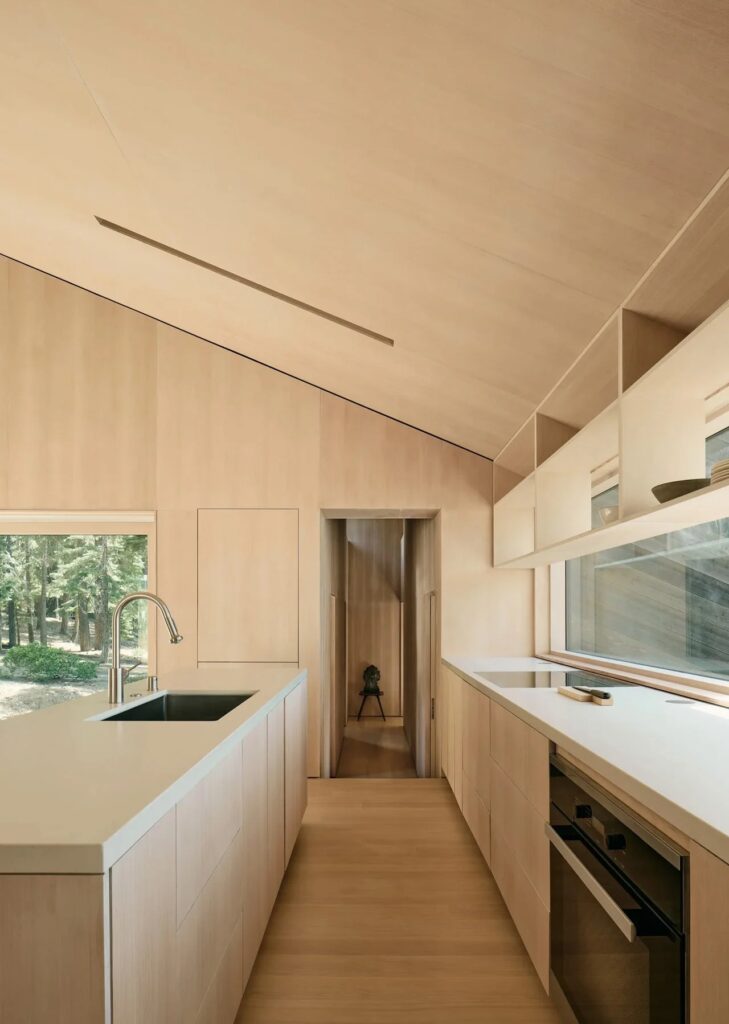
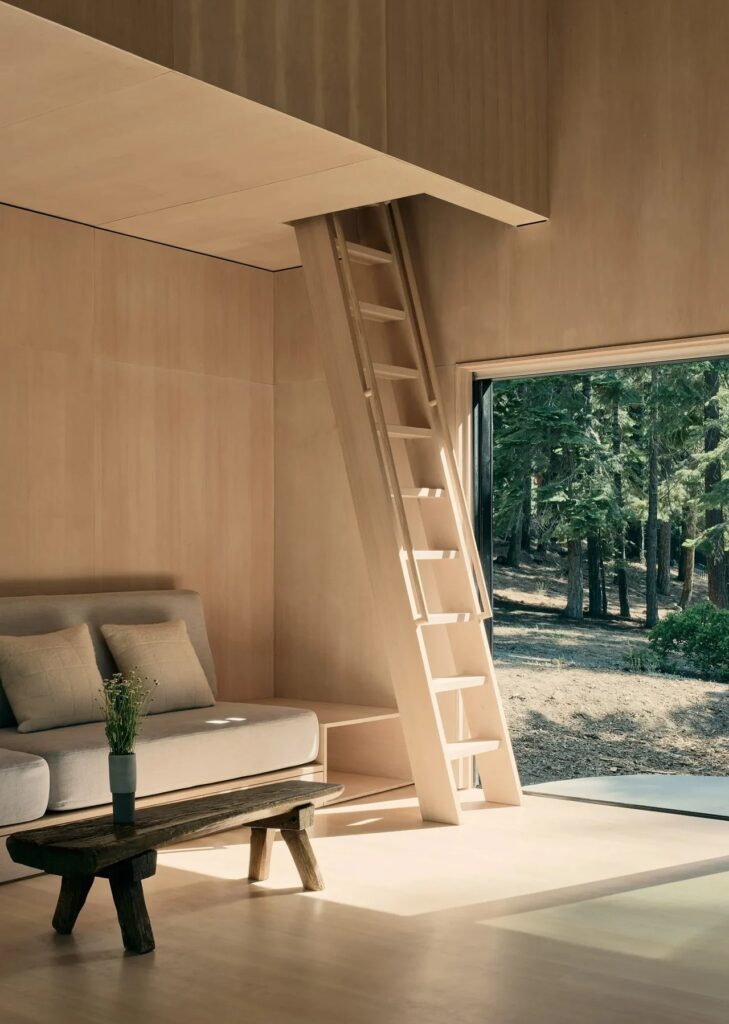
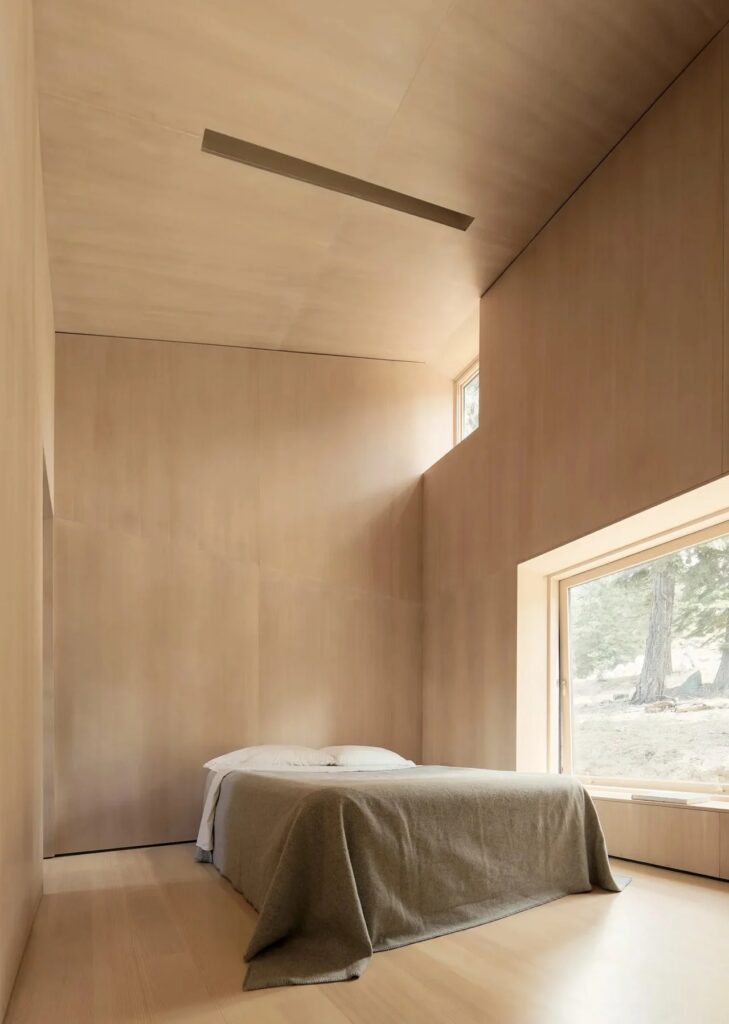
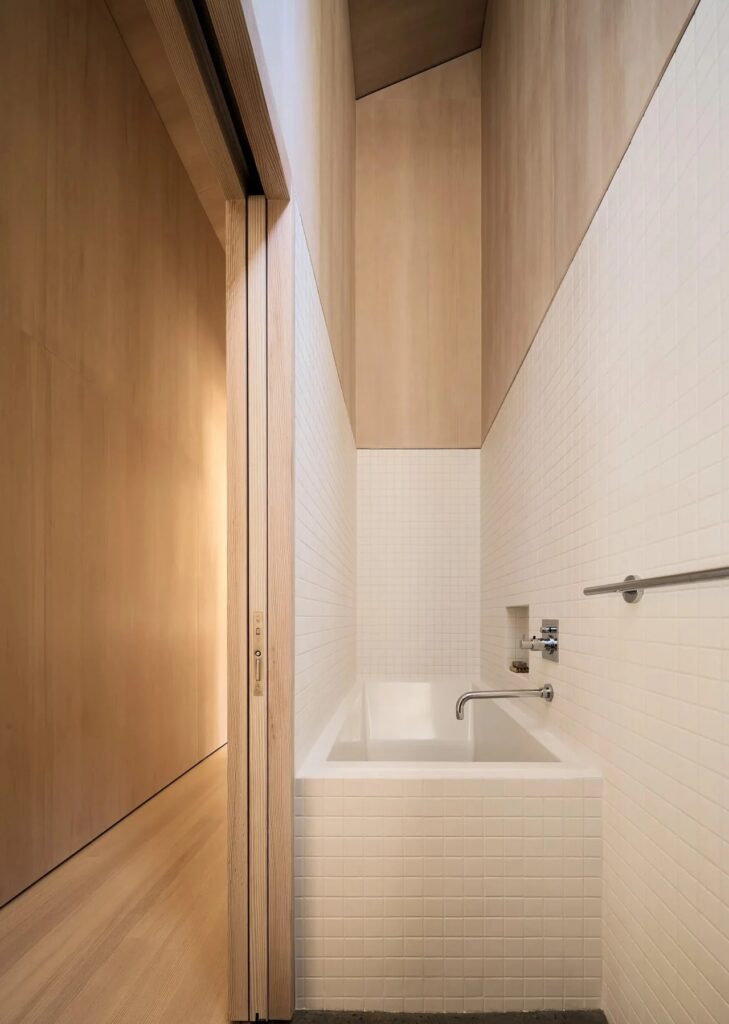
Plywood panels of Douglas fir line the walls, ceilings, and custom-built cabinetry in a continuous surface treatment, producing a unified interior language that enhances visual warmth, particularly under the natural light filtering in from the Sierra environment. In this way, wood becomes both a visual and organizational element, linking the different parts of the interior space.
Exploiting Roof Form and Views to Expand Spatial Perception
Furthermore, the steeply pitched roof geometry is utilized to create upper mezzanine spaces, while a wooden staircase provides access to a compact home office integrated beneath the roofline. Meanwhile, high strip windows frame the surrounding pine canopy, directing the gaze upward and generating a sense of spatial extension beyond the physical footprint. Through this precise orchestration of light and views, the 1,469-square-foot interior feels significantly more expansive and open than its direct geometric dimensions would suggest. You can explore similar innovative Projects and stay updated with the latest Architectural News on our website.
A Cultural Continuum Between Scandinavian Architecture and the Californian Context
The work of Mork-Ulnes Architects demonstrates a clear intersection of two primary architectural influences: Scandinavian sensibility on one hand, and the spirit of Northern California on the other. Within this framework, the “Staggered Cabin” project directly reflects this cultural and architectural continuum, remaining deeply tied to the studio’s broader Design lineage while rearticulating it within a contemporary mountainous context.
Formal References Between Northern Europe and Sierra Traditions
In this sense, the shed-roof forms evoke clear references to Northern European Architecture, where structural simplicity and rigorous climatic response are central principles. At the same time, an equally significant influence emerges from the A-frame cabin traditions of the Sierra region, establishing a balance between two architectural languages that differ in origin yet converge in functional logic.
A Permanent Residence Balancing Comfort and Nature
From a programmatic perspective, the project is designed as a permanent residence for a young family of four, positioning it outside the category of seasonal or temporary cabins. As such, the design does not treat the site as a transient experience, but rather as a continuous everyday living environment. You can explore similar innovative Projects that redefine residential living on ArchUp.
A Balance Between Comfort and Site Without Compromise
Most importantly, the cabin does not frame the relationship between comfort and natural context as a trade-off. On the contrary, it seeks to integrate both within a unified framework, where the demands of daily living coexist with the conditions of a high-altitude site exceeding 6,000 feet, without any compromises that would diminish either aspect at the expense of the other. This approach to balancing interior and exterior needs is frequently examined in Interior Design discourse.

✦ ArchUp Editorial Insight
The Staggered Cabin project operates as a spatial resolution emerging from the intersection of capital allocation mechanisms, insurance risk evaluation, and building regulations governing high-altitude mountain zones at the edge of the Sierra Nevada. The primary driver is the demand for secondary residential units within a high-value recreational landscape, while steep slope conditions and environmental classifications impose strict limitations on formal composition. Friction arises from wildfire risk requirements, snow load demands, complex supply chains, elevated labor costs, and insurance frameworks that penalize solid, monolithic Buildings forms.
As a result, the program is fragmented into stepped volumes that follow contour lines, reducing excavation and redistributing structural risk. The preservation of existing rocks and trees functions as a dual strategy for cost reduction and regulatory compliance, while the interstitial voids become operative zones that ease constraints and reorganize circulation. The selection of appropriate Building Materials played a crucial role in achieving this fragmented yet cohesive strategy. For more technical specifications on such materials, refer to our Material Datasheets.
Ultimately, the role of architecture recedes in favor of a negotiated regulatory equilibrium between climate, legislation, and capital. This type of integrated thinking is increasingly part of current Discussion within the architectural community. To stay updated on how contemporary firms navigate such constraints, follow the latest Architectural News and Top News on ArchUp.
★ ArchUp Technical Analysis
Technical and Documentary Analysis of the Staggered Cabin – Sierra Nevada, California, USA:
This article presents an architectural analysis of the Staggered Cabin as a case study in redefining the relationship between architecture and the mountainous landscape. To enhance its archival value, we would like to present the following key technical and design data.
The project was completed in the summer of 2024 and is situated at an elevation exceeding 6,000 feet, where the southern edge of Lake Tahoe meets the foothills of the Sierra Nevada. The project consists of four architectural volumes clad in unfinished western red cedar treated with a dark, low-luster pigment, arranged in a staggered formation that follows the natural slope of the land while preserving existing granite boulders and pine trees.
The interior layout spans approximately 1,400 square feet (1,469 square feet), featuring a central living and dining area with surrounding bedrooms, all with walls, ceilings, and cabinets clad in Douglas fir plywood to create a unified interior language. Each volume is covered by a separate standing seam metal roof, incorporating engineered snow retention devices that help maintain a balanced snow layer for natural insulation and regulated gradual melting.
Small, sheltered outdoor spaces are formed between the architectural volumes, acting as intermediate courtyards that capture natural light and provide wind protection. A wooden staircase provides access to a small home office integrated beneath the sloping roofline, with high ribbon windows framing the surrounding pine canopy.
Related Insight: Please refer to this article to understand the context of modern architectural preservation:
Architectural Adaptation in Mountain Regions: Design and Material Strategies.




✅ Official ArchUp Technical Review completed for this article.