

The Administrative Capital Hall: How Textile Architecture Blends Climate and Identity

Standing on the vast horizon of the New Administrative Capital, a striking landmark emerges: the Multisport Hall—a bold embodiment of Textile Architecture. More than just an athletic facility designed to host major international events, the building represents a climate-responsive innovation. Its form reinterprets the traditional Bedouin tent through advanced engineering, using lightweight tensile fabrics and structural textiles to mediate the harsh desert environment. This approach establishes not only a functional sports venue but a pioneering example of Textile Architecture on the African continent, where identity, performance, and sustainability converge.
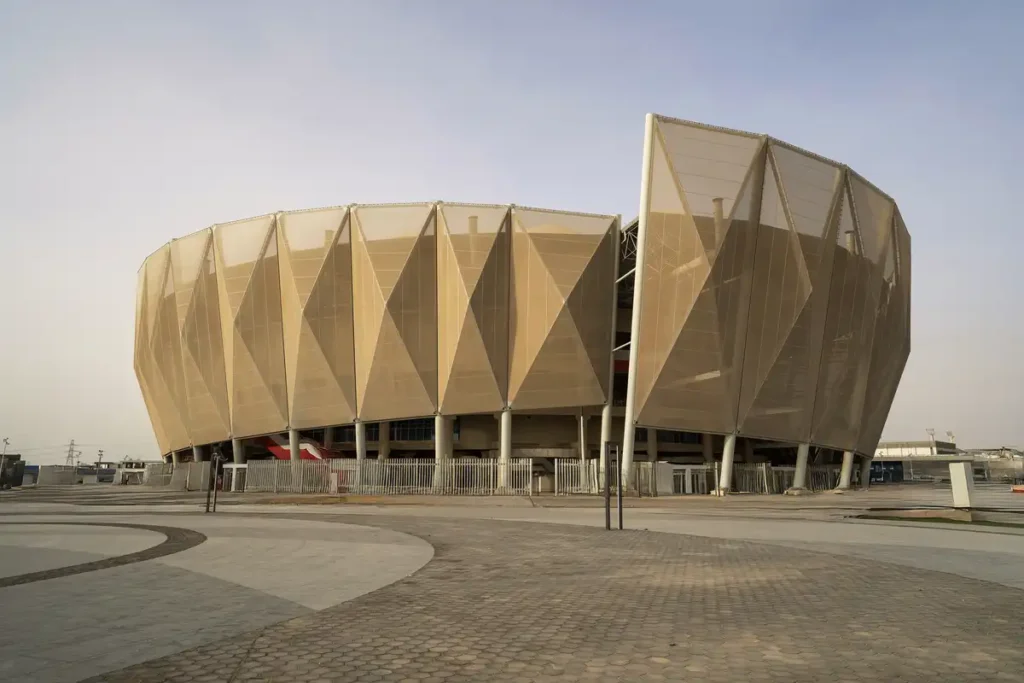
A Breathing Shell: The Textile Facade as a Climate Filter
Approaching the building, visitors don’t see solid walls. Instead, they face a rhythmic envelope composed of triangular textile panels. This facade functions as both a visual and dynamic element, making it the defining feature of Textile Architecture in this project.
During the day, these panels act as a precise climate filter. They allow natural light into the interior spaces but break the intensity of the direct desert sun. This achieves a crucial balance between shadow and transparency.
As the sun sets, the building transforms completely. The internal lighting becomes the source, causing the structure to resemble a lantern, confirming its visual identity throughout the evening.
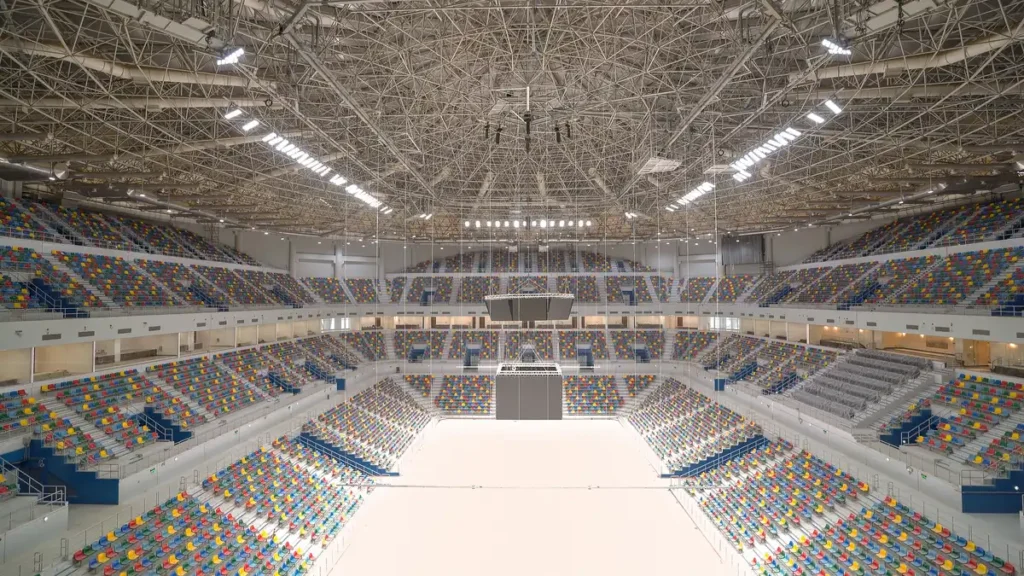
One Hundred Meters of Open Space: The Engineering Challenge
Upon entering the main hall, visitors experience a sense of vastness. No columns obstruct the view. This was achieved through a prominent engineering feat. A three dimensional steel roof covers the hall. This roof spans a full 100 meters without any intermediate supports. This design ensures clear sightlines from every seat.
Construction relied on modern techniques to guarantee precision and efficiency.
Key Materials and Technologies Used:
- Three-Dimensional Steel Structure: Capable of spanning 100 meters without columns.
- Tensile Roof: Provides lightweight and flexible coverage.
- Textile Panels: For the facades, acting as light and climate filters.
- Prefabrication: Reduces construction time and ensures quality control.
- Local Materials and Sourcing: Decreases embodied energy and supports the regional economy.
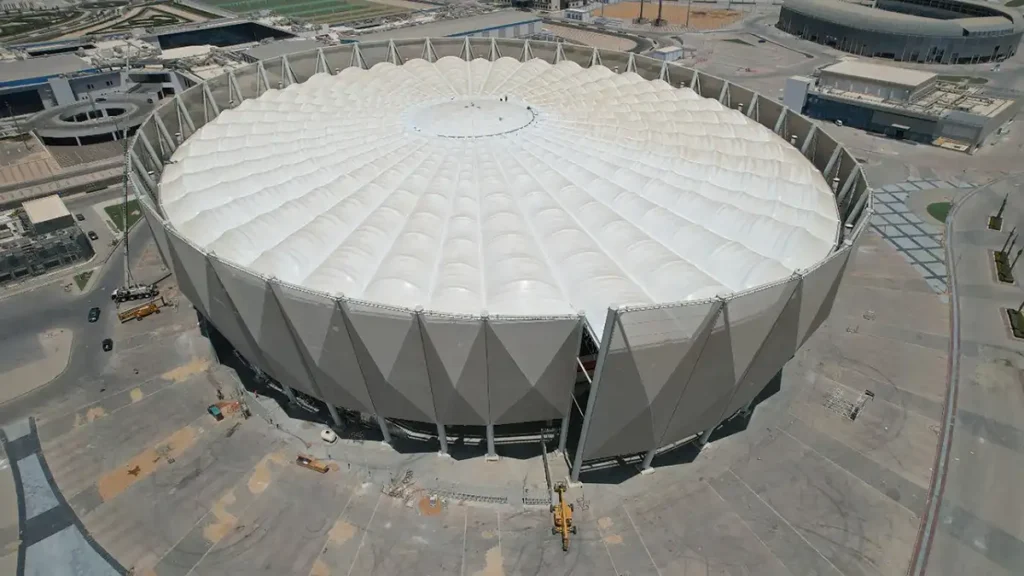
Desert-Adaptive Design: Passive and Natural Ventilation
The “Multisport Hall” is not just a massive structure; it is a system that interacts with the climate. The building was designed to minimize reliance on mechanical cooling systems.
The engineers utilize passive and natural ventilation strategies. The building’s careful orientation allows for air movement. The textile facades and shading also provide protection from heat gain.
This smart design helps maintain a comfortable internal atmosphere, significantly lowering operational energy consumption. This represents a design approach that prioritizes environmental solutions when facing arid climates.
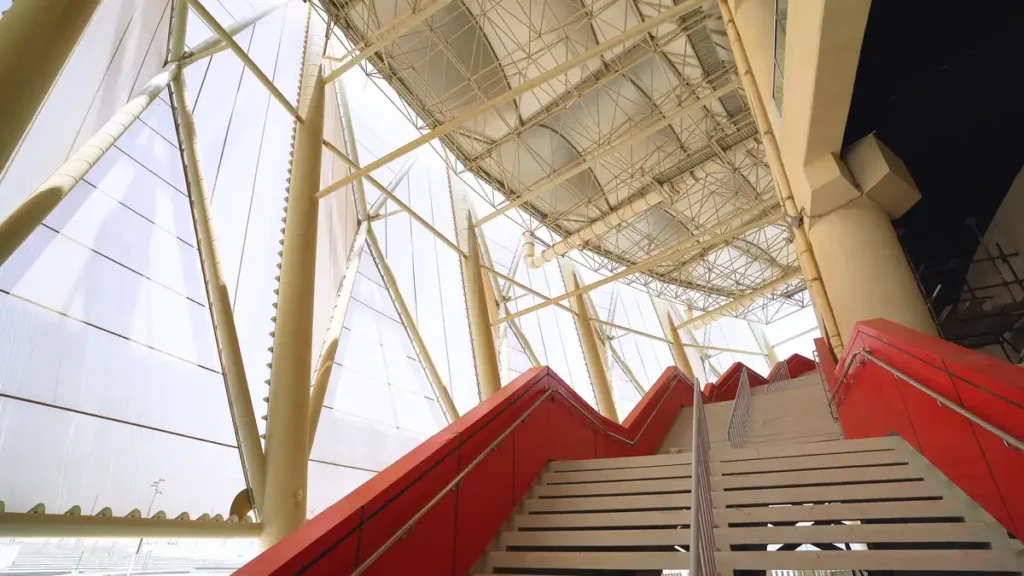
From Entrance to Seat: A Seamless Visitor Journey
The “Multisport Hall” was designed with a strong focus on the audience experience, starting with the outdoor spaces. The landscape design is adapted to the desert environment.
The exterior plazas use heat-reflective surfaces and provide shaded areas for pedestrians. This improves thermal comfort outside the building and reduces heat absorption.
Inside, circulation paths are clear and intuitive, ensuring a smooth flow for the crowds. The 15,000 seats are arranged to provide excellent views of the playing field from every angle.
The natural light filtered through the Textile Architecture facade, along with the use of warm finishing materials, contributes to creating a comfortable and welcoming environment for visitors and athletes alike.
An Urban Landmark Connecting Sport and Culture
Ultimately, this project is more than just a sports facility. It represents a significant addition to the urban landscape of the new capital.
The building offers an advanced model of Textile Architecture , integrating the massive functional requirements of an international arena with an intelligent response to the climate.
The Hall thus becomes a meeting point for both sporting and cultural events, strengthening the city’s position as a regional hub capable of hosting global events with a distinct architectural identity.
✦ ArchUp Editorial Insight
The exploration of textile-based shading in Cairo’s New Administrative Capital is a visually enticing intervention that cleverly merges material lightness with the formality of civic architecture. The structure’s sweeping canopies gesture toward nomadic tents, embedding a regional reference that softens the rigidity of bureaucratic buildings. Yet, beneath the fluid geometry lies a deeper architectural paradox: is this textile language an authentic environmental response, or a symbolic veil over deeper inefficiencies? While the design promotes passive shading and daylight filtration, little is discussed regarding maintenance, durability, or Cairo’s notorious dust load—key factors that could determine the true sustainability of such an installation. A more detailed environmental simulation or lifecycle analysis would have elevated the claims. Still, the concept earns merit for pushing beyond concrete, offering a poetic metaphor for shelter and openness. In ten years, such fabric-centric civic spaces may be the norm—or forgotten gestures—depending on how well they stand the test of urban use and climate wear.
Architecture professionals can follow ArchUp’s events section for verified updates on exhibitions, conferences, competitions, and results.




ArchUp: Technical Analysis of the Administrative Capital Sports Hall
This article provides a technical analysis of the Administrative Capital Sports Hall as a case study in sustainable tensile architecture. To enhance its archival value, we would like to present the following key technical and structural data:
The structural system utilizes a three-dimensional steel frame with 100-meter spans without intermediate columns, featuring a 1.2 mm thick PTFE fabric membrane that reflects 85% of solar radiation. The seating capacity reaches 15,000 with clear 120-degree viewing angles.
The environmental system achieves natural ventilation providing 5 air changes per hour, reducing energy consumption by 40% through fabric shading. The system maintains an internal temperature of 22-26°C in the desert climate.
In terms of visual performance, the fabric membrane provides 18% light transmittance while reducing glare by 70%. The 2,500 triangular panels are engineered to withstand wind speeds up to 130 km/h.
Related Link: Please review this article for a comparison of tensile architecture techniques:
Tensile Architecture: From Traditional Tents to Contemporary Structures
https://archup.net/giuseppe-gallo-transforms-mecanoos-architecture-into-minimalist-pattern-posters/