

The 1970s Home in Hollywood Hills: Where a House Becomes a Biography

A Fateful Meeting in Beachwood Canyon
When Brandon Mieske and David Valbuena first stood before the quiet Beachwood Canyon home, tucked away in the folds of the famous Hollywood Hills, they felt as if their wish list for a perfect dwelling had finally aligned with reality. This moment came after years of living in Nichols Canyon, which offered isolation and nature but at the cost of being far from daily life and its necessities, like the nearest coffee shop. The ideal solution was to find a place that combined the serenity of the hills with connectivity to the city. This house, built in the 1970s and located on a quiet cul-de-sac lined with mature trees, was the answer they were looking for. Stepping inside, they were greeted by its sloping ceiling lines, wide windows flooding the space with light, and the original stone fireplace that pulsed with the building’s history.
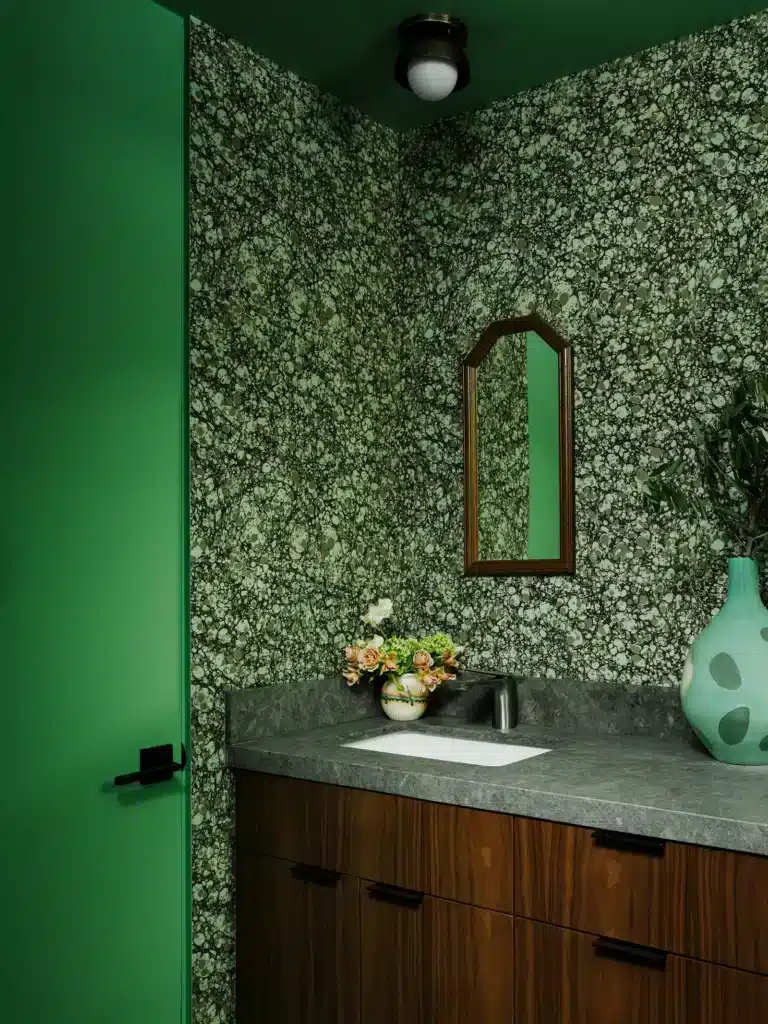
A Serendipitous Partnership: Collaborating with Designer Leah Ring
This was not the first time the couple had met interior designer Leah Ring, founder of the firm Human. They had become acquainted months earlier during the bidding process for another property they didn’t win. “By the time we found this house, Leah already had a deep understanding of our personalities and lifestyle,” says David Valbuena. This understanding was not superficial; it included specific details: Brandon’s life as a working artist, whose personal paintings would adorn the home’s walls alongside photography by friends, and David’s work as a graphic designer and animator. The couple also shared a passion for dark, bold interiors. “I felt that Leah would be able to translate our lives into this space even before we officially moved in,” Valbuena adds.
The Blank Canvas: A House Awaiting Its Identity
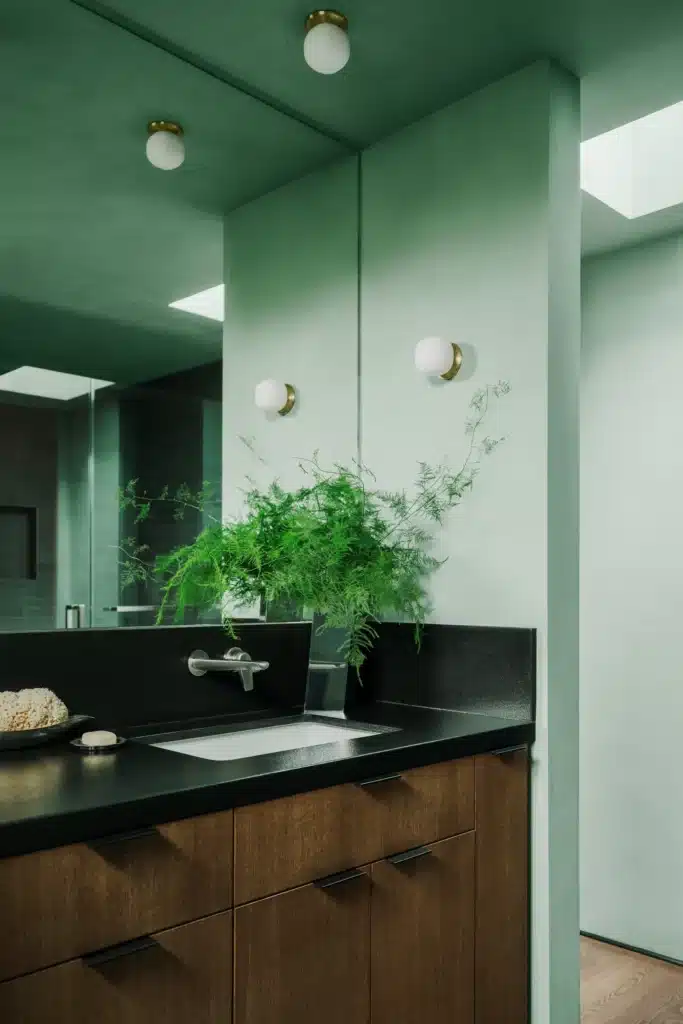
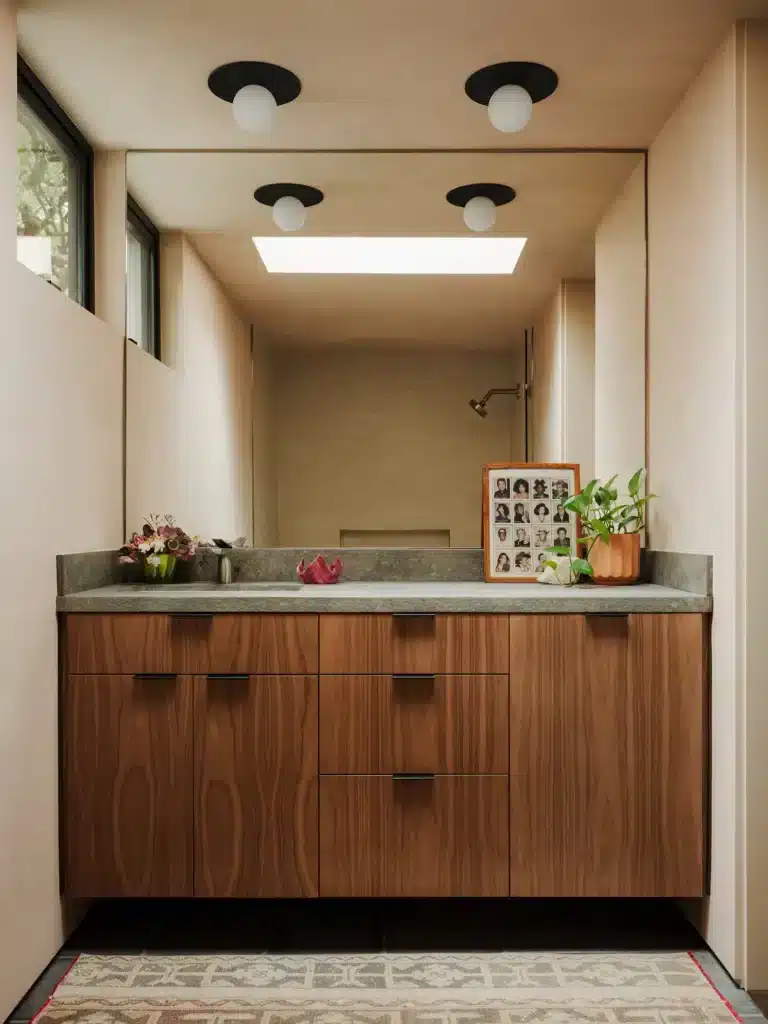
The couple inherited a home from the previous owners that had modernized systems (electrical, plumbing) but maintained a white, neutral interior devoid of any personal character. This lack was not a flaw but rather an open invitation for designer Leah Ring to fill it with the story of Brandon and David through furniture, textiles, and artwork collected from their travels and life. Ring commented on this, saying, “The infrastructure and architectural bones of the house were strong and beautiful; it made no sense to fight them. The real challenge was not to create a beautiful house, but to create a house that felt like Brandon and David the moment you stepped inside.”
The Living Room: The Heartbeat of Life and Personality
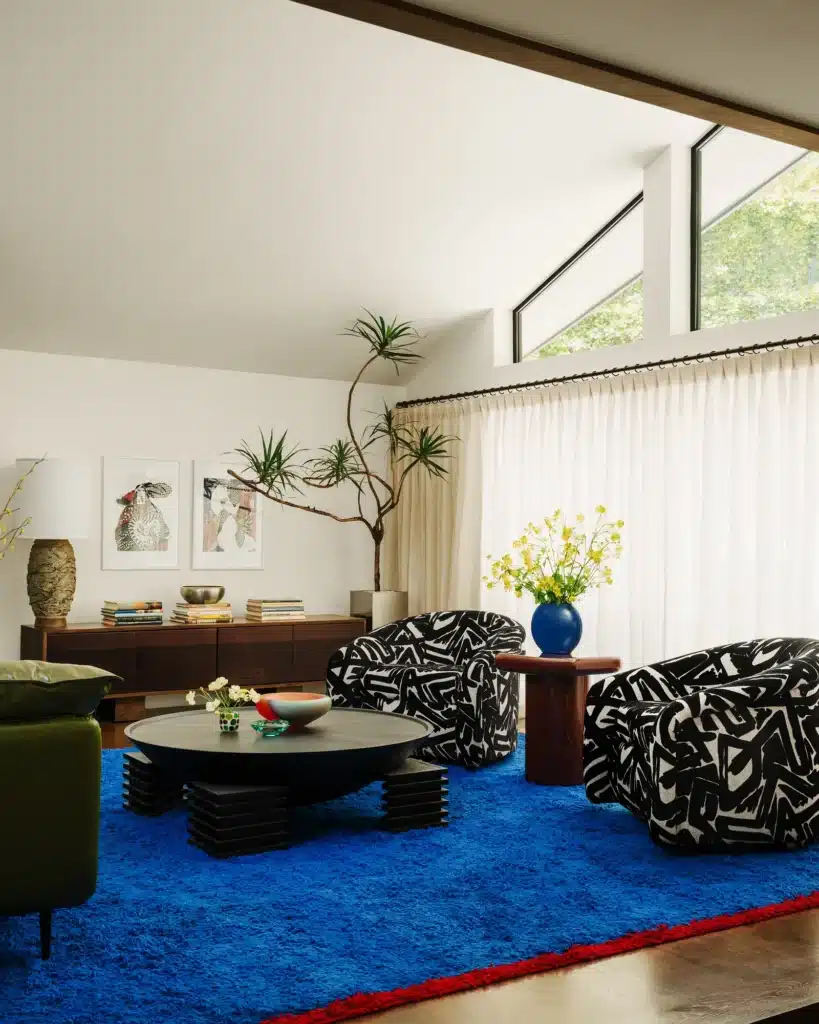
The living room stands as the prime example of this approach’s success. At its heart sits a luxurious olive-green leather sofa, paired with a traditional Moroccan cobalt blue rug, which Ring describes as “the piece that illuminated and energized the entire space.” To the side, a pair of vintage Milo Baughman swivel chairs adds a touch of playful elegance and movement. On the wall above the sofa, a photograph taken by a close friend holds a place of prominence, confirming that the home’s artistic choices follow this deeply personal vein. Brandon Mieske admits with a laugh, “We probably gave her more artwork than she needed to work with, but it’s a good problem to have.” Even the lighting adhered to this concept; the custom chandelier in the dining room, designed as a halo of fabrics inspired by the 80s style, presents itself as an independent art piece, attracting attention quietly and without fuss.

Conclusion: Where Every Corner Tells a Story
The final result is more than just a renovated house; it is an open record of two lives, filled with pieces that hold memories and stories. It is no longer just about aesthetics but about creating an authentic environment that reflects identity and celebrates personal details. David Valbuena summarizes the goal: “We wanted the space to feel like a snapshot of our life together – reflecting all the things we’ve collected over the years, not just those we bought all at once to decorate the house.” This goal was successfully achieved, making the house a true mirror of its inhabitants.
✦ ArchUp Editorial Vision
This project involves the conversion of a residential property into a model that expresses the biography of its inhabitants through interior design. An dominance of an aesthetic approach based on displaying personal memorabilia and memories is noticeable, which may raise a question about the extent to which it offers genuine architectural solutions that redefine the space or its relationship with the surrounding context. The intervention appears confined to the superficial and decorative layer without questioning the potential inherent in the original spatial structure. The design relies heavily on ready-made solutions and movable pieces, which may limit the emergence of an original design language cohesive with the existing framework. However, a positive aspect lies in the preservation of the original building’s structural integrity and the avoidance of waste resulting from demolition and reconstruction processes, giving it a value of sustainability within the framework of design updates.
Brought to you by the ArchUp Editorial Team
Inspiration starts here. Dive deeper into Architecture, Interior Design, Research, Cities, Design, and cutting-edge Projectson ArchUp.


