The Social Hub 2.0 – Reimagining Community Spaces

Competition overview
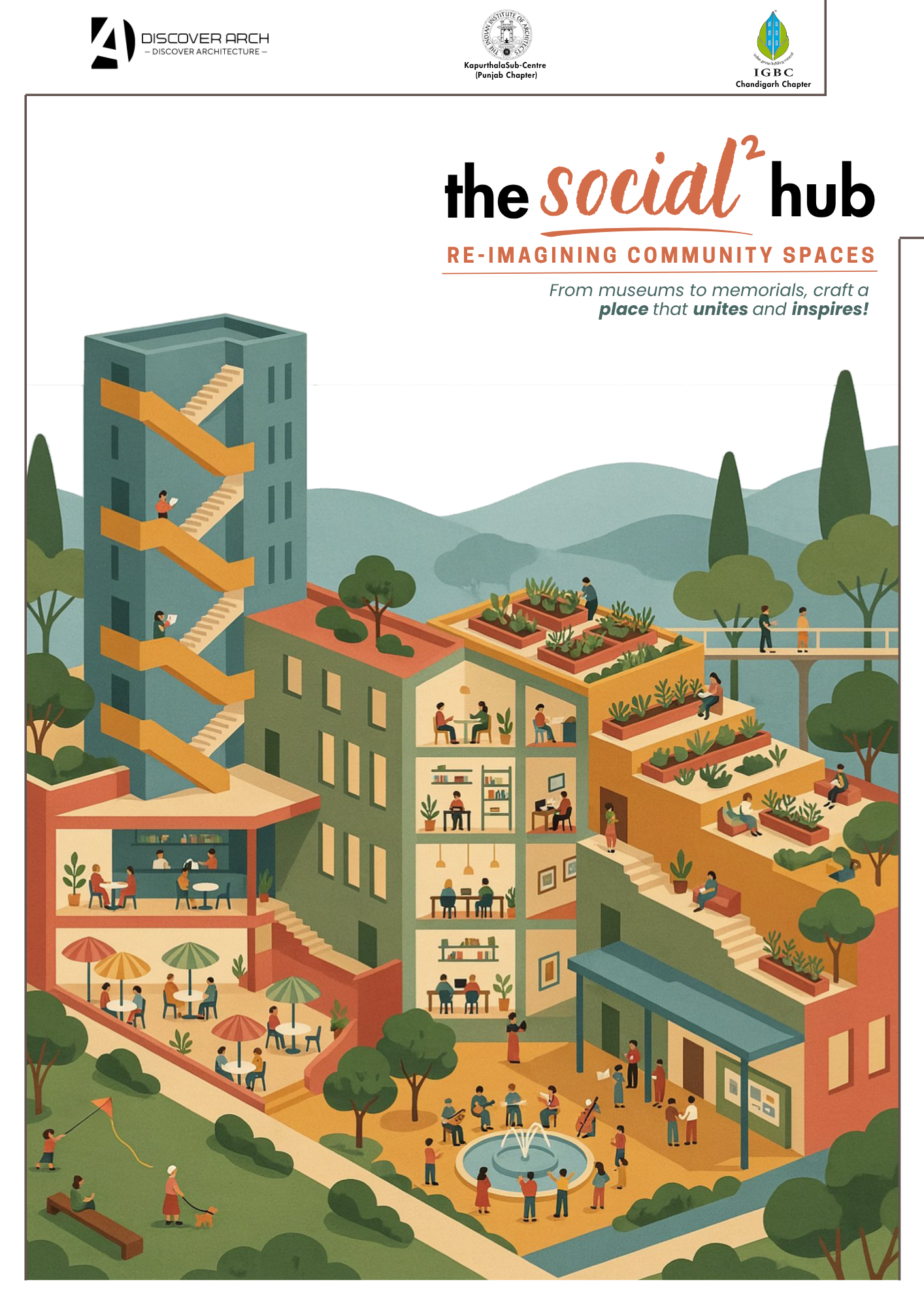
The Social Hub 2.0 – Reimagining Community Spaces invites students to develop a socio-cultural project around the identity and needs of a community. DiscoverArch presents the competition in collaboration with the IGBC Chandigarh Chapter and the IIA Kapurthala Sub-Centre (Punjab Chapter), according to the supplied competition brief and organiser’s announcement.
Participants choose their own site and building type. Options include museums, memorials, libraries, convention centres, spiritual centres and other community spaces. The task connects a site’s history or social identity to spatial planning, circulation, materials and landscape. The reviewed brief does not announce a construction commission or an implementation budget.
Eligibility and design requirements
Currently enrolled undergraduate and postgraduate students in architecture, urban planning, landscape design and related disciplines may enter worldwide. Entries may be individual or by teams of up to four, including students from different institutions. An optional faculty mentor does not count towards the four-member limit. Each additional entry requires separate registration.
A proposal must explain why its site matters, supported by maps, sketches or photographs. The brief asks for inclusive access, contextual sensitivity, flexible shared spaces and sustainable strategies, including passive design, suitable materials and reduced resource consumption. It does not prescribe a universal site area or a fixed building programme.
Submission requirements
Submit a maximum of two A1 sheets in PDF format through the DiscoverArch dashboard. The stated file-size limit is 50 MB. Include a site plan; site analysis or a narrative diagram; plans, sections and elevations; a large-scale detail of an innovative feature; and three-dimensional views. Written communication and project descriptions must be in English.
Place the registration identification number at the top right of each sheet. Names, logos and institutional identifiers must not appear. Selected participants will be asked to explain their design to the jury using a laptop; mobile-device presentations are not accepted. The brief does not specify the presentation date. Certificates require a project submission, not registration alone.
Jury and assessment
The brief names Sabeena Khanna (Studio KIA), Silvia Covarino (German University Cairo), Shreya Srivastava (studio shunya), José Manuel Pinto de Carvalho (MIA/ISMAT, Portugal), Minakshi Jain (NIT Hamirpur) and Palav Dhananjay Desai (S.V.I.T., Vasad). These affiliations are reported as supplied by the organiser.
Assessment covers concept and vision, functionality and spatial planning, innovation and sustainability, community and contextual response, and presentation. Numerical weights are not supplied. Anonymous sheets are required, while the later presentation introduces a further assessment interaction.
Prizes in US dollars
| Award | Approximate USD equivalent |
|---|---|
| First prize | $104 |
| Second prize | $62 |
| Third prize | $42 |
| Total advertised prize pool | $208 |
The organiser denominates the awards in Indian rupees: 10,000, 6,000 and 4,000 respectively. Dollar equivalents are rounded editorial conversions at INR 96.315 per USD, the 1 October 2026 closing rate reported by Reuters. They are not a promise of payment in dollars; conversion costs and subsequent exchange-rate changes may affect the amount received.
Ten honourable mentions receive appreciation certificates and publication on the organiser’s website. The top 50 shortlisted projects receive appreciation certificates. Participation certificates are available to those who submit their projects.
International registration fees and dates
| Registration stage | Fee per member outside India | Closing date |
|---|---|---|
| Early bird (closed) | $2 | 1 October 2026 |
| Standard | $4 | 2 November 2026 |
| Late | $6 | 10 November 2026 |
A four-person international team therefore pays $16 at the standard rate or $24 at the late rate. Fees are non-refundable. Separate local rates apply to entrants from India; international entrants should use the organiser’s dollar tariff rather than a conversion of the domestic tariff.
The competition opened on 7 September 2026. Project submission closes on 12 November 2026; results are scheduled for 31 January 2027. The organiser reserves the right to adjust the schedule and notify participants. Registration windows overlap on their boundary dates in the brief, so confirm the applicable tariff before payment.
No closing hour or time zone is stated in the supplied brief. The countdown is an indicative reference to the beginning of 12 November in UTC, not a verified submission cutoff. Confirm the actual deadline with the organiser and submit early.
✦ ArchUp Competition Committee Review
The useful architectural question is how a community’s story changes the operation of a building. A narrative applied only to façade imagery would leave the central brief unanswered. Stronger proposals can show how memories, recurring activities and different users determine entrances, circulation, shared rooms and the relationship between quiet and collective space.
Freedom to choose both site and programme gives students room to work with a context they understand, but it also makes comparison less straightforward: a small library and a large convention centre face different operational demands. A clear account of users, daily schedules, access and maintenance can make the social claims testable. Within two A1 sheets, a precise spatial argument is more persuasive than a long list of sustainable technologies.
The low international entry fee and named jury support its value as a student exercise. The modest prize pool and emphasis on certificates, publication and a supplementary sustainability webinar position it primarily as an educational and visibility opportunity. These features do not establish a route to construction or professional appointment.
The supplied brief does not define copyright ownership, the scope of any licence to reproduce submissions, prize-payment timing or deductions. Participants should clarify these terms before paying or submitting. The committee has not independently audited previous prize payments or the collaborating organisations’ involvement.
Reviewed on 2 October 2026 using the brief and poster supplied directly by the organiser, under ArchUp’s competition transparency policy. Featured image: official DiscoverArch poster.