The Standard Hotel Singapore: A Tropical Rebirth of Iconic Hospitality

Three years after shuttering its legendary West Hollywood location, The Standard returns to the global spotlight with a striking new venture in Southeast Asia. The Standard Hotel Singapore is not merely an expansion — it’s a bold architectural statement that redefines what a hotel can be in the 2025 context: part social club, part sanctuary, and entirely unexpected.
Nestled between Singapore’s vibrant Orchard Road and the lush Botanic Gardens, the hotel taps into both urban energy and tropical stillness. Its design — led by local architecture and interiors studio Ministry of Design in collaboration with The Standard’s in-house team — reflects the brand’s provocative spirit, but through a uniquely Singaporean lens. The result is an “urban oasis” where glamour meets greenery, and every spatial element tells a story of reimagined hospitality.
This location doesn’t try to mimic the past. Instead, it channels the essence of the original West Hollywood property — famous for its boundary-pushing aesthetics and star-studded presence in Sex and the City, Ocean’s Twelve, Gossip Girl and more — and reinvents it with biophilic design, bold materials, and a theatrical sense of arrival.
Ministry of Design’s Vision: Playfulness Meets Precision
From the moment guests arrive, they’re greeted with a sense of irony and wonder. The hotel reception isn’t just a counter — it’s an art piece: a whimsical terrarium co-designed with artist Eric Tobua, recalling the original Standard’s infamous ‘Box’ installation. Instead of posing models, it showcases a fantastical micro-garden, making it immediately clear that this is a hotel where nature isn’t just referenced — it’s staged.
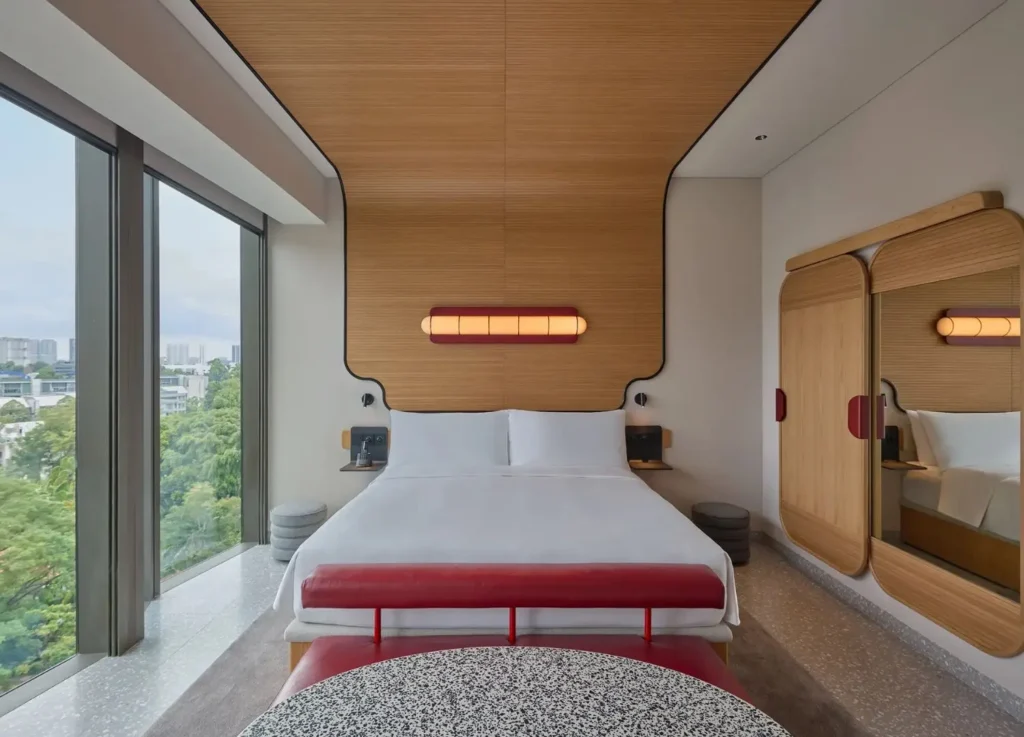
The hotel features 143 rooms, each drawing from local materials like timber and stone, but expressed through mid-century modern design elements. Full-height glass facades frame views of either Orchard Road or the green courtyards, connecting guests constantly to their surroundings. Timber canopy beds, curved lines, and warm neutrals with vibrant color accents bring warmth and intimacy to each suite.
Kaya Restaurant: Theatrical, Tropical, and Truly Standard
One of the boldest interior expressions is Kaya, the hotel’s main restaurant. Inspired by Japanese Izakayas and reinterpreted through the brand’s lens, Kaya blurs the lines between interior and exterior, with wall panels designed by Sara Yen Tanya that mimic botanical forms. The experience is immersive: drink, dine, and socialize in a “garden” that opens into the pool deck and green terraces.


A Biophilic Oasis Above the City
Above the rooms and restaurant lies a two-level garden sanctuary, directly inspired by the adjacent Botanic Gardens. It’s here that the hotel’s tropical identity is at its peak — layered foliage, curated artworks from local artists, and a swim-up bar that lets guests float into relaxation without leaving the water.
The design language plays with protection versus openness, offering both secluded nooks and vibrant communal spaces. Whether guests are here for a staycation or stopping over between continents, the hotel serves as a microcosm of Singapore’s architecture: fluid, natural, and radically cosmopolitan.
✦ ArchUp Editorial Insight
The Standard Hotel Singapore demonstrates how hospitality architecture can become a medium for cultural and environmental storytelling. By blending The Standard’s irreverent DNA with Ministry of Design’s contextual sensitivity, the project avoids cliché and instead offers a masterclass in narrative-driven design.
More importantly, it reflects a deeper trend: hotels no longer serve just as accommodations — they’ve become platforms for experience, identity, and place-making. This hotel does not imitate its Western predecessor; it reconstructs the brand’s ethos in dialogue with Southeast Asia’s ecology, materials, and mood.
The Standard’s Return — and a New Standard in Asia
In an increasingly homogenized hotel industry, The Standard Hotel Singapore offers a vivid counterpoint. It dares to be specific, playful, and rooted in its environment. From its satirical reception to its immersive greenery and theatrical interiors, the hotel is not just a space to sleep — it’s a destination that invites guests to participate in a larger narrative of design, nature, and city life.
As hospitality continues to evolve, projects like this remind us of the potential in cross-cultural design collaborations — where brand legacy doesn’t dictate aesthetic sameness, but instead fuels transformation.

Explore More with ArchUp
ArchUp documents the evolving profession of architects worldwide, from career insights and research to project profiles and industry news. Our editorial team publishes global salary trends, career advice, and opportunities for emerging talents. Learn more on our about page or contact us to collaborate.