This biobased house is made from sustainable materials

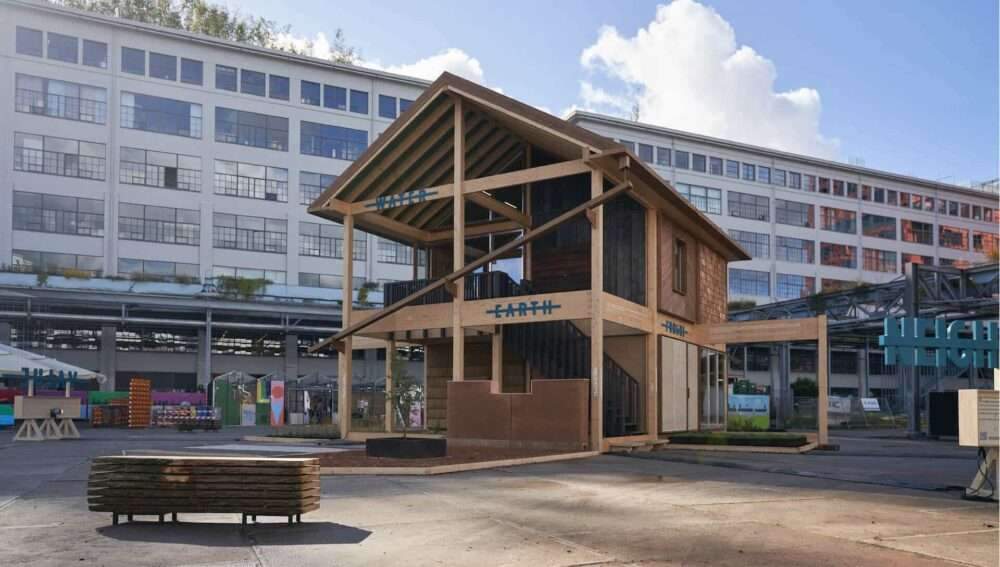
Currently on display at Dutch Design Week 2021, “The Exploded View” uses only biobased materials to demonstrate the potential of sustainable design.
Mycelium flooring, seaweed tiles, and a bacteria lamp are just three of over 100 sustainable materials and other technologies featured inside “The Exploded View”. An installation created using only biobased materials and circular construction methods.
Made predominantly from wood, the house contains a series of modules that exist in small, self-contained arrangements, which can be turned into smaller or larger homes. Each module contains a different area or room that represents a theme. For example, the outside of the house explores “Earth” materials including limestone flooring and planters made of cork.
Currently, on display at Dutch Design Week, the purpose of the exhibition is to prompt discussion around sustainability and the future of design. It serves as an amalgamation of the various materials and methods of building that might inform what houses look like in the future.
Inside, several other rooms and themes unfold, including the “Water” room. Which uses breathable insulation made from reed, ceiling tiles made from seaweed, and lime plaster colored using algae. Meanwhile, the Funghi room champions a more familiar material with insulation, wall panels, and flooring all made from mycelium.
Other innovative materials and techniques include concrete made from bacteria instead of cement and Shou Sugi Ban. A traditional Japanese wood-burning technique that has become a popular choice for external cladding. Because of its longevity and low-maintenance requirements.
The bacteria-infused concrete is by the American company Biomason. Which produces bioLITH precast concrete tiles with bacteria that precipitate calcium carbonate in an aggregate matrix. The calcium carbonate bio cement consists of inorganic crystals formed by the bacteria at ambient temperatures. Moreover, the resulting product is recyclable at the end of its life and has no inherent VOCs (Volatile Organic Compounds).
This biobased house is made from sustainable materials
From food and textiles to seaweed and sewage water, The Exploded View showcases the endless, potential material streams available including those that aren’t readily available yet. It also demonstrates the potential of collaborative research, bringing together builders, producers, farmers, scientists, designers, governments, knowledge institutes, storytellers, and artists, to develop ideas and possible alternatives to the current way of making.
After all, establishing new design and construction methods is difficult, especially when it comes to sustainability. Which is a mainstream approach with no consensus on its application. This project is a great response to this dilemma for two reasons. Firstly, it showcases an exhaustive list of what is currently possible. And secondly, it showcases them within a domestic environment that is easily applicable in countries around the world. All of this is captured in an immersive environment that truly inspires.
Finally, read more on Archup:
Want to Stay Relevant in Architecture? Become an Adaptive Reuse or Renovation Expert