Transforming Abandoned Factories in China into Cultural Hubs: Reviving Industrial Heritage

Introduction: A Radical Shift in the Urban Fabric
China is undergoing a profound transformation of its urban landscape, where derelict factories are being reborn from obsolete industrial symbols into vibrant cultural spaces. This shift is more than a simple change of use; it is a redefinition of urban identity and an act of architectural sustainability. These massive structures are a legacy of a significant industrial era in China’s history, and their conversion today represents a pioneering model of urban renewal that balances heritage preservation with contemporary needs.
Historical Background: From Industrial Revolution to Economic Transformation
The roots of this transformation trace back to the founding of the People’s Republic of China in 1949, when the state directed investment towards heavy industries like steel and machinery. That era witnessed the construction of countless massive industrial facilities designed to support rapid industrialization. These colossal structures symbolized economic progress and self-sufficiency, built to last for decades.
As China’s economy pivoted from traditional industries to technology and innovation sectors, these installations began to lose their original purpose. According to the World Economic Forum, China now represents the world’s second-largest economy and no longer relies primarily on traditional heavy industries. This economic shift created a unique architectural challenge: how to repurpose these vast spaces originally designed for specific technological processes.
The Architectural Challenge: Redefining Industrial Structures
Architects face a three-dimensional challenge when dealing with these sites: how to preserve historical identity while meeting contemporary needs, how to address structural and environmental difficulties, and finally, how to integrate these isolated monoliths into the evolving urban fabric. These buildings are characterized by their immense height and superior load-bearing capacity, requiring intelligent architectural interventions that respect the original character while adding contemporary value.
Most successful projects rely on a “minimal intervention” strategy, where distinctive industrial elements like furnaces, chimneys, and massive machinery are preserved and transformed into both aesthetic and functional features. This approach ensures the preservation of collective memory while creating new spaces that serve the needs of modern society.
Exemplary Models of Adaptive Reuse
Shougang No. 3 Blast Furnace Museum in Beijing: Lessons in Balancing Old and New
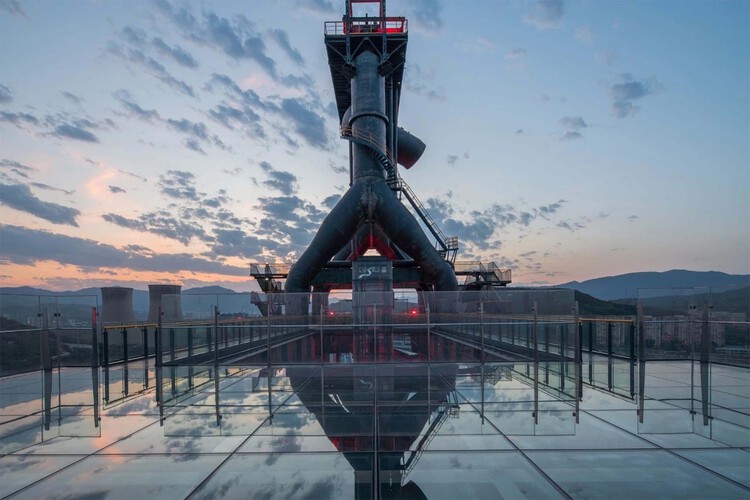
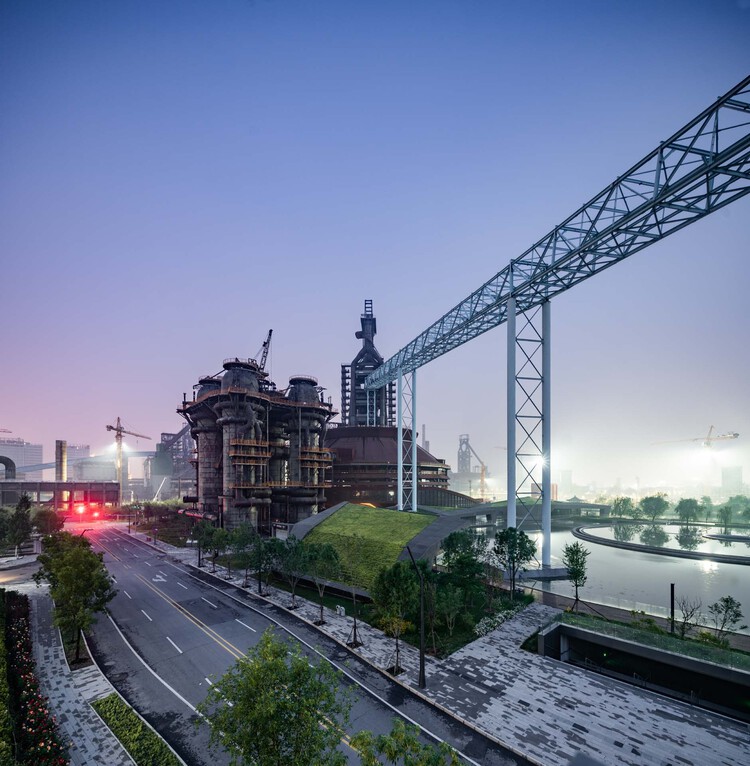
The Shougang No. 3 Blast Furnace Museum in Beijing is a prime example of the successful conversion of an industrial facility. The factory was originally shut down before the Beijing 2008 Olympics to reduce pollution and has now been transformed into an architectural masterpiece spanning 49,800 square meters. Designers from CCTN adopted the concept of “circulation” as a core design idea, adding new elements that integrate with the existing structure without overwhelming it.
The architectural intervention includes adding a “folding base staircase” and 72-meter-high glass walls, allowing visitors to traverse the vast internal spaces that were once exclusive production areas. This intervention turns the complex industrial shell into a legible, multi-level museum, making the massive scale useful for the overall experience. The site has now become a major cultural destination attracting visitors from around the world.
Zoucheng Ferroalloy Heritage Park in Jining: A Model for Comprehensive Sustainability
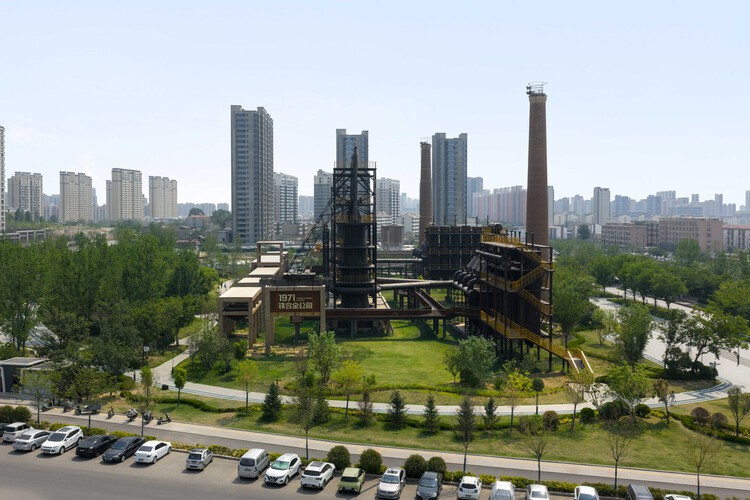
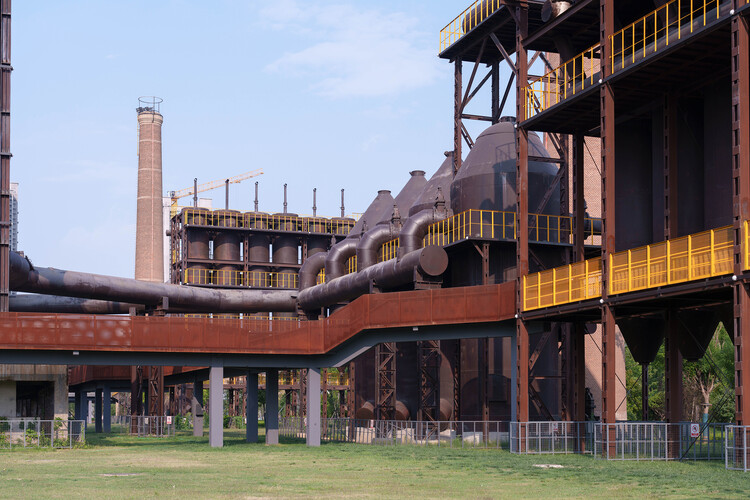
The first phase of the Zoucheng Ferroalloy Heritage Park project in Jining represents a unique case study that combines architectural regeneration with environmental sustainability. The factory was decommissioned in 2005, and the project covers an area of 61,019 square meters. The goal of the local government was not only to reassess the building’s role in daily life but also to restore soil contaminated within the factory area and advance the site’s ecological rehabilitation.
The architects from DDON adopted an architectural strategy that explicitly identifies the original factory building as “significant industrial heritage.” They framed the structure with soft landscaping, creating a visual and spatial contrast between the rugged industrial aesthetic and the surrounding natural greenery. The project also serves as a symbolic gateway to a future-oriented ecological industrial park, helping to connect the industrial past with the area’s ecological future.
Baoshan WTE Exhibition Center in Shanghai: A Dialogue Between Past and Present
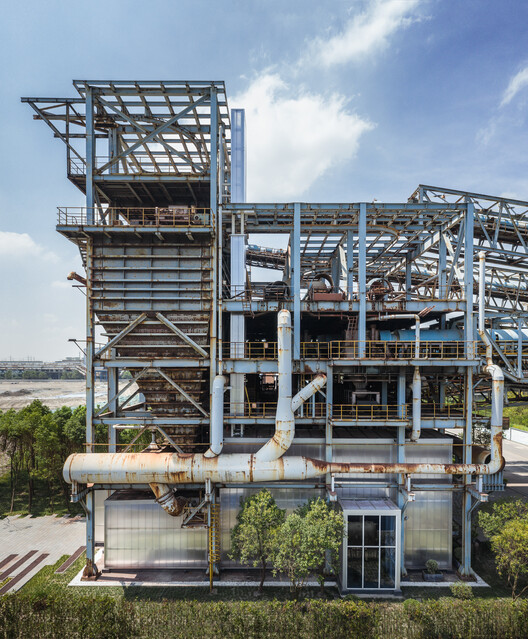
At the Baoshan WTE Exhibition Center in Shanghai, the focus is on a material dialogue between the old and the new. The former steel production building, covering 725 square meters, was once home to a steel mill. Today, most of the factory buildings have been demolished, and the site is scheduled to host a future power generation station and a surrounding park.
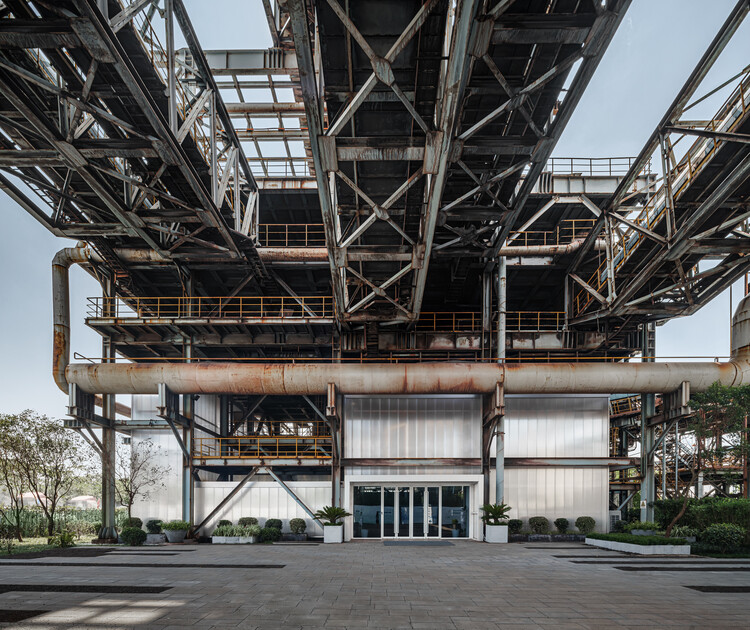
For the project, architects from Kokaistudios introduced a fully independent multi-faceted envelope within the existing, heavy factory building. This architectural choice solves technical problems while creating a strong contrast: the new, lightweight, and recyclable structure engages in a conversation with the preserved industrial past. Simultaneously, alternating bands of stone tile and steel slag (a byproduct of metal manufacturing) recall the site’s former function.
Preserving Collective Memory
Converting factories into cultural facilities represents more than just a change of use; it preserves the collective memory of local communities. Many of the workers who labored in these factories and their children see these transformations as a way to safeguard their history and achievements. These sites have become places for storytelling, where narratives of industrial work are transformed into cultural heritage for future generations.
Environmental and Economic Sustainability
This approach contributes to a dual sustainability: environmental and economic. Environmentally, reusing existing structures reduces waste from demolition and new construction. Economically, turning these sites into cultural and tourist destinations creates new jobs and stimulates the local economy. Furthermore, remediating contaminated soil at many of these sites represents an investment in community and environmental health.
Integration with the Urban Fabric
These projects have become an integral part of the urban fabric in Chinese cities, transforming from isolated pockets into vibrant centers that serve the community. This conversion helps create a unique urban identity that blends authenticity with modernity. These sites become attractions that increase the value of surrounding areas and stimulate further development.
Conclusion: Towards a Sustainable Future for Industrial Heritage
China’s experience in converting dormant factories into cultural facilities serves as a model for the world. This approach not only preserves architectural heritage but also creates new spaces that meet the needs of contemporary society. By combining historical sensitivity with architectural innovation, China successfully turns challenges into opportunities, offering valuable lessons on how to handle industrial legacy in a sustainable and creative manner.
✦ Archup Editorial Insight
The article examines the conversion of dormant factories in China into cultural facilities as a response to economic and urban fabric transformations. Some architectural interventions appear as merely superficial additions to existing structures, where the integration of old and new fails to address the functional complexities of the vast spaces. An over-reliance on aesthetic solutions sometimes neglects long-term structural efficiency and operational sustainability, and the attempt to standardize design models across diverse sites can weaken the response to local specificities. However, the preservation of original industrial elements as visual references creates a sense of authenticity and history within the architectural experience.
Brought to you by the ArchUp Editorial Team
Inspiration starts here. Dive deeper into Architecture, Interior Design, Research, Cities, Design, and cutting-edge Projectson ArchUp.