
Transforming Heritage into Life: St. Louis’s Powell Hall Undergoes an Ambitious Renovation, Opening Its Doors to the City

How Snøhetta Successfully Turned a Historic Cinema Palace into an Inclusive Cultural Beacon
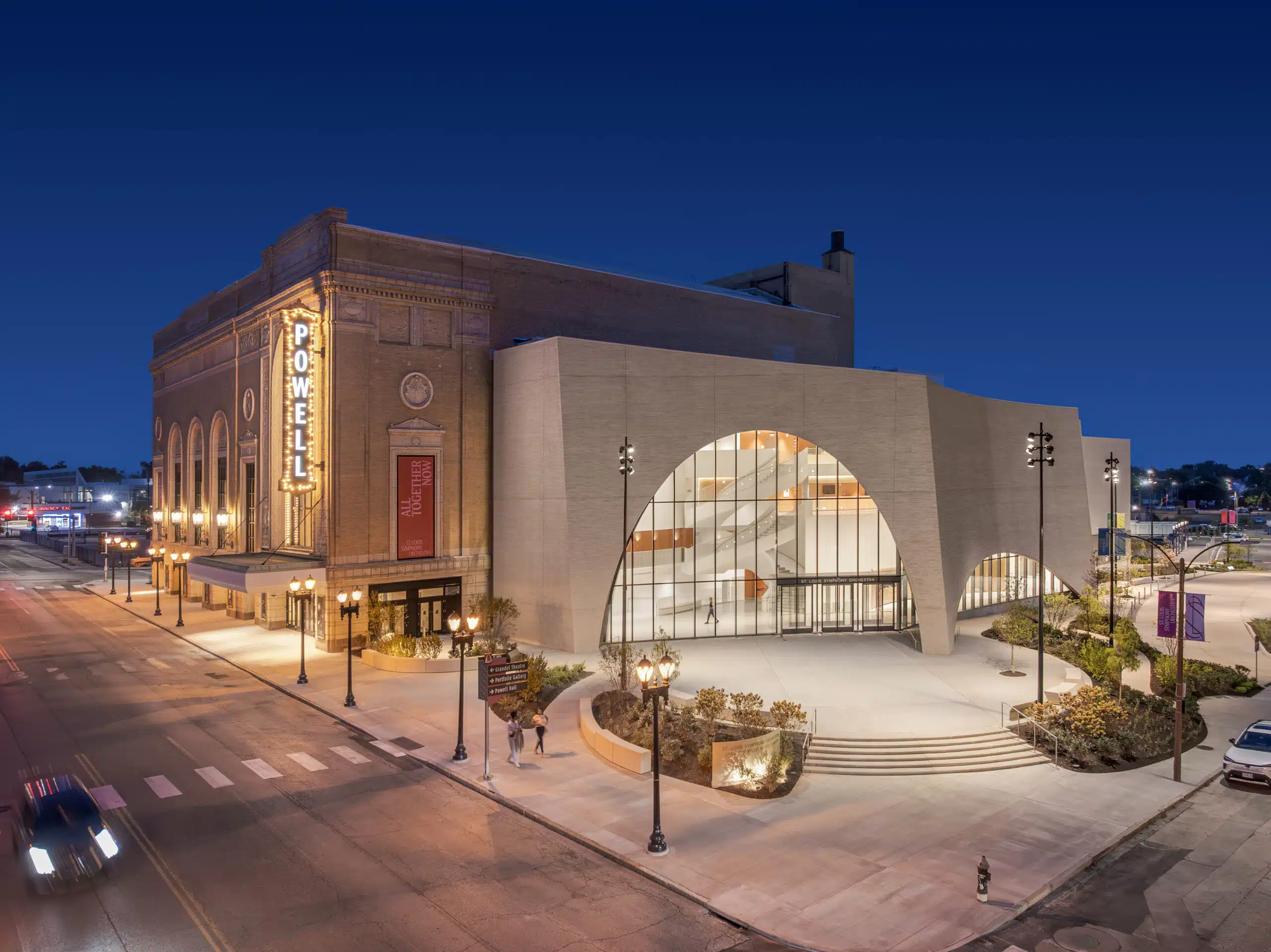
After a century, St. Louis’s Powell Hall is no longer merely a relic of the past but a living model for transforming heritage architecture into a vibrant space that breathes with the city’s present and future. The expansion and renovation project led by the architectural firm Snøhetta was not a conventional restoration but a redefinition of the building’s spirit and its relationship with the surrounding urban fabric. Starting from a deep understanding of the emotional connection St. Louis residents have with the place, the project evolved from an act of preservation into a space for belonging, open to the public with full transparency and architectural craftsmanship.
From Preservation to Belonging: The Design Philosophy That Reshaped the Brief
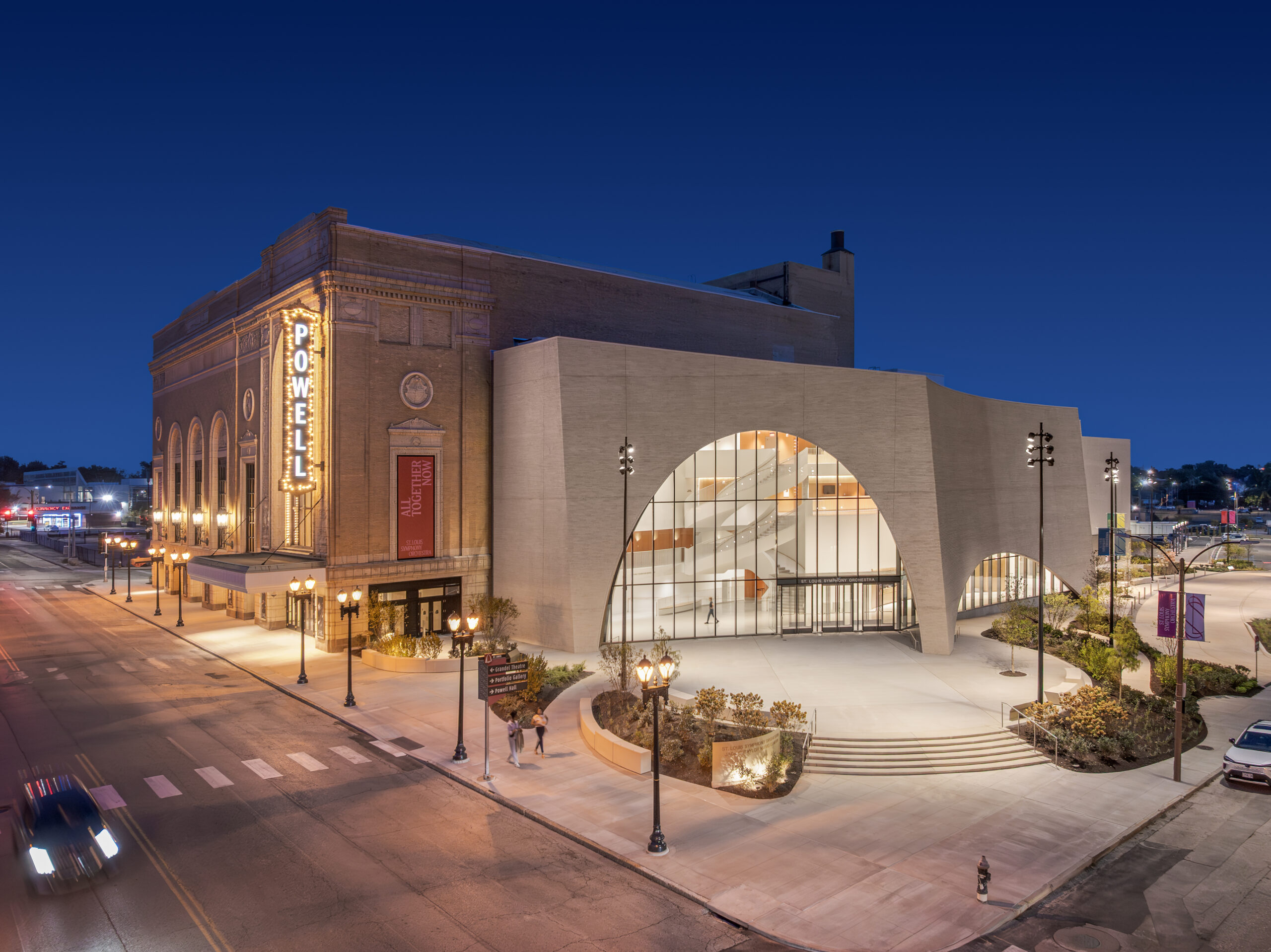
The designers viewed the building not only through the lens of its architectural history but also through the emotions held by the community. Craig Dykers, co-founder of Snøhetta, clarified that the challenge was not the building’s age, but the fact that “it was beloved.” This vision led the team to adopt a philosophy focusing on “belonging” rather than mere “preservation.” The task was to honor that collective affection while shaping a vibrant future home for the St. Louis Symphony Orchestra, integrated with the city’s evolving Grand Center Arts District. The ultimate goal was to create a feeling that “this is a place everyone can visit,” a spirit that shaped every subsequent design decision, from the urban strategy down to the smallest brick details.
Breaking Isolation: The Transformation from a Single Front to a Building Interacting with the City
The historic hall, designed by the legendary theater architects Rapp & Rapp and completed in 1925, had long suffered from its one-sided design. It possessed an lavish, ornate front facade, while the other three sides remained largely blank, reflecting its original nature as a movie palace for a transient audience. Snøhetta confronted this urban dilemma with boldness; the crucial step was turning this enclosed building into an active civic entity that is accessible and welcoming to all. As Takeshi Torenier, Project Manager at Snøhetta, stated: “We decided we were going to open this building from all sides.”
The Southern Addition: Glass Arches Creating a Visual Dialogue with the Surroundings
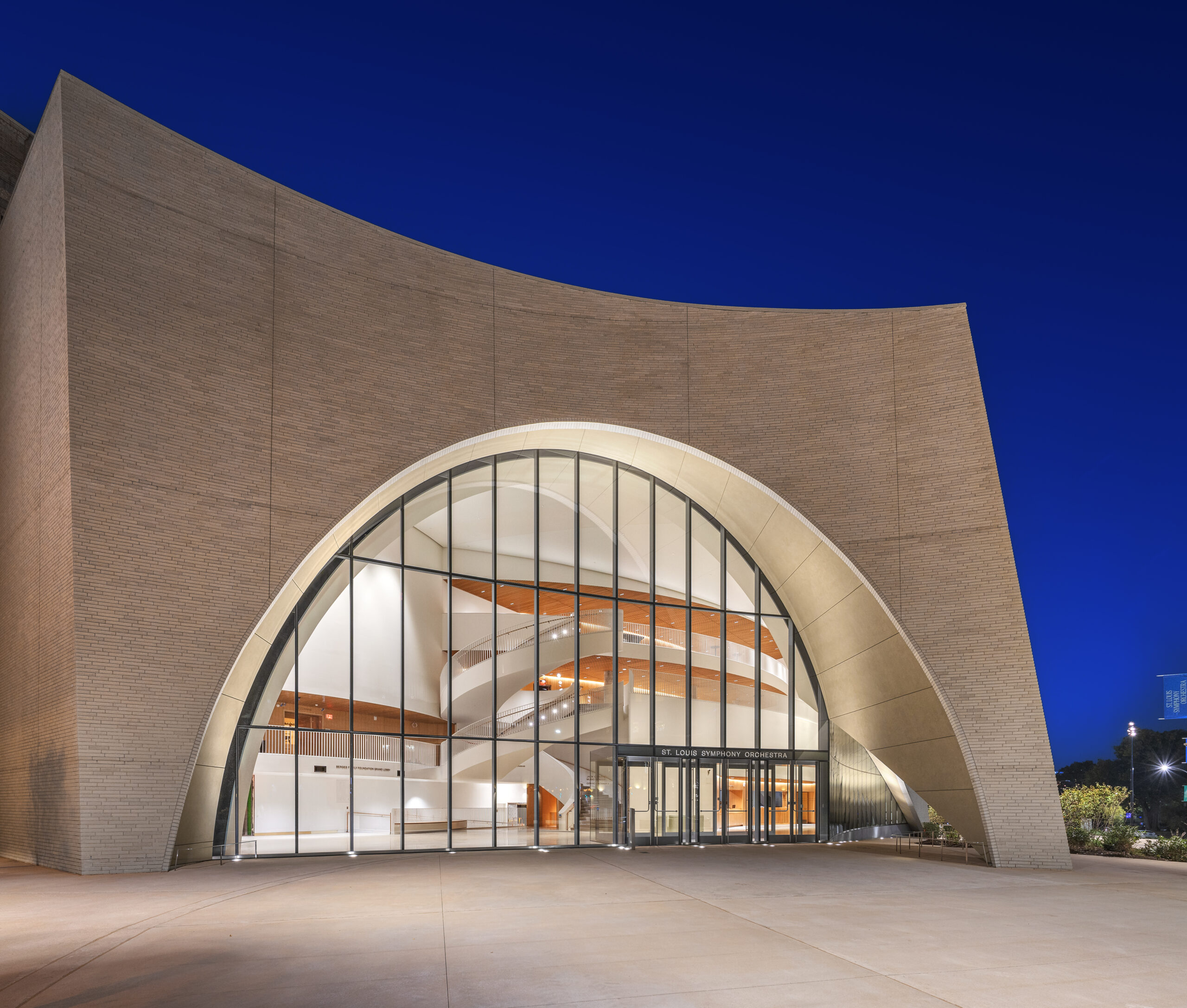
The new addition to the south represents an intelligent architectural intervention, where broad glass arches cut sightlines through the complex. Now, passersby can approach Grand Boulevard and see the view through a series of wide glass facades extending to Delmar Street. This visual connection is not merely an aesthetic detail but an effective wayfinding tool that makes navigation easier and provides a clear sense of permeability. Entrances, vistas, and thresholds are now cumulatively and continuously linked.
Grand Boulevard Plaza: A Civic Prelude Welcoming the Public
The new plaza on Grand Boulevard serves as a civic prelude to the project. Snøhetta reshaped this space by pulling its sculpted mass back from the street, maintaining clear views of the historic Rapp & Rapp facade while making room for gatherings. The main window in the lobby, described by Dykers as a “beacon,” became a strong visual signal for the institution. Before performances, the plaza transforms into an outdoor lobby; on non-performance days, it functions as a small, attractive urban square for local residents.
A New Architectural Language: Lyrical Arches and Gradated Brickwork
The architecture of the new addition deliberately refrained from mimicking the historic envelope, instead seeking a complementary rather than confrontational relationship. The visual language was inspired by operatic scores, expressed through curves, inflections, and varied rhythmic openings.
Lyrical Arches: Music Embodied in Stone and Glass
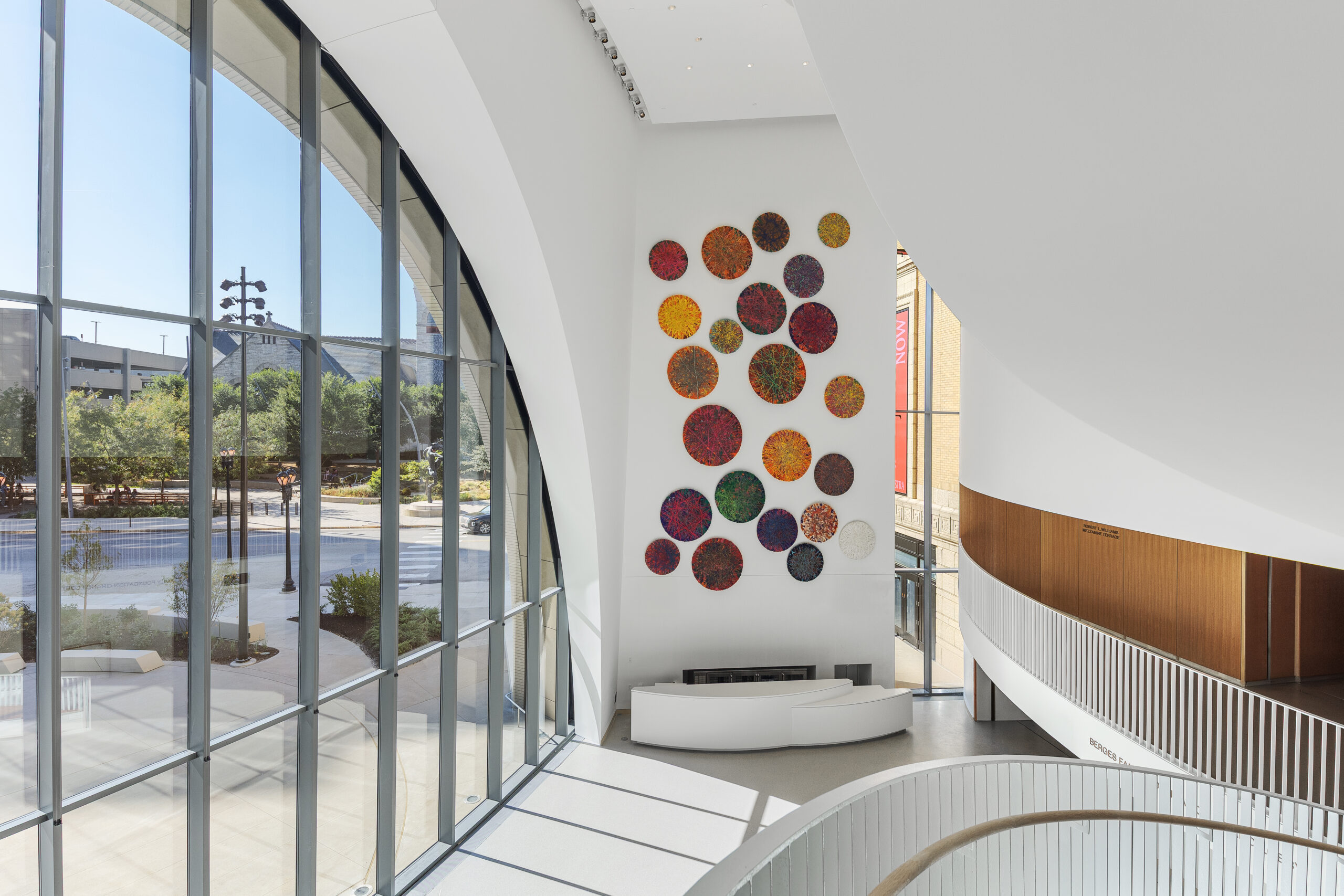
“We don’t use uniform arches. We use a kind of echoing lyrical arch that almost seems like a piece of music,” explained Dykers, likening the forms to the movement of a conductor’s baton and the waists and F-holes of string instruments. These design gestures describe not only the external facades but also the sequence of interior balconies that allow the audience to “see and be seen” across the triple-height lobby space, enhancing the visual and social experience within the building.
Graded Brick Facade: Craftsmanship Playing with Light and Shadow
Snøhetta’s extension was built from graded brick that gives the building a dynamic, tactile quality. The sloping exterior walls are made up of tiered surfaces of canted brick. Dykers clarified that “the walls aren’t actually sloping, they’re stepped… each course of brick zigzags slightly further out than the one above it.” This geometry creates a refined exterior that expresses different qualities depending on the season. In summer, the slant improves solar access to lower spaces while lightening the visual mass as it rises. In winter, the “little ledges” of brick catch snow, tracing delicate horizontal lines across the facade.
The Grand Stair: A Performative Sculpture Connecting Spaces
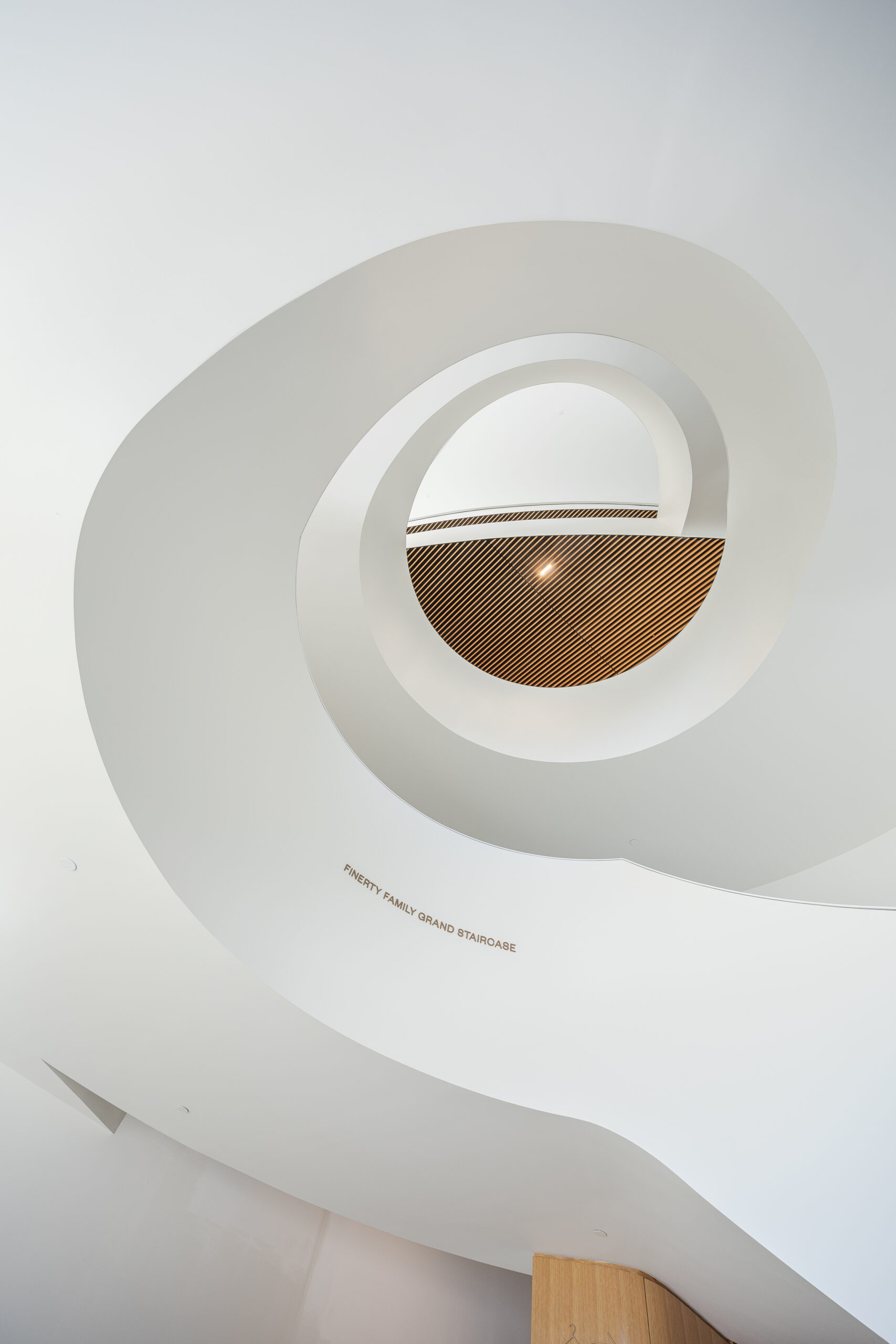
The main stair in the triple-height lobby serves as the beating heart of the experience and the central masterpiece within the new addition.
Manufacturing Inspired by Sculpture
Dykers described the stair’s upper railing as “made from solid steel that’s been bent and formed into this spiral shape that’s as close as you can get to a Richard Serra sculpture.” Its manufacturing process was akin to choreography, where craftsmen would bring it to the site, inspect it, and adjust it repeatedly until the desired form was achieved. The glowing, non-repeating treads were largely fabricated from plywood before being precisely modified on site.
A Visual Performance Connecting Users and Space
The resulting stair is dramatic, delightful, and highly tactile. Its role extends beyond connecting floors; it doubles as a visual and social link, and a scenic element visible to the public through the sequence of large arched windows in the lobby. It has become a sculpted record of movement and a visual performance that enhances the idea of “seeing and being seen” in public architecture.
Back-of-House Improvements: When Design Serves Performers and Performance
While the visual transformations are most prominent, the technical challenges behind the scenes define the success of such a project.
Improved Circulation for Artists
A logical circulation loop now connects dressing rooms, rehearsal halls, storage doors, and the stage. This simple, legible design significantly enhances the comfort and efficiency of performing artists. “We give them daylight, access to fresh air, and a beautiful place to rest,” Dykers explained. Even small, empathetic details found their way into the design, such as special shelves designed for each musician to place their coffee cup.
Precise Renovation of the Historic Hall: Updating Acoustics and Ventilation Without Compromising Spirit
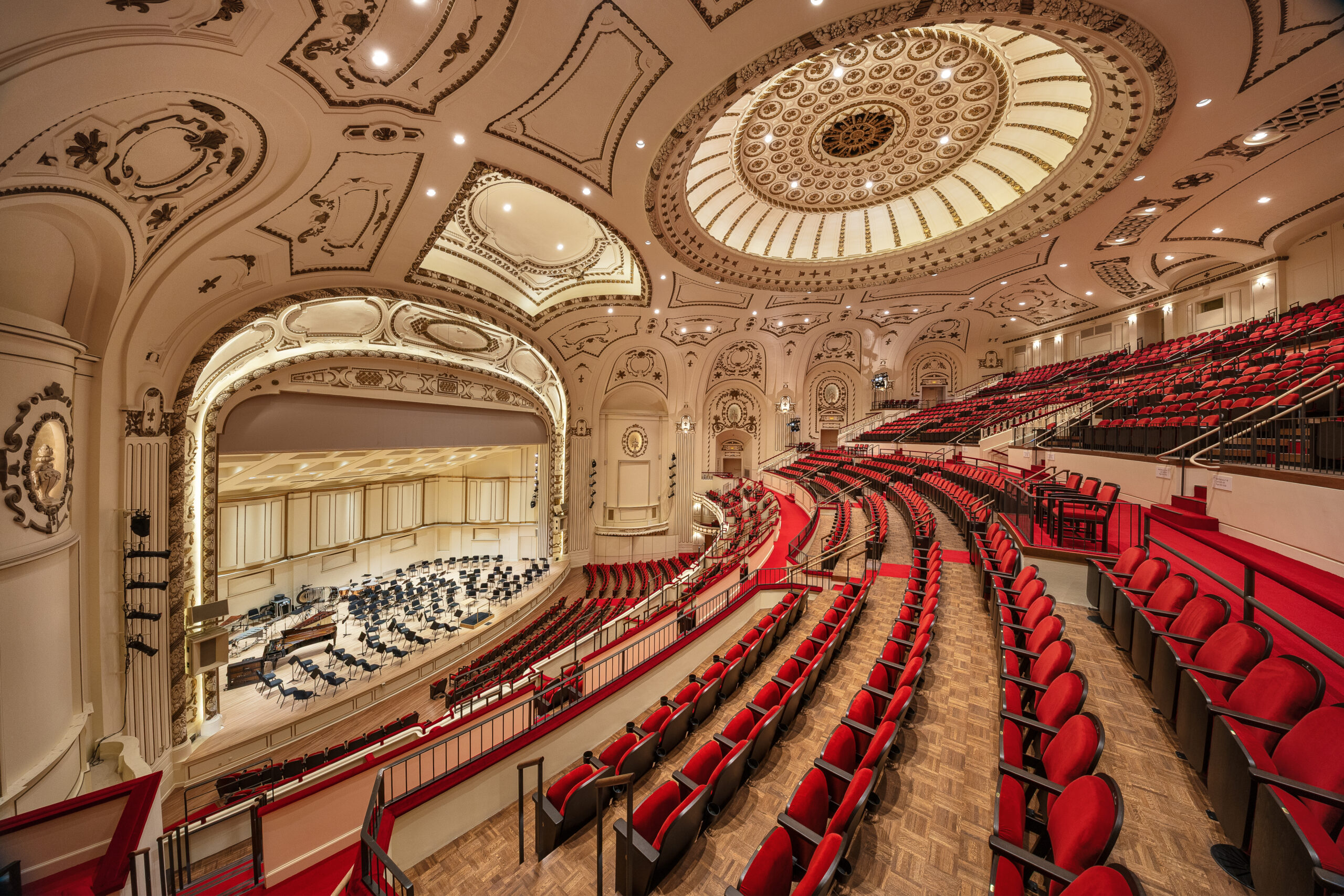
Updating the historic hall was a high-wire act. The air supply and acoustic calibration were meticulously recalibrated without damaging the room’s original character. As Dykers acknowledged, “If you mess up the acoustics, that’s it. There’s no purpose in executing the project.” The goal was to retain what musicians already found distinctive about the hall and enhance it further for contemporary performances. Early feedback from musicians indicates the success of this effort.
The Learning and Education Center: Expanding the Role of the Cultural Institution
The project also adds a Learning and Education Center, a wood-lined, multi-purpose space seating 300 with a street-facing window. This space is not just an additional hall; it is a statement about expanding the institution’s role. It will host a variety of contemporary performing arts programs and support community partners and youth teams. This addition confirms that Snøhetta’s project was not just about adding square footage but about providing more types of creative space for more types of people.
Heritage in a Contemporary Context: Redefining the Concert Hall’s Role in the 21st Century
Powell Hall sits at the crossroads of St. Louis’s complex history, engaging with a legacy of unequal access to cultural resources. The project acknowledges this context through its actions, not just its rhetoric. By opening facades and entrances in every direction, the building now acknowledges the surrounding communities, including those who long felt unwelcome.
Perhaps most importantly, the work reimagines what a concert hall should be in 2025. The historic hall remains intact, but everything around it shifts toward public life. The spaces between the ticket and the applause—the plaza, lobbies, lounges, and classrooms—have now become active civic zones. This is adaptive reuse as cultural urbanism, calibrated for the present and future of St. Louis. In Dykers’ words, the project was about “reusing as much as possible and adding as little as possible.” The goal was not to create a new architectural icon but to enhance a new relationship with musicians, neighbors, and the city itself.
✦ Archup Editorial Insight
This project tackles the challenge of expanding a beloved heritage building by adopting an approach that balances preservation of identity with the creation of a contemporary openness. The design raises a question about the effectiveness of the aesthetic separation between old and new, where the addition presents an architectural language entirely distinct from the historical context, creating a visual dialogue that can be read as a rupture rather than a continuity. The project relies heavily on visual and physical transparency to achieve openness; however, this logic weakens the building’s sense of being a secure refuge and the intimacy required for some cultural experiences, converting large portions of the space into zones of transit and constant observation. On the other hand, the project excels in its treatment of the performers’ backstage areas and technical infrastructure, where the focus shifted from the public facade to internal performance, restoring a balance between the audience’s experience and the quality of the artists’ work.
Brought to you by the ArchUp Editorial Team
Inspiration starts here. Dive deeper into Architecture, Interior Design, Research, Cities, Design, and cutting-edge Projectson ArchUp.


