Trnava School Campus Renewal: Functional & Ecological Design

Urban Context and Site Condition
The site is located within the cadastral zone of the city of Trnava on parcel No. 5671/92. It is classified as a built-up area and an open space within the urban fabric, with an approximate area of 13,555 square meters. The site forms the grounds of a primary school and includes part of a sports hall. Before the intervention, it contained outdated sports facilities, paved surfaces, and urban furniture elements, with a relatively flat topography and utility networks passing through it. Later, the surfaces, pathways, and urban elements were removed, while the artificial turf football field was retained.
Reorganization of the School Campus
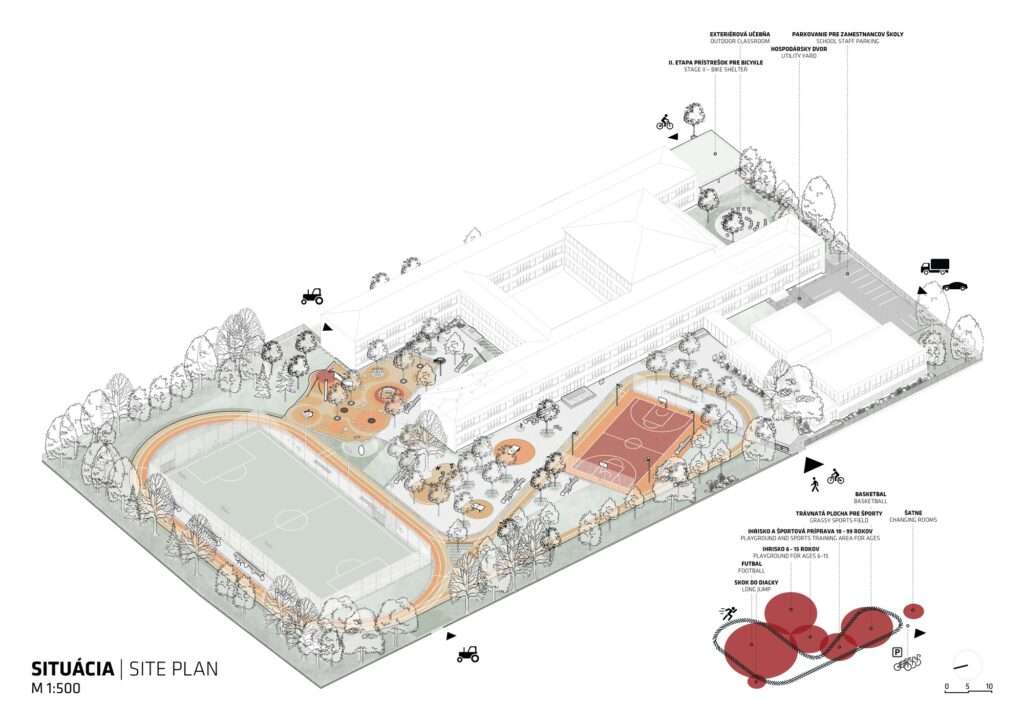
The proposal focuses on a comprehensive renewal of the school grounds through a clear redistribution of zones and their integration into logical functional relationships. Sports, recreational, and relaxation areas are organized within a coherent structure aimed at improving spatial legibility and movement clarity across the site. The design also seeks to produce a readable environment that supports daily circulation, relaxation, and social interaction, while maintaining the potential for public use.
Conceptual Structure and Functional Distribution
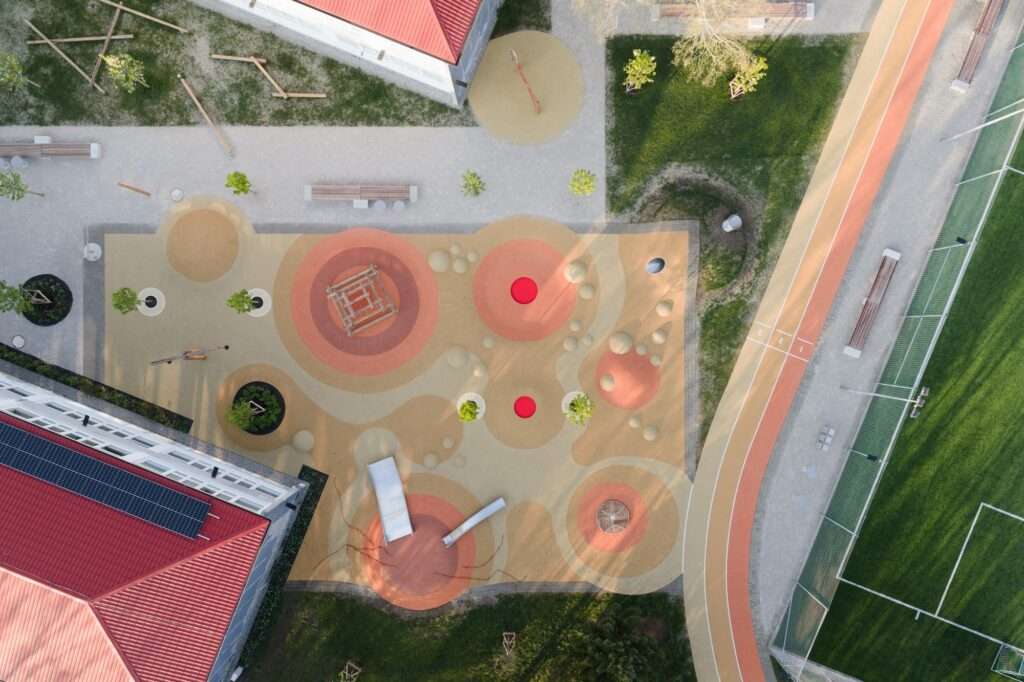
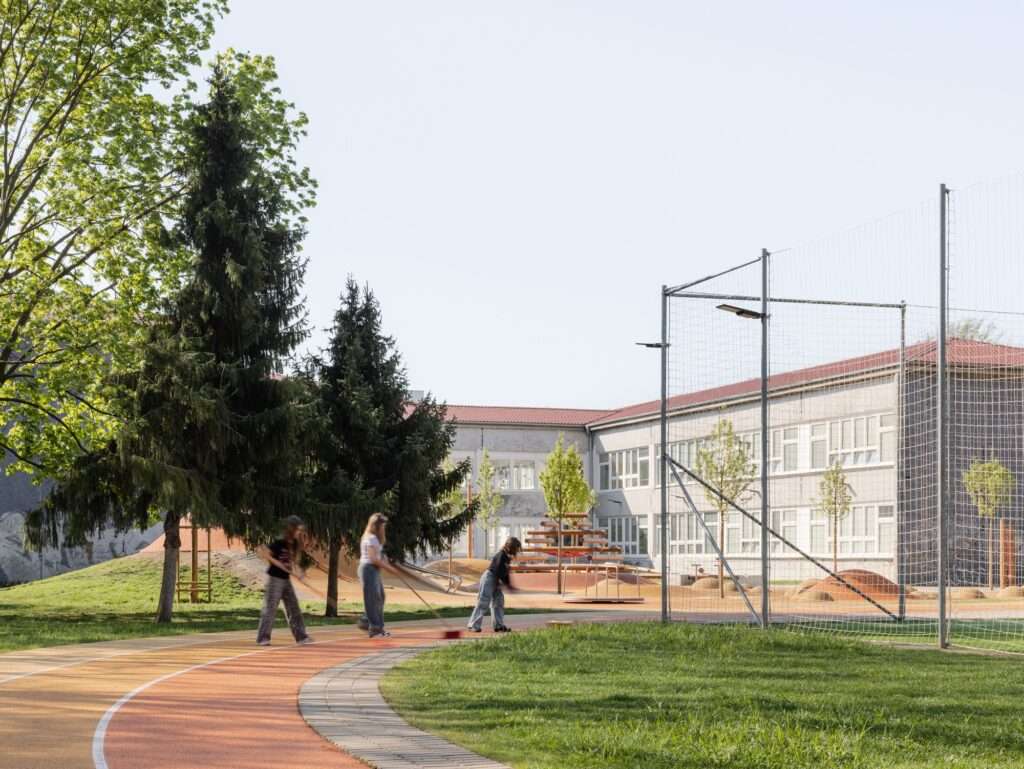
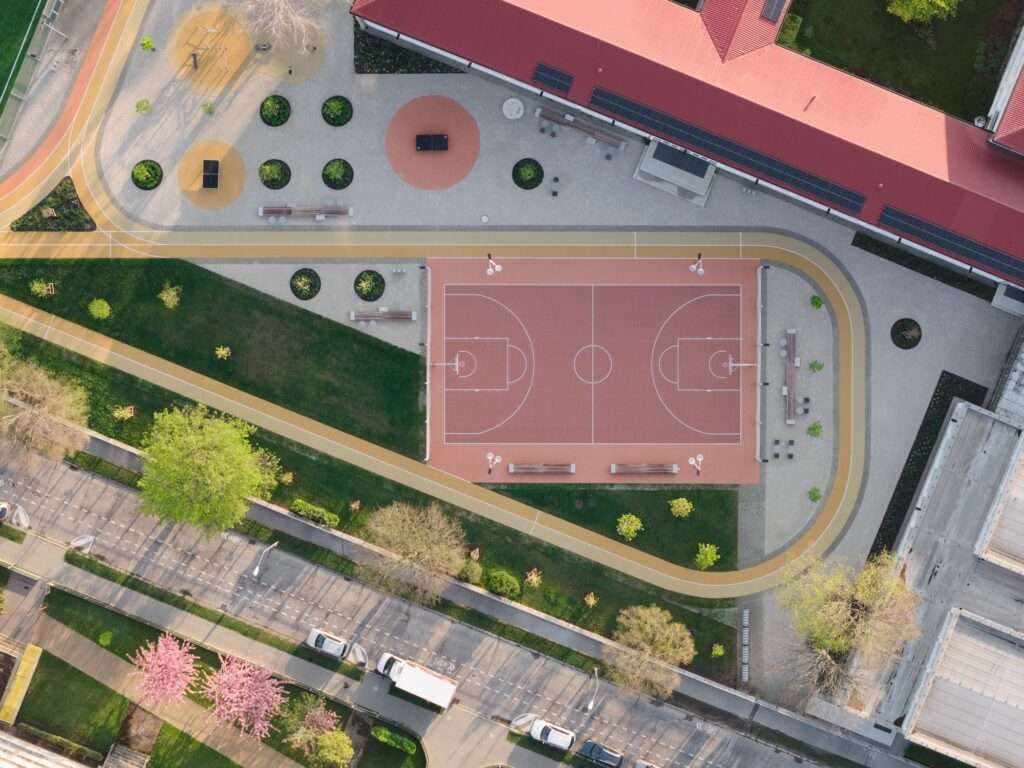
The overall concept is based on a linear organization of functions, where elements are arranged in a sequence that facilitates intuitive movement throughout the site. The running track acts as a central element in the form of a continuous strip that connects and unifies the various areas into a single system. Activities are distributed according to age groups and usage types, ensuring a clear functional organization within the campus.
Functional Integration Between Sports and Recreational Areas
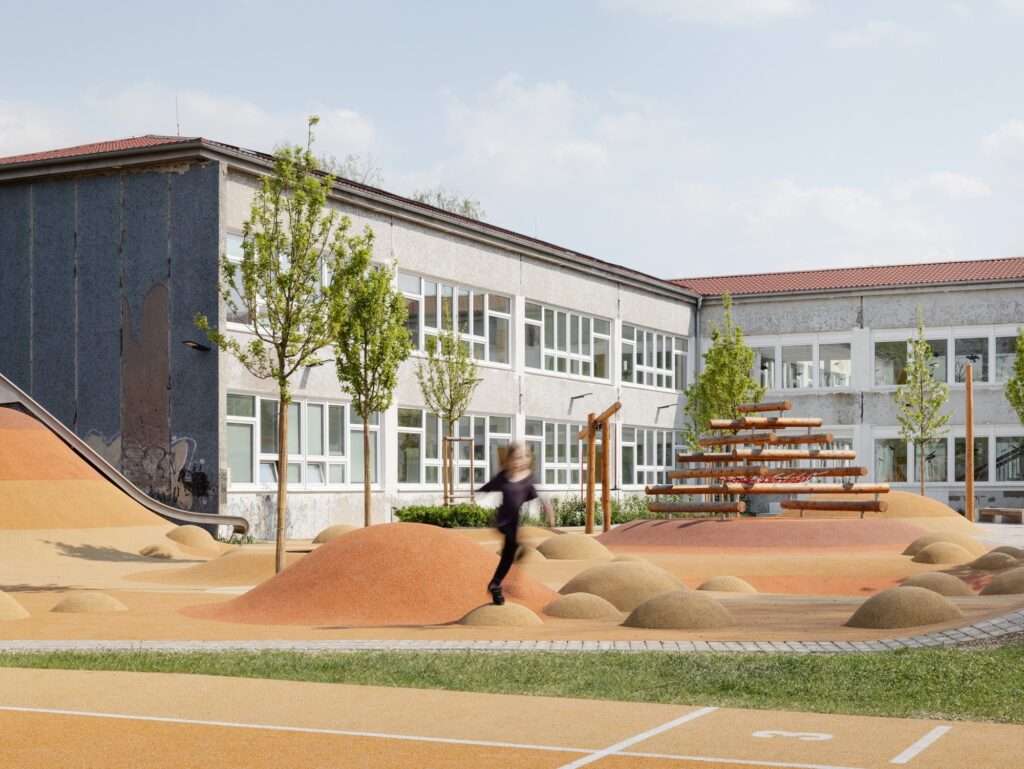
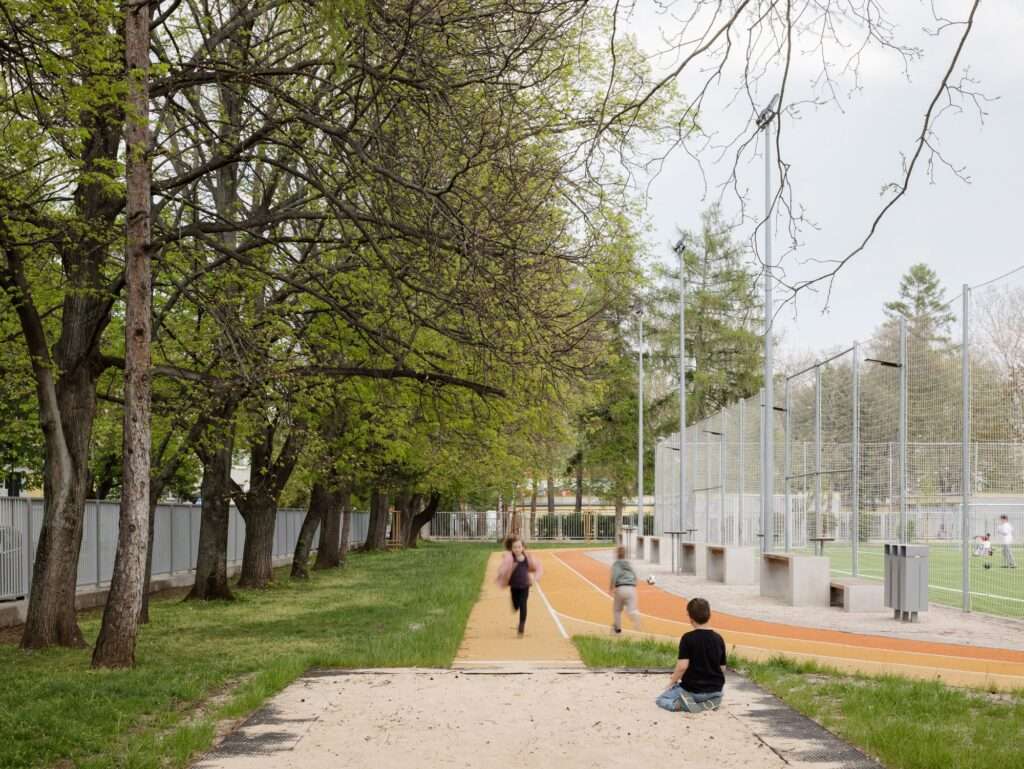
Dynamic sports areas are integrated with calmer recreational spaces, resulting in a functional balance across the site. The composition also takes into account the irregular shape of the plot and its direct relationship with the school building. The intervention includes upgrading the sports infrastructure, including the renovation of the football field surface, modification of fences, and the addition of a two-level spectator stand, along with other sports facilities such as a basketball court, a short sprint track, and a long jump area. Smaller recreational zones with EPDM surfaces are also distributed to support multiple activities such as physical exercise, teqball, and table tennis. Many of these buildings and facilities are designed for shared use between the school and the public.
Reorganization of the Forecourt and Material Gradation
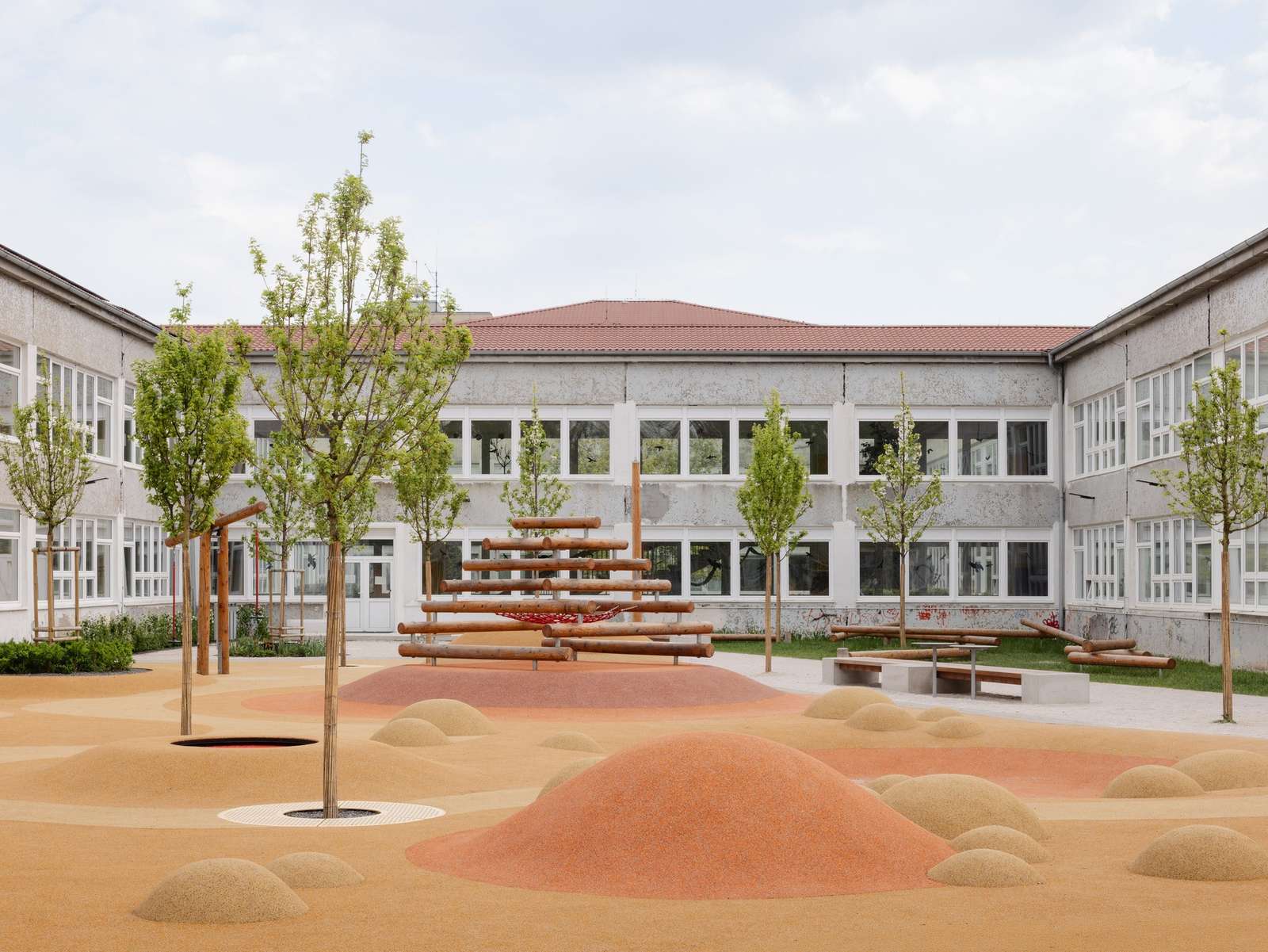
The school’s front courtyard has been opened by removing barriers and rehabilitating the surface through replacing asphalt with paving stones, complemented by newly introduced green areas. The material and color gradation within the design, from gravel surfaces to vegetated zones and then EPDM surfaces, enhances orientation clarity and ensures visual continuity across the space. Various building materials were carefully selected to achieve this gradation and improve the overall spatial quality.
Educational and Supportive Recreational Spaces
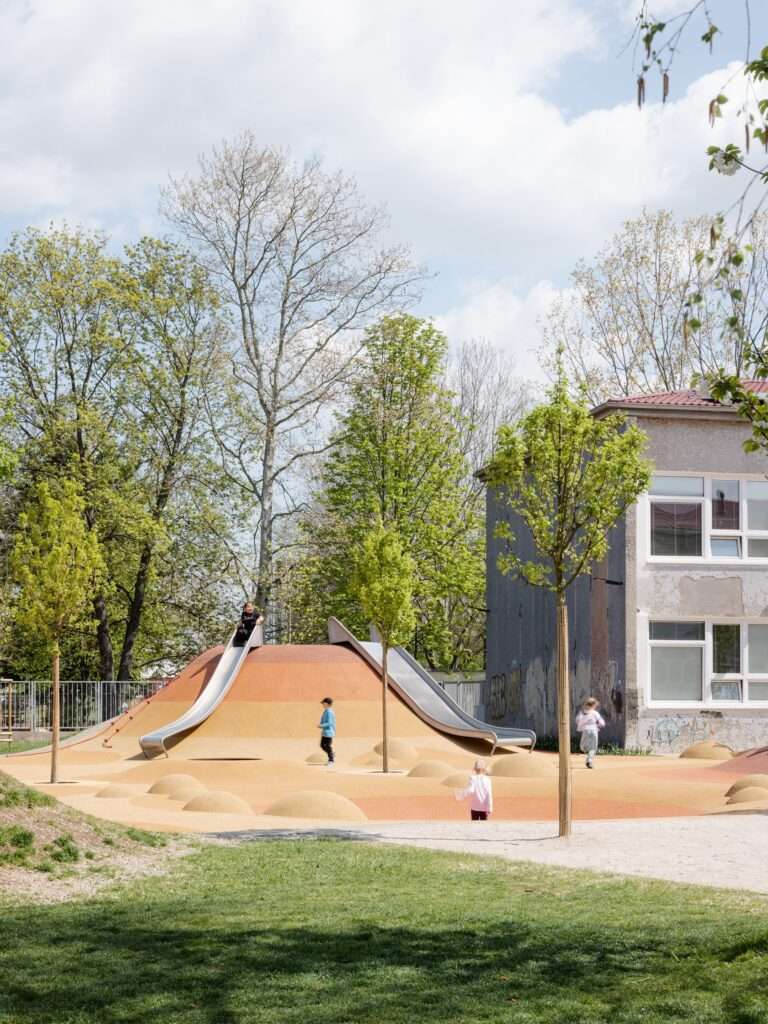
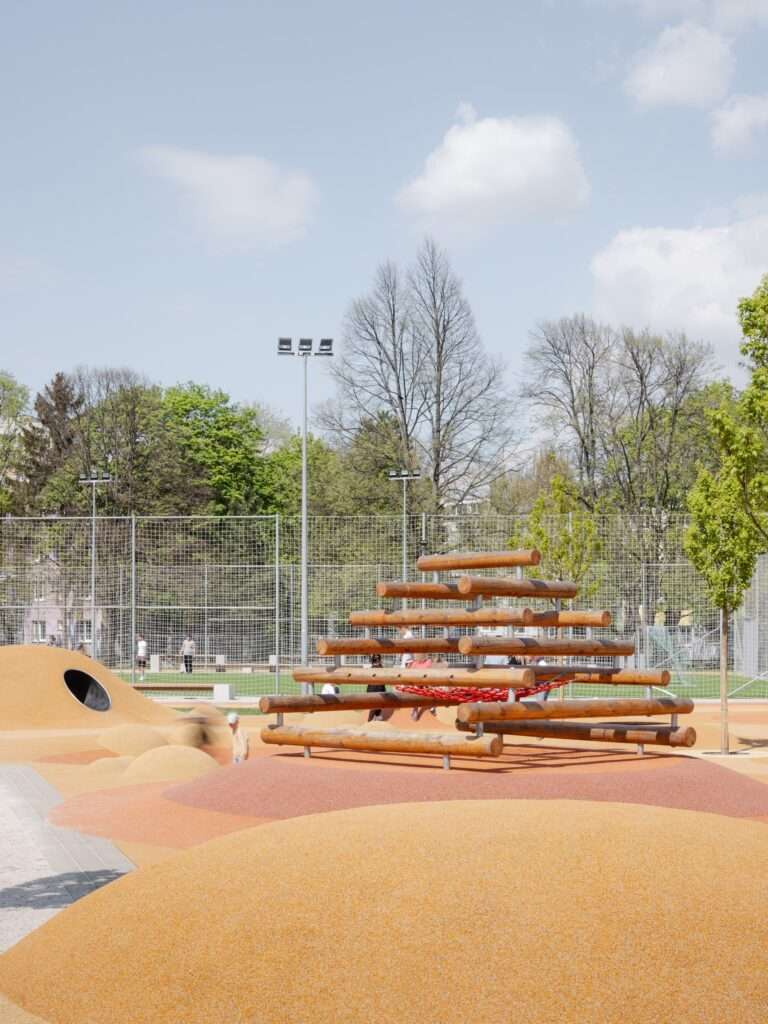
Adjacent to the school building lies a main recreational area with a gravel surface and flexible furniture that allows for multiple uses. In the southern part, an outdoor classroom has been designed in a circular form that supports flexible teaching methods outside the traditional framework. The younger children’s playground is designed as play-oriented topography, incorporating play elements and protective canopies, with the playground itself acting as the central feature of this space. These educational zones are complemented by detailed material datasheets that guide the selection of safe and durable surfaces.
Upgrading of Sports Hall Facilities and Accessibility
The proposal includes the reorganization of sports hall facilities by converting changing rooms into two separate units containing sanitary facilities, including provisions for users with disabilities. The design allows shared use of these facilities between the school and the public, ensuring full barrier-free accessibility. A large portion of the existing fence has been retained, with localized repairs carried out where necessary. The integration of sports, educational, and recreational activities reflects an institutional pressure to maximize the functional return of the space, as seen in similar projects.
Service Infrastructure and Site Management
The intervention includes the addition of designated parking spaces for staff, along with an organized waste management solution within the site. This organization improves daily operational efficiency and ensures clear definition of service functions. The partial retention of the fencing also supports the continuity of spatial boundaries while improving their functional condition. Efficient construction methods were employed to implement these service upgrades while minimizing disruption to school activities.
Vegetation Cover and Sustainability Principles
The vegetation design builds upon existing green areas while reinforcing them with new plantings aimed at improving the local microclimate. The overall concept is based on principles of functionality, sustainability, and clarity, adopting a nature-based approach to green space management. The tree layer is strengthened through carefully selected plantings along the site edges, using local and adaptive species that reflect site conditions and contribute to improving its microclimatic performance.
Vegetation Organization and Spatial Functions
Shrub planting is applied selectively, maintaining horizontal visibility, ensuring safety, and supporting spatial orientation within the site. The herbaceous layer consists of a mix of perennial beds, ornamental grasses, and bulb plants, applying principles of plant compatibility and self-organization. This composition produces a visually valuable vegetation structure while remaining low in operational and maintenance requirements. Such landscape strategies are often discussed in research focused on sustainable urban environments.
Classification of Lawn Areas by Use
Lawn areas are classified according to intensity of use into three categories: active recreational lawns, extensive low-intensity meadows, and gravel lawns. This classification improves maintenance efficiency while preserving the overall ecological stability of the site. The gradation of use also enables a clearer distribution of activities within the open spaces. This approach to architecture landscape integration ensures a balance between human activity and ecological function.
Ecological Integration and Green Infrastructure
The design integrates blue-green infrastructure principles, particularly in relation to rainwater retention, microclimate improvement, and biodiversity support. This integration results in a high-quality, environmentally sustainable functional landscape that enables shared daily use between the school and the public within an environmentally and operationally balanced framework.
✦ ArchUp Editorial Insight
The site in Trnava operates as a regulatory reconfiguration of a low-efficiency municipal plot within a school environment, where the previous infrastructure of facilities and hard surfaces has been dismantled in order to reduce maintenance burdens and recalibrate usage risks across both school and public users. The intervention is not presented as a purely design-driven act, but rather as a direct response to compliance requirements, movement efficiency, and the separation of usage flows within a single campus. The linear axis represented by the running track functions as an operational organizing device that integrates fragmented functions into a single administratively controllable system, increasing land-use efficiency within public budget constraints. The integration of sports, educational, and recreational activities reflects an institutional pressure to maximize the functional return of the space. Vegetation elements and blue-green infrastructure operate primarily as environmental mitigation mechanisms, supporting stormwater management and improving local microclimatic conditions, rather than purely compositional decisions, thereby establishing the site as a standardized urban interface designed for shared use.