Young Projects Integrates Cut Out House into the Canadian Rocky Mountains

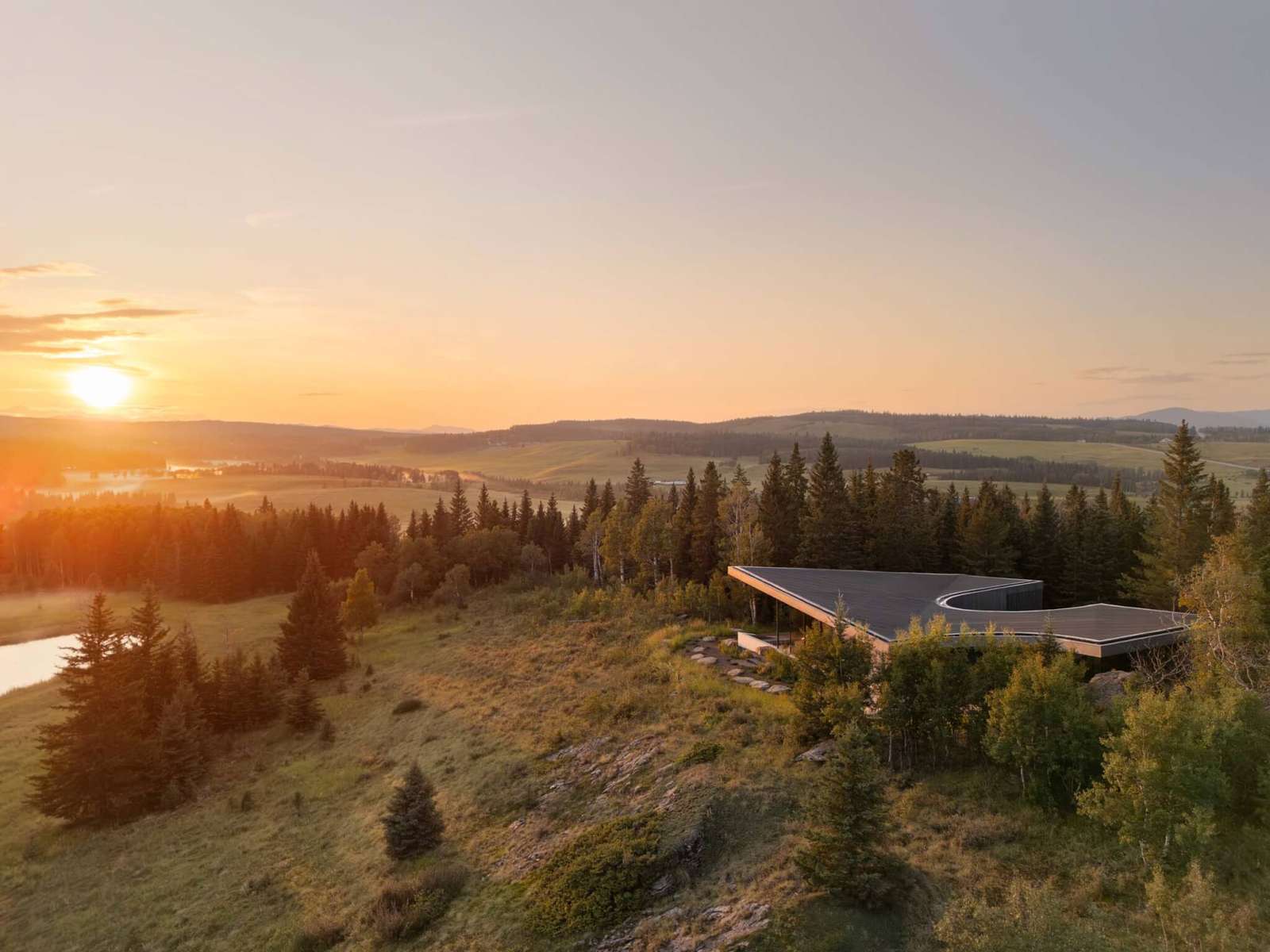
New York-based firm Young Projects completed Cut Out House, an irregularly shaped family vacation home nestled along the foothills of the Canadian Rocky Mountains. The structure occupies a site in a low-density forest where the building footprint directly engages with an uneven treeline. The design team utilized a series of subtractions to navigate the local topography and environmental constraints.
Gray Accoya clads the entire exterior building envelope, providing a muted tonal palette that sits quietly within the wooded landscape. A prominent butterfly roof tops the residence, serving as the primary formal element of the architecture. This roofline mirrors the angles of the surrounding sloping terrain while performing specific interior functions.
Interior volumes respond to forest density
The internal organization follows the site’s natural visual cues and physical barriers. Young Projects positioned private living areas in sections where dense tree clusters naturally limit sightlines. This strategy uses the forest as a literal screen for privacy without requiring additional construction elements.
By contrast, the communal spaces occupy the areas where the roofline slopes upward. These high-volume zones open the interior to expansive, panoramic views of the mountain range. The geometry of the angled planes effectively directs the gaze of the occupants outward, reinforcing the connection between the domestic space and the wilderness.
The project title refers to the sculptural “cut outs” that define the perimeter of the home. These subtractions allow the building to weave around existing natural features rather than displacing them. This approach transforms site challenges into the central aesthetic and functional logic of the retreat.
✦ ArchUp Editorial Insight
Cut Out House demonstrates a sophisticated response to the “building in nature” typology by treating the site’s irregularities as a formal generator. Young Projects rejects the standard box in favor of a subtractive geometry that negotiates the treeline and topography simultaneously. The butterfly roof serves a dual purpose: it achieves a contextual silhouette that mimics mountain ridges and dictates a hierarchy of interior views. By aligning communal programs with upward roof slopes and private zones with dense forest blocks, the design creates a precise spatial calibration. This project highlights how material uniformity, specifically the monochromatic Accoya cladding, allows complex forms to remain grounded and respectful of their environmental context.
Project Team: Young Projects (Architecture and Design). Location: Canadian Rocky Mountains.
Project Notes: Completed June 2026. Features Accoya cladding and butterfly roof structure.