The Furniture Still Works. Can It Change?

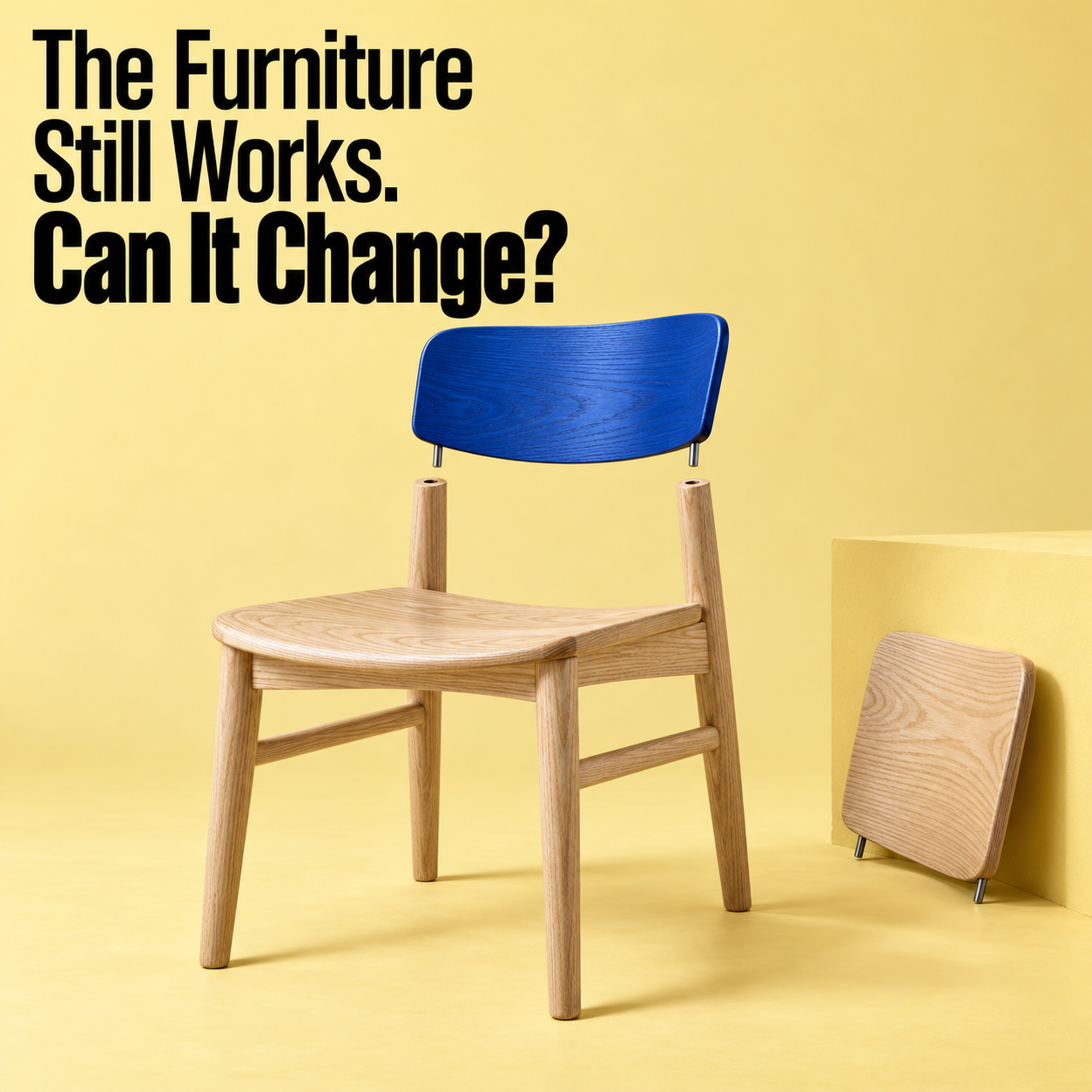
Research preparation and design analysis: the ArchUp research team.
The desk is still standing. Its frame has not failed, its legs are straight, and its surface can carry everything it was bought to hold. What has changed is the work around it. A second screen needs support. Cables need a route. The person using it needs a different working height. Replacing the entire desk can appear easier than changing one relationship between its parts. This hypothetical scene identifies the problem that design for upgrade attempts to address: a product can remain physically intact after its usefulness has become difficult to extend.
The issue is not simply whether furniture lasts. It is whether useful change remains possible without discarding the parts that still perform well. A durable object and an adaptable object are not necessarily the same thing. A heavy cabinet may survive for decades while resisting every change of layout. A modular cabinet may come apart easily but depend on connectors that are no longer available. Designing for upgrade means considering that future transaction while the first version is still being designed.
Physical Life and Useful Life
The supplied research review places upgradability among strategies intended to extend product use, alongside durability, maintenance, repair, compatibility and disassembly. Its central distinction is between the design strategy and the property it seeks to create. Design for upgradability is the deliberate organisation of a product so that later improvement is feasible. Upgradability describes its potential to accommodate that improvement effectively. Neither term should be reduced to the availability of optional accessories at the moment of purchase. [1, 2, 3]
Furniture makes this distinction particularly visible because use is closely connected to changing circumstances. A move, a different working arrangement, a growing household or altered physical needs may change what an object is expected to do. These are possible reasons for replacement, not a claim that every discarded piece has become obsolete in the same way. The design question is which foreseeable changes justify preparation and which would make the original object unnecessarily complicated.
Repair Is Not the Same as Upgrade
Repair restores a function that has been lost or impaired. Replacing a broken hinge allows a door to work again. An upgrade improves or adds capability: a changed internal arrangement may allow the cabinet to serve another purpose, while a different hinge system may improve access. Refurbishment can renew condition or appearance without changing capability. Reconfiguration rearranges components. These actions may overlap in a real intervention, but separating them prevents every replaceable part from becoming evidence of an upgrade strategy. [2, 4]
Nor does a better looking replacement automatically constitute a technical improvement. A new front may extend the owner’s willingness to keep a cabinet, which is a meaningful outcome, but that is different from increasing load capacity or accessibility. A credible specification should name the intended change. Otherwise, upgrade becomes a promotional word that conceals whether the intervention preserves useful material, satisfies a new requirement or merely encourages another purchase.
The Platform That Remains
A useful working interpretation for furniture is a persistent structure combined with layers that can change. The structure might be a frame, carcass or supporting system. The changing layers might include upholstery, fronts, storage elements, work surfaces or accessories. This is an editorial synthesis of the supplied literature, not a universally adopted definition or a requirement that every item follow the same construction. A chair and a storage wall have different loads, failure modes and patterns of use. [2, 3, 6]
The platform must also be worth retaining. If it is damaged by every disassembly, excessively heavy to move, or incompatible with likely future components, its theoretical persistence offers little practical benefit. Conversely, a sound structure can retain value when the surrounding finishes or functions change. The designer’s task is to locate the boundary between what should remain and what should be allowed to evolve, then explain why that boundary fits the product.
Modularity Is a Means, Not a Guarantee
Modular design can support adaptation by dividing a product into components with defined relationships. It can also serve manufacturing efficiency, packaging or assembly without enabling useful changes after sale. A product assembled from many parts may still have only one viable configuration. Another may offer many configurations but require replacement of nearly every component when moving between them. Counting modules is therefore a poor substitute for examining the actual route to improvement. [2, 4, 7]
The relevant question is what happens at the interface. Can a new component connect without modifying the retained structure? Are dimensions and tolerances documented? Does the connection preserve safety and performance? Can the owner obtain the correct version? A visually identical fitting may conceal a different thread, depth or load rating. Compatibility is an engineering and information commitment, not simply a resemblance between two parts in a catalogue photograph.
The Joint Is Where the Promise Is Tested
The supplied account of Uysal and colleagues describes comparative testing of wooden chair joints, considering durability alongside disassembly, repair and reuse. Its useful lesson is the need to assess these objectives together. A joint selected for strength alone may frustrate future separation. A connection selected for convenient disassembly may introduce other demands concerning stiffness, wear or repeated assembly. The reported experiment does not establish a universal ranking for every furniture type, material or loading condition. [8]
For practice, this suggests specifying the expected sequence of opening and closing a connection, not merely the first assembly. Can the fastener be reached after installation? Is a sacrificial insert replaceable? What happens if a thread is damaged? Does an instruction distinguish a reusable connector from one that must be renewed? The answers turn a claim of circularity into a procedure that a technician or owner can actually follow.
Preparing for Change Without Overbuilding Everything
The research review includes the idea of a component that assists a future upgrade by accommodating its consequences. In product design, this can involve allowing for a future demand that the first configuration does not yet impose. Furniture offers an analogous design question: should a frame include attachment points or capacity for a later accessory? This is a transfer of design logic, not evidence that a numerical result from an electronic product applies to desks or seating. [5]
Preparation carries a cost. Extra material, unused holes, more complex fittings and additional assembly work exist in the first product whether or not the upgrade occurs. The correct comparison is therefore not between preparedness and no preparedness in the abstract. It is between plausible use scenarios, including the possibility that the owner never changes the product. An upgrade strategy should identify which future needs are sufficiently likely and valuable to justify their present burden.
Replaceable Layers Need Different Clocks
A furniture item contains parts that may change at different rates. A structural frame, fabric cover, mechanism and electronic accessory need not share one replacement interval. Separating these layers can prevent the shortest lived element from determining the fate of the entire object. Yet separation should follow the likely intervention, rather than a desire to make every part independent. A system with excessive fragmentation can become difficult to assemble, clean, store or maintain. [1, 6]
The supplied review makes a restrictive claim about what furniture refurbishment can change. That claim should not be treated as a universal technical boundary. Depending on construction and expertise, interventions may extend beyond colour or upholstery. The more defensible question is what can be changed safely and economically in the particular product. A manufacturer should state those limits, including changes that require reassessment rather than presenting every imaginable transformation as an approved option.
An Upgrade Catalogue Is a Long Term Obligation
A catalogue of future possibilities is useful only if components, instructions and service remain available when needed. The value of a standard hole pattern is limited if nobody knows its dimensions or can identify the relevant generation. Product identification, compatibility records, assembly drawings and replacement part descriptions belong to the design proposition. Their absence can make a physically simple repair harder than buying a new object. [2, 3, 9]
This also raises a commercial question. Does the customer depend on one supplier, or can an appropriately qualified third party manufacture a compatible part? An open interface and a proprietary interface can both be documented, but they distribute future dependence differently. Neither should be described as universally superior without considering safety, quality assurance and the product’s use. The important point is that the purchaser can understand the dependence before accepting the promise of a longer life.
The Service Must Survive the Sale
Product and service systems appear in the supplied literature as one way to align income with continued use. Rental, take back, maintenance and refurbishment arrangements can give a supplier a reason to recover and retain products. They can also introduce transport, storage, cleaning, administrative and financial costs. A contract labelled circular does not demonstrate that these activities are viable or environmentally beneficial in a particular market. [2, 9, 10]
The office furniture discussion by Besch is especially useful as a historical examination of barriers and opportunities. Its age matters. It should not be used to announce current market averages, customer behaviour or regulatory requirements without newer evidence. Its enduring analytical contribution is the need to connect the object to the organisation supporting it. A well designed joint cannot compensate for an unavailable collection service or a replacement part whose delivery makes the intervention impractical.
The Environmental Benefit Must Be Compared
Keeping a serviceable frame may avoid manufacturing another one. That is a plausible mechanism, not a universal carbon saving. A proper comparison would include added components, transport, processing, packaging, energy and the remaining useful life delivered. It would also ask whether the upgrade actually replaces a new purchase or becomes an additional purchase alongside it. The supplied research supports examining these relationships; it does not provide one transferable percentage for all furniture. [1, 5, 11]
This is why the article does not repeat the source synthesis’s broad numerical claims about environmental impact or translate an older policy discussion into a statement of current legal obligation. Design strategies and applicable regulation are separate questions. For a real project, compliance must be checked for its jurisdiction, date and product category. The design argument remains meaningful without implying that every strategy discussed here is already a mandatory furniture standard.
A Hypothetical Desk Across Three Uses
Consider a hypothetical desk moving from individual home working to shared office use and then to a smaller room. This is an editorial scenario, not a tested product. In the first phase, the user needs a work surface, cable management and a screen support. In the second, storage and separation become more important. In the third, footprint and access govern the arrangement. The exercise tests whether the original structure can remain useful as the surrounding requirements change.
A credible upgrade plan would identify which components remain, which are exchanged and which cannot be reused. It would specify the tools and skills required, and whether each new configuration stays within approved loads and stability limits. It would also describe the destination of removed parts. Calling the desk adaptable while leaving a collection of unusable panels behind merely moves the disposal problem from the whole object to its modules.
The scenario should also include a refusal case. If adaptation requires extensive reinforcement, specialist labour and distant shipping, continued use in the original role or transfer to another user may be preferable. Designing for upgrade does not mean requiring an upgrade. It means adding a feasible route when change is useful, while preserving other routes such as repair, direct reuse and responsible replacement.
What a Buyer Should Ask For
A purchasing brief can turn the argument into a manageable set of evidence requests. Ask the supplier to demonstrate one realistic change of use, identify retained components and disclose compatibility limits. Ask how parts are identified and ordered, what tools are needed and which operations affect warranties or require professional assessment. These are editorial procurement suggestions, not a certified assessment framework. Their purpose is to make a broad claim inspectable.
The buyer should also distinguish commitments from intentions. A declared service period, an accessible drawing and an available replacement module are different from an attractive rendering of a future configuration. None guarantees indefinite support, but each clarifies what is being offered. The more a product depends on future service, the more that service belongs in the original commercial discussion rather than in a footnote after the purchase.
A Longer Life Requires a Designed Next Step
The strongest case for upgradable furniture is not that every object should transform into something else. It is that predictable changes should not automatically make sound material disposable. That requires decisions about structures, interfaces, maintenance, information and responsibility. The product begins the process, but suppliers, technicians, purchasers and users determine whether its designed potential becomes a practical next step.
A piece of furniture earns the description upgradable when improvement is credible after the showroom moment has passed. It must be possible to know what can change, obtain what is needed and carry out the intervention without defeating the reasons for retention. Longevity then becomes more than a quality of the material. It becomes a continuing arrangement between the object and the people responsible for its next use.
Method and Reading Limits
This analysis uses the research synthesis supplied to the editorial team. The original papers were not independently read in full for this article. References identify the works discussed in that synthesis. Definitions and design distinctions are paraphrased; the furniture specification, purchasing questions and hypothetical desk are editorial interpretations. The synthesis’s mathematical indices are not presented as universally accepted standards, and numerical findings from individual experiments are not generalised across furniture products.
Sources
- Royo M, Mulet E, Chulvi V, Ruiz-Pastor L. A metric for assessing the upgradability and adaptability of circular concepts. Resources, Conservation and Recycling. 2024;205:107512 DOI: 10.1016/j.resconrec.2024.107512
- Khan MA, Mittal S, West S, Wuest T. Review on upgradability – A product lifetime extension strategy in the context of product service systems. Journal of Cleaner Production. 2018;204:1154-1168 DOI: 10.1016/j.jclepro.2018.08.329
- Aziz NA, Wahab DA, Ramli R, Azhari CH. Modelling and optimisation of upgradability in the design of multiple life cycle products: a critical review. Journal of Cleaner Production. 2016;112:282-290 DOI: 10.1016/j.jclepro.2015.08.076
- Gu P, Xue D, Nee AYC. Adaptable design: Concepts, methods, and applications. Proceedings of the Institution of Mechanical Engineers, Part B: Journal of Engineering Manufacture. 2009;223(11):1367-1387 DOI: 10.1243/09544054JEM1387
- Inoue M, Yamada S, Yamada T, Bracke S. Product Upgradability for Satisfying Future Performance, Low Price and Environmental Loads, and Manufacturer Profitability Throughout the Product Lifecycle. Procedia CIRP. 2016;48:40-44 DOI: 10.1016/j.procir.2016.03.015
- Liu L. The Exploration of Recycling Design of Furniture Products Based on Structure. Advanced Materials Research. 2012;605-607:44-48 DOI: 10.4028/www.scientific.net/amr.605-607.44
- Yu G, Dai C, Huang S, Gan L, Gao W. Research on Innovative Application of Modular Design in University Student Apartment Furniture. IOP Conference Series: Materials Science and Engineering. 2019;573(1):012016 DOI: 10.1088/1757-899x/573/1/012016
- Uysal M, Haviarova E, Eckelman CA. A comparison of the cyclic durability, ease of disassembly, repair, and reuse of parts of wooden chair frames. Materials & Design. 2015;87:75-81 DOI: 10.1016/j.matdes.2015.08.009
- Marques M, Poler R, Agostinho C, Jardim-Goncalves R. An architecture to support the development of reconfigurable and updatable product-service systems in furniture sector. In: 2017 International Conference on Engineering, Technology and Innovation (ICE/ITMC). IEEE; 2017:1076-1081 DOI: 10.1109/ice.2017.8280001
- Besch K. Product-service systems for office furniture: barriers and opportunities on the European market. Journal of Cleaner Production. 2005;13(10-11):1083-1094 DOI: 10.1016/j.jclepro.2004.12.003
- Attilio Ceconello M. Circular Economy Solutions and Strategies for the Furniture Sector in the European Union. DIID. 2022;1(78) DOI: 10.30682/diid7822k