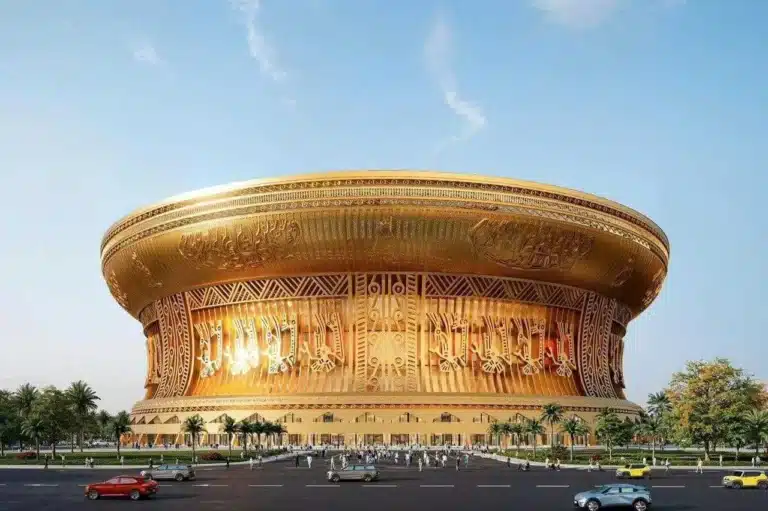
Washington’s New NFL Stadium: Neoclassical Design at RFK

Washington’s New NFL Stadium will replace RFK Stadium with a 65,000 seat venue designed by HKS. Construction begins in 2026. The team plans to open it by 2030 as part of a $3.7 billion, 180 acre mixed use redevelopment in southeast Washington. The plan includes housing, retail, and year-round events infrastructure.

Aligning with D.C.’s Architectural Language
The National Capital Planning Commission (NCPC) advises that Washington’s New NFL Stadium adopt neoclassical features. These include symmetry, proportion, and monumental scale. The goal is visual alignment with federal buildings and monuments. Designers will draw from Greek and Roman precedents. This approach embeds the stadium within the capital’s historic aesthetic.

A Multifunctional Urban Node
The stadium anchors a district built for continuous use. A translucent roof enables climate-controlled operations. It will host concerts, conventions, and potential Super Bowl games. This reflects modern strategies in cities planning. Large venues now act as catalysts for urban vitality.

Performance vs. Context
The Commanders previously called their vision the loudest, most dynamic stadium. They have not confirmed how classical motifs will appear. The NCPC can influence façade treatment and public plazas. Technical performance, spectator flow, and revenue remain top priorities. Washington’s New NFL Stadium tests whether sports infrastructure can engage heritage contexts meaningfully.
The architecture platform tracks the project as a civic benchmark. Its outcome may shape future design competition briefs. Material choices will mediate between innovation and tradition. Ongoing research analyzes this balance. Unlike generic arenas, Washington’s New NFL Stadium must negotiate institutional weight not just function.
Architectural Snapshot
Washington’s New NFL Stadium treats neoclassicism not as ornament but as urban syntax embedding sport within the capital’s spatial grammar.

✦ ArchUp Editorial Insight
Washington’s New NFL Stadium is the logical outcome of federal oversight mechanisms, long-horizon public financing, and risk-managed urban redevelopment models converging on a symbolically sensitive site.
Large-scale sports infrastructure in Washington operates under exceptional approval density. NCPC review protocols prioritize institutional continuity, reducing formal uncertainty and narrowing acceptable architectural expressions. Simultaneously, a $3.7 billion mixed-use financing stack demands predictable ROI, year-round activation, and insurance-compatible operational control driving enclosure, programmability, and revenue diversification.
Culturally, the capital protects visual order as a governance tool. Classical alignment functions less as taste than as regulatory shorthand, signaling compliance, stability, and political neutrality. This minimizes approval friction and accelerates entitlement timelines.
The stadium emerges not from stylistic intent, but from procurement logic + regulatory pressure + symbolic risk avoidance. Architecture appears last as the stabilized interface between spectacle-driven economics and institutional continuity.