Wege Prize 2027

Competition Brief
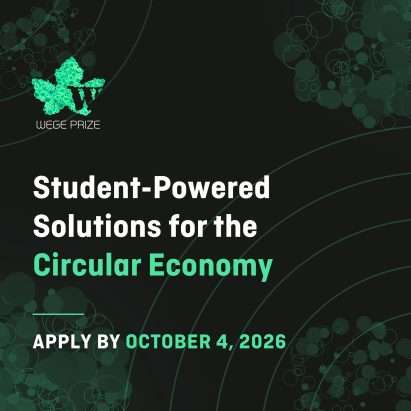
Wege Prize 2027 is an annual international competition organised by the Wege Center for Sustainable Design at Ferris State University’s Kendall College of Art and Design, with support from The Wege Foundation. It challenges transdisciplinary teams of university students to develop circular economy solutions to complex, real-world problems — functioning simultaneously as a design competition and a structured global learning experience. The 2027 edition opens for team applications on 3 August 2026.
The competition draws on the framework of the circular economy — a systemic alternative to the linear take-make-waste model — as both the lens and the design constraint. Teams are not assigned a specific site or product category; instead, they identify a “wicked problem” of their choosing and propose a product or service whose circular design logic is its defining differentiator. Past winning solutions have ranged from bio-based leather derived from banana crop waste to integrated mealworm-and-maize farming systems addressing malnutrition. The breadth of eligible approaches is deliberate: the organisers explicitly state that all circular projects are welcome, whether developed from scratch or applied to an existing system.
Intent
Wege Prize is structured around the premise that complex systemic problems require teams whose composition mirrors the cross-functional nature of those problems. The mandatory requirement for members from at least three academic disciplines and two separate institutions is not incidental — it is the pedagogical core of the competition. The judging criteria reinforce this: “Collaboration” is one of seven evaluated dimensions, assessed on how effectively teams leverage their diverse makeup and engage external perspectives. The competition aims to produce not just a winning proposal but a transferable experience of transdisciplinary problem-solving.
Purpose
Unlike competitions that conclude with a winning rendering or report, Wege Prize is designed to produce solutions with real-world traction. The three past winners — Rutopia (2018), Banofi Leather (2023), and AgPress (2025) — have each continued operating as functioning entities after the competition. The four-phase structure, in which judges provide written feedback at every stage rather than simply scoring submissions, is oriented toward developing viable proposals rather than identifying the most polished initial concept. Travel support of up to $3,000 USD and two hotel rooms is provided to each finalist team for the awards event in Grand Rapids, Michigan.
Requirements
Teams of exactly five students must represent a minimum of three academic disciplines and two institutions of higher education — with colleges within a single university counted as separate institutions. All members must be enrolled full-time for the majority of the competition period; members graduating before May 2027 must remain enrolled through at least 6 December 2026. Entry is free. Phase 1 requires written responses to eight structured questions covering the problem, system, proposed solution, existing alternatives, impact, and next steps. Phase 2 and beyond require a designed Project Overview document (6 pages in Phase 2, expandable to 8 in Phase 3), along with short reflective videos in Phases 3 and 4. Phase 4 finalists present in person for 10 minutes followed by a 10-minute judge Q&A.
Jury
Individual jury member names have not been published on the competition page or in the official Design Brief for the 2027 edition. The Brief describes judges as providing “in-depth feedback” at each phase and selecting semifinalists and finalists at the close of Phases 2 and 3 respectively. Jury composition details are expected to be published as the competition cycle progresses.
Lم يُؤكد — تحقق من الموقع الرسمي: wegeprize.org
Registration Fees
| Entry Type | Fee |
|---|---|
| All teams (individual or business entity) | Free — no registration fee |
Apply at wegeprize.org. Teams registering as a business entity must hold a valid U.S. tax identification number (EIN) to receive prize payments as a lump sum. Non-business teams receive prize money split equally among all five members on an individual basis. Tax obligations vary by location and entity type.
Prizes and Rewards
| Award | Prize (USD, before tax) |
|---|---|
| 1st Place | $30,000 |
| 2nd Place | $20,000 |
| 3rd Place | $10,000 |
| Finalist Award × 2 | $2,500 each |
| Total Prize Pool | $65,000 |
| Finalist Travel Support | Up to $3,000 in travel reimbursement + 2 hotel rooms in Grand Rapids per finalist team |
All prizes are subject to applicable taxes. Prize distribution method (individual payments vs. lump sum to business entity) depends on how the team registered. Written consent from all members is required if non-entity members wish to redirect their share to a registered business.
Key Dates
| Milestone | Date |
|---|---|
| Team application period opens | 3 August 2026 |
| Phase 1 deadline — Team Application | 4 October 2026 |
| Phase 1 judge feedback returned (accepted teams only) | 18 October 2026 |
| Phase 2 deadline — Project Overview 1st Draft | 6 December 2026 |
| Phase 2 judge feedback + semifinalists selected | 3 January 2027 |
| Phase 3 early review submission (optional) | 25 January 2027 |
| Phase 3 early review feedback returned | 31 January 2027 |
| Phase 3 deadline — Project Overview 2nd Draft (semifinalists) | 21 February 2027 |
| Phase 3 judge feedback + finalists selected | 15 March 2027 |
| Phase 4 early review submission (optional) | 12 April 2027 |
| Phase 4 early review feedback returned | 18 April 2027 |
| Phase 4 deadline — Final Project Overview + presentation materials (finalists) | 16 May 2027 |
| Final Presentation and Awards Event | Friday, 21 May 2027 — Kendall College of Art and Design, Grand Rapids, Michigan, USA |
Submission Materials
| Phase | Deliverable | Format / Specs |
|---|---|---|
| Phase 1 | Team Application — written responses to 8 questions covering problem, system, scope, solution, innovation, UN SDG impact, stakeholder engagement, and next steps | Via online application at wegeprize.org |
| Phase 2 | Project Overview 1st Draft — pitch + written and visual responses across 9 sections | 6 pages | 8.5 × 11 in | Min. 11pt font |
| Phase 3 | Project Overview 2nd Draft — revised document + 2 additional pages on financials and material flows + short reflective video (3–5 min, one team member, no production required) | Up to 8 pages | Same dimensions and font guidelines as Phase 2 |
| Phase 4 | Final Project Overview (revised from Phase 3) + slideshow presentation + optional physical prototypes + short reflective video (3–5 min) | Same page specs as Phase 3 | 10-min live presentation + 10-min judge Q&A at awards event |
✦ ArchUp Competition Review
Wege Prize occupies an unusual position in the landscape of student design competitions: it is genuinely indifferent to discipline. An architect, a biochemist, an economist, and a sociologist are as eligible — and arguably as well-suited — as a team of five designers. The mandatory transdisciplinary structure reflects a coherent pedagogical argument: that the problems most worth solving resist single-discipline framing, and that the act of building across institutional and academic boundaries is itself part of the education. The circular economy framework is broad enough to accommodate almost any product or service typology, which keeps the field of eligible ideas wide while still imposing a rigorous design logic.
The feedback-at-every-phase model is the competition’s most distinctive structural feature. Most competitions score and rank; Wege Prize scores, ranks, and coaches. Teams that reach Phase 3 will have received detailed written feedback twice before their semifinalist submission is due — a significant advantage for developing genuinely viable proposals rather than polished-but-thin concepts. The track record of past winners who have continued operating as real companies and organisations gives the competition credibility beyond the academic exercise category.
The primary limitations are practical. Jury composition for 2027 has not been disclosed, making it impossible to assess the professional weight of the evaluation panel. The competition is free to enter, which removes a financial barrier, but the four-phase timeline runs from August 2026 to May 2027 — a nine-month commitment that demands sustained team cohesion across institutions and time zones. For architecture and design students specifically, Wege Prize is most valuable as a cross-disciplinary proving ground rather than a portfolio-building exercise in the traditional sense. The deliverables are written and diagrammatic rather than rendered or built — the work is systemic thinking made visible.
Final Thoughts
Wege Prize 2027 is a free, four-phase international student competition challenging transdisciplinary teams of five to develop circular economy solutions to complex real-world problems, with $65,000 USD in total prizes. Applications open 3 August 2026 and close 4 October 2026. The awards event takes place 21 May 2027 in Grand Rapids, Michigan. Apply and download the full Design Brief at wegeprize.org.
Registration Deadline
Brought to you by the ArchUp Editorial Team
Inspiration starts here. Dive deeper into Architecture, Interior Design, Research, Cities, Design, and cutting-edge Projects on ArchUp.