

Zenith Tower Bangalore: Reshaping the Commercial Landscape on the Golf Course Edge

The major city in India is receiving a quiet, decisive architectural addition
. A commercial building
, standing 70 meters tall, now offers a different model for workspaces. The structure is situated along the golf club. It leverages this strategic location despite significant constraints. These included limited setbacks and a narrow frontage. The core challenge was to craft an operationally efficient structure. It also needed to maintain a visually consistent presence in a crowded urban setting
. This accomplishment firmly established Zenith Tower Bangalore as a prime business destination.

The Visitor’s Journey: From the Busy Street to the Serene Inner Oasis
The experience of the place begins on the ground floor. The movement here departs from the conventional. Instead of a typical elevated lobby, the design
carves out a deep entry void. This forms a high canopy. It offers a sense of shelter and a tranquil transition from the exterior bustle. The visitor passes through an advanced digital entry experience. A crewed reception disappears. A virtual kiosk manages access and badge issuance with great smoothness and efficiency. Large digital screens complement this experience. They serve as platforms for curated contemporary visual arts, not just for guidance. This emphasizes the new technological dimension embraced by Zenith Tower Bangalore.
Strategic Architecture: A Measured Rotation Shapes the Tower’s Identity
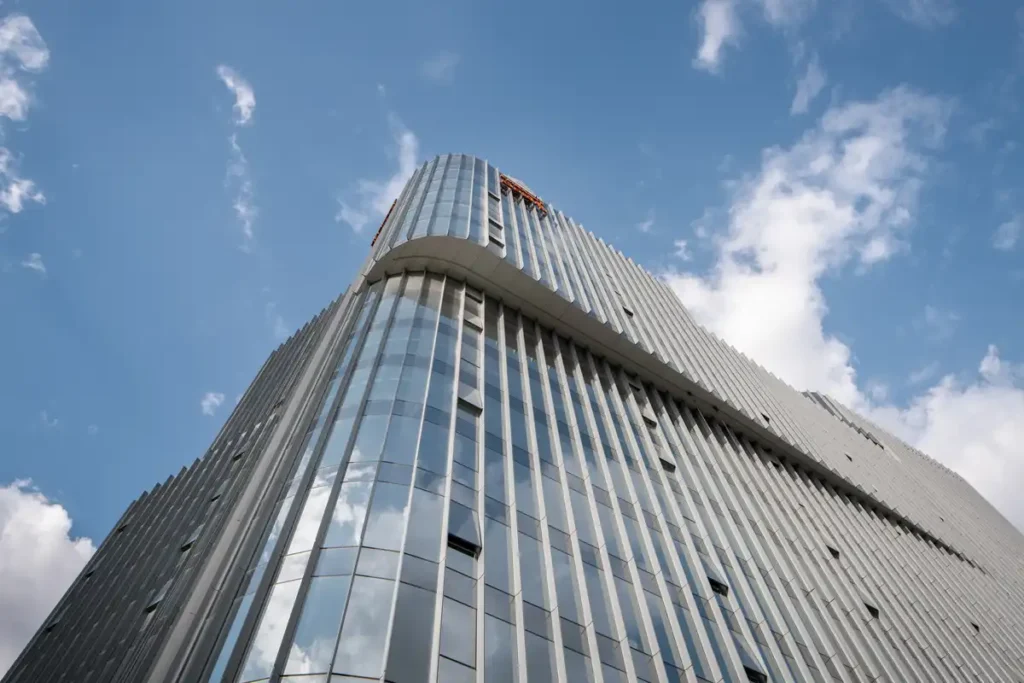
The 13 storey tower is designed around a rectangular plan. This adheres to the mandatory 16 meter front setback. To achieve a distinct identity on this tight urban plot, designers applied a precise strategy. The upper mass was slightly rotated and shifted. This move was functional, not merely aesthetic. It created open terraces and active break areas. The building’s corners are shaped with a 5 meter radius. This integrates the different façades into one smooth, continuous mass. From any vantage point whether from the golf courses or the surrounding roads Zenith Tower Bangalore reads as a unified object. This eliminates the traditional distinction between front and back elevations.

Harmony of Materials and Performance: The Façade Interacts with Sunlight
The building is clad in a repetitive, high performance façade system. It relies on a single curtain wall module. This system was crucial for achieving thermal efficiency. It also simplified construction and installation. The design incorporates angled glass. This effectively shields the interior from direct sunlight. It still retains expansive outward views, however. The façade’s expression transforms as the light changes. This is due to the tapered mullions, which give the structure a dynamic appearance. This approach exemplifies projects that adopt passive sustainability solutions.
The primary façade components and essential technologies include:
- Curtain Wall Units: Constitute 100% of the elevation coverage.
- Glass Design: Angled glass for improved passive solar protection.
- Surface Treatment: Application of a self cleaning surface treatment for the glass, maintaining clarity in the city’s environment.
- Guiding Elements: Tapered vertical mullions to regulate light reflection.
- Landscaping Materials: Use of granite sculptures in the ground-level garden design.

Environment and Community: Green Spaces Mitigate Urban Pressure
The design integrates green spaces. This was driven by the necessity of providing a balanced work environment. These areas enhance the occupants’ well being. A landscaped rooftop garden offers uninterrupted views of the urban skyline. The podium terraces serve as areas for informal gatherings and outdoor working. At the heart of the project, a community garden provides a sense of calm. It is adorned with granite sculptures. This offers a quiet cultural retreat from the fast-paced rhythm of the surrounding city. Zenith Tower Bangalore proves how disciplined design can transform a constrained site into a future-ready workspace.
✦ ArchUp Editorial Insight
Zenith Tower Bangalore represents a rigorous exercise in adaptive architecture. The visual description is embodied in the singular, sculptural form, where the 5-meter radius corners emphasize the unity of the glass mass, erasing façade distinction. While the design cleverly addressed the restrictive site through the programmed rotation of the upper mass creating vital spaces this approach raises questions regarding the dominance of formal performance over contextual awareness. The high-tech façade is primarily dedicated to serving the strict internal requirements of the global tenant, with an excessive focus on digital entry solutions. Nevertheless, the project stands as a high-value model demonstrating the efficacy of architectural discipline in constrained business locations.


