2027 COTE Competition

Brief
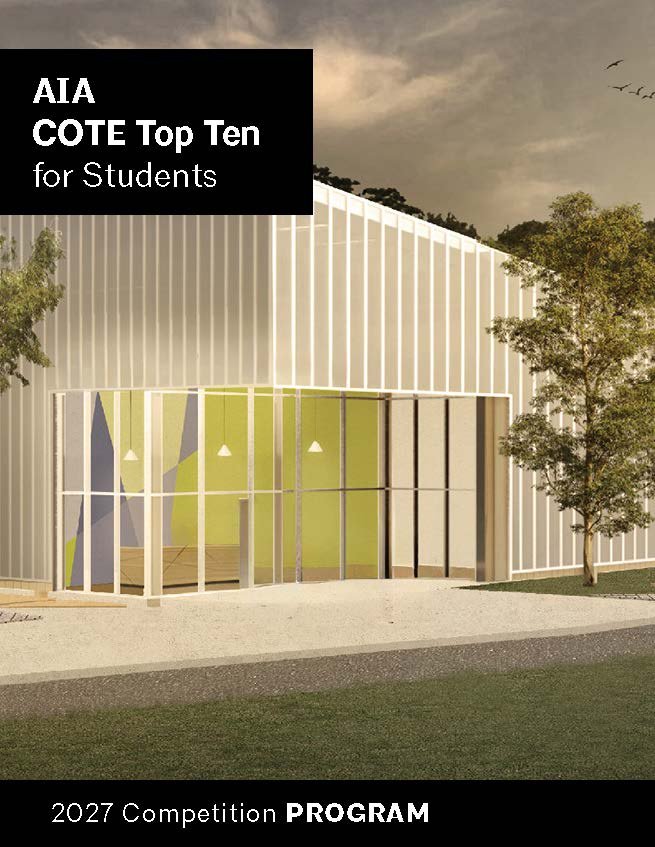
2027 COTE Competition is the eleventh annual AIA COTE Top Ten for Students program. It recognises ten architecture-studio projects that integrate design quality with health, sustainability, climate adaptation and equity. Entries must be buildings, but may use any program, scale or location, including renovation and adaptive reuse.
Purpose, categories and eligibility
| Item | Published terms |
|---|---|
| Purpose | Identify student work that meaningfully addresses climate impacts and imagines a healthy, sustainable and equitable built future. |
| Category I | Foundation Level: students in first- or second-year studios or related classes in two-year, four-year and undergraduate programs. |
| Category II | Upper Level: students in third year or above, including graduate students. |
| Eligible institutions | ACSA member schools worldwide, including international member schools. A faculty sponsor must confirm eligibility and register the entry. |
| Teams | Individuals or teams of no more than three students. Students may not enter both categories. |
| Eligible work | A building project of any program, scale or location, including remodels and adaptive reuse, completed in a design studio or related class during the 2026–2027 academic period. Work completed before Spring 2026 is not accepted. |
| Competition type | Student design recognition program. It does not promise construction, procurement or a professional commission. |
Design framework
Entries are assessed through the AIA Framework for Design Excellence: integration, equitable communities, ecosystems, water, economy, energy, well-being, resources, change and discovery. The program asks entrants to connect environmental metrics to architectural decisions rather than present sustainability as a separate technical layer.
The stated evaluation focus includes progress toward carbon-neutral operation, passive design, climate resilience, social and environmental equity, community benefit, land and ecology, energy and water, health, materials and construction, adaptability and long-life performance. Calculated metrics must explain their assumptions, sources and reliability.
Registration, fees and awards
| Item | Published terms |
|---|---|
| Entry and submission fee | Free. |
| Number recognised | Ten projects, distributed between the two categories according to the proportion of submissions. The organiser describes the selected work as approximately the top 2–3% of jury rankings in each category. |
| Student award | USD 1,000 for each selected project. |
| Faculty award | USD 350 for the faculty sponsor of each selected project. |
| Total cash awards | USD 13,500. |
| Additional recognition | Display and recognition at the 2028 AIA National Convention, plus promotion through ACSA and AIA COTE channels. |
Schedule
| Stage | Date |
|---|---|
| Registration deadline | 7 April 2027. The published schedule does not state a closing hour or time zone. |
| Submission deadline | 2 June 2027 at 23:59 Pacific Time; 3 June 2027 at 06:59 UTC. |
| Jury convenes | Summer 2027. |
| Winners announced | Fall 2027. |
Registration closes before submission. Because the registration hour is not published, entrants should register before 7 April ends. The countdown below uses the precisely stated submission deadline converted to UTC.
Submission requirements
| Requirement | Published specification |
|---|---|
| Presentation boards | No more than two digital boards, each 24 × 36 inches. |
| File formats and size | BMP, GIF, JPEG, JPG or PNG; maximum 20 MB per board. |
| Core drawings | Site or context plan, floor plans, building/site sections and a perspective or isometric view. Diagrams and calculations should explain performance against the ten design principles. |
| Abstract | Maximum 300 words describing the design approach, intentions and strategies. |
| Program brief | Maximum 300 words stating building type, gross area, project location and climate zone. |
| Scale and orientation | Drawings require an appropriate graphic scale and north arrow. |
| Anonymity | Student, school and faculty names must not appear on boards, the abstract or project title; revealing authorship causes disqualification. |
| Submission method | Online through the ACSA competition platform after faculty registration. |
| AI disclosure | Use of AI must be attributed in the abstract. Students remain responsible for originality, accuracy, academic integrity and every submitted image. |
Jury and assessment
The jury names have not yet been published for the 2027 edition. The announced framework is unusually explicit, but no numerical weighting is provided among its ten principles. Entrants should therefore build a coherent architectural argument in which climate, equity, experience and measured performance reinforce one another.
Organisers, rights and publication
The American Institute of Architects Committee on the Environment sponsors the competition in partnership with the Association of Collegiate Schools of Architecture. AIA was founded in 1857, and COTE advances design practice that connects built and natural systems. ACSA, founded in 1912, administers the program as an international association for architectural education and research.
Entrants warrant that their submissions are original. By uploading, winners allow AIA and ACSA to use their submissions, images and materials in a summary publication, online, and in promotional and exhibition resources, with authorship attributed to students, teams, faculty and institutions. The program does not state that copyright ownership is transferred.
✦ ArchUp Competition Review
The value of this competition is its demand for integration. It does not reward a sustainability diagram detached from the architecture; the ten principles require participants to connect climate response, community, water, energy, resources, health and change to plans, sections, material choices and spatial experience.
Free entry, international ACSA-school eligibility and recognition for both students and faculty make the call accessible within its academic scope. The main restriction is institutional: independent students outside an ACSA member school cannot enter, and the faculty sponsor controls registration. The unpublished jury also means entrants currently know the criteria more clearly than the evaluators’ individual backgrounds.
Reviewed on 9 October 2026 against the official 2027 competition page and program document issued by ACSA. No construction outcome or professional commission has been inferred.
Related competitions — Editorial team selection
For related student and environmental design opportunities, see the 2027 Steel Competition and Eulsukdo Land Ecological Art Open Call in the ArchUp archive.
Time remaining for submission
3 June 2027 · 06:59 UTC.
Competition page
Review the official program and arrange registration through the faculty sponsor.