2027 Steel Competition

Brief
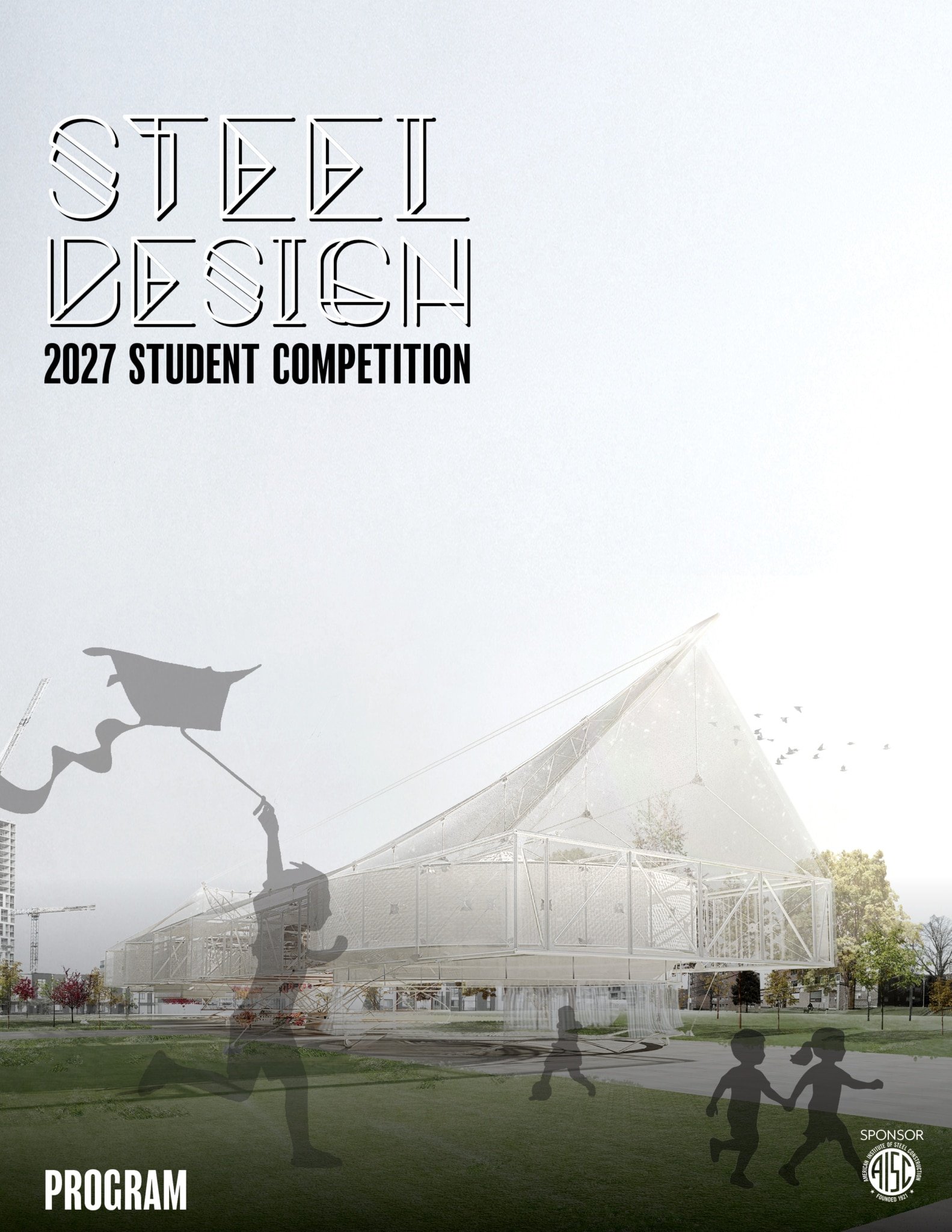
2027 Steel Competition is the 27th annual ACSA/AISC student design competition for the 2026–2027 academic year. It asks architecture students to use structural steel as the primary material and to include at least one long-span space or element. Entrants choose between two tracks: a Community Youth Center or an Open category with a self-selected site and building program.
Purpose, scope and eligibility
| Item | Published terms |
|---|---|
| Category I | Design a Community Youth Center on a site chosen by the student and faculty sponsor. The building must respond to its community and include an added local program of no more than 30% of the youth-center area. |
| Category II | Select a site and building program of comparable complexity. Community and recreational centers are excluded from this open category. |
| Material requirement | Structural steel must be the primary structural material, with at least one long-span space or element and a clear emphasis on innovation. |
| Eligible students | Undergraduate and graduate students at ACSA Full or Candidate Member Schools, plus ACSA Affiliate Member Schools in the United States, Canada and Mexico. |
| Teams | Individuals or teams of up to five students, working under a required faculty sponsor. A student may enter only one category. |
| Competition type | Academic ideas and design competition. The published program does not offer construction, procurement or a professional commission. |
Program and design requirements
Category I requires a 25,000–35,000 sq ft Community Youth Center. Its core program includes reception, recreation, classrooms and vocational training, multimedia and mentoring rooms, maker and creative spaces, a cafeteria, library, lounge, meeting space, staff areas and support services. Outdoor space may include a courtyard, covered porch, play or sports areas and gardens. The chosen site should connect to an understood user group and be accessible through more than one form of movement, such as transit, walking or cycling.
Category II allows another building type, but the proposal must match the first category’s complexity. Entrants must supply a written program stating the building type, gross area and project location. In both categories, steel should be resolved from primary structure through envelope or tectonic detail rather than used only as a visual theme.
Registration and awards
| Item | Published terms |
|---|---|
| Registration fee | Free. The faculty sponsor registers each individual or team. |
| Total cash prizes | USD 20,000 across both categories. |
| Each category | First: USD 4,000 to student(s) and USD 1,500 to the faculty sponsor; second: USD 2,000 and USD 1,000; third: USD 1,000 and USD 500. |
| Additional recognition | A limited number of honourable mentions may be awarded. Prize-winning work is scheduled for exhibition at the 2028 ACSA Annual Meeting and 2028 AIA National Convention and for inclusion in a summary publication. |
Schedule
| Stage | Date |
|---|---|
| Registration deadline | 7 April 2027. No closing hour or time zone is stated. |
| Submission deadline | 2 June 2027 at 23:59 Pacific Time; 3 June 2027 at 06:59 UTC. |
| Jury | Summer 2027. |
| Results | Fall 2027. |
Registration closes before submission. The organiser does not publish a registration closing hour, so entrants should not rely on the end of 7 April. The countdown below uses the precisely stated submission deadline converted to UTC.
Submission requirements
| Requirement | Published specification |
|---|---|
| Boards | Four digital boards, each 20 × 20 inches, uploaded individually. |
| File formats | BMP, GIF, JPEG, JPG or PNG, at high resolution. |
| Design essay | Maximum 300 words, pasted into the online submission form. |
| Program summary | Maximum 300 words, including interior and exterior spaces, net and gross areas, the auxiliary program and any substantial program deviation. |
| Required drawings | Three-dimensional views; site plan with context, access and circulation; building/site sections; floor plans; and large-scale drawings explaining steel structure, envelope or integrated design. Drawings need graphic scales and the site plan needs a north arrow. |
| Anonymity | Student, school and faculty names must not appear on boards, file names, essay or program summary. |
| Submission method | Online through the ACSA competition platform. After final submission, entries cannot be edited. |
| AI disclosure | Any AI use must be attributed in the design essay. Students remain responsible for originality, accuracy, academic integrity and every submitted image. |
Jury and assessment
The jury names have not yet been announced. The organiser says updates will be published as members are confirmed. The stated criteria include creative use of structural steel, response to context, human activity, structural integrity, architectural coherence, conceptual integration, formal quality, sustainability and social responsibility. No weighted scoring matrix is published.
Organisers, rights and publication
The Association of Collegiate Schools of Architecture administers the competition and the American Institute of Steel Construction sponsors it. ACSA was founded in 1912 as a nonprofit association for architectural education; AISC was established in 1921 as a nonprofit technical institute and trade association serving structural-steel design and construction.
Entrants warrant that submitted work is original. By uploading, winners grant ACSA the right to use their submission, images and materials in the summary publication, online channels, promotional resources and exhibitions, with authorship attributed to students, teams, faculty and institutions. The program does not state that copyright ownership is transferred, but entrants should understand the publication permission before submitting.
✦ ArchUp Competition Review
This is a strong academic brief because the material requirement is tied to spatial and structural performance, not simply appearance. The Community Youth Center category adds a substantial social program, while the Open category gives studios room to align the competition with their own curriculum and site research.
Free registration and prizes for both students and faculty sponsors reduce the usual financial barrier. The narrower eligibility is important, however: this is not an open international competition for independent students. Participation depends on an eligible ACSA member school and a faculty sponsor, and the work should arise principally from a studio or related class.
Reviewed on 8 October 2026 against the official ACSA competition page and program document. Jury names remain pending; no construction outcome or commission has been inferred.
Related competitions — Editorial team selection
For related educational and cultural design briefs, see the William Gladstone School New Academic Wing and Design Circle’s Art Gallery Competition in the ArchUp archive.
Time remaining for submission
3 June 2027 · 06:59 UTC.
Competition page
Read the official program and ask the faculty sponsor to register the entry.