
Anantara Miami Resort & Residences Introduces Mixed-Use Luxury Tower to Edgewater


Anantara Hotels & Resorts will open its first U.S. property in Miami’s Edgewater district. The 50-story waterfront tower combines hotel suites and private residences. The project introduces a mixed-use hospitality model that integrates wellness, ownership flexibility, and high-rise living in one vertical development.
A 50-Story Tower Reshapes Miami’s Waterfront Skyline
The project rises nearly 650 feet above Biscayne Bay. It occupies a strategic site between the Design District and Wynwood. Therefore, it positions itself within two of Miami’s most active cultural zones. The tower adds to the growing collection of high-rise towers redefining the city’s waterfront.
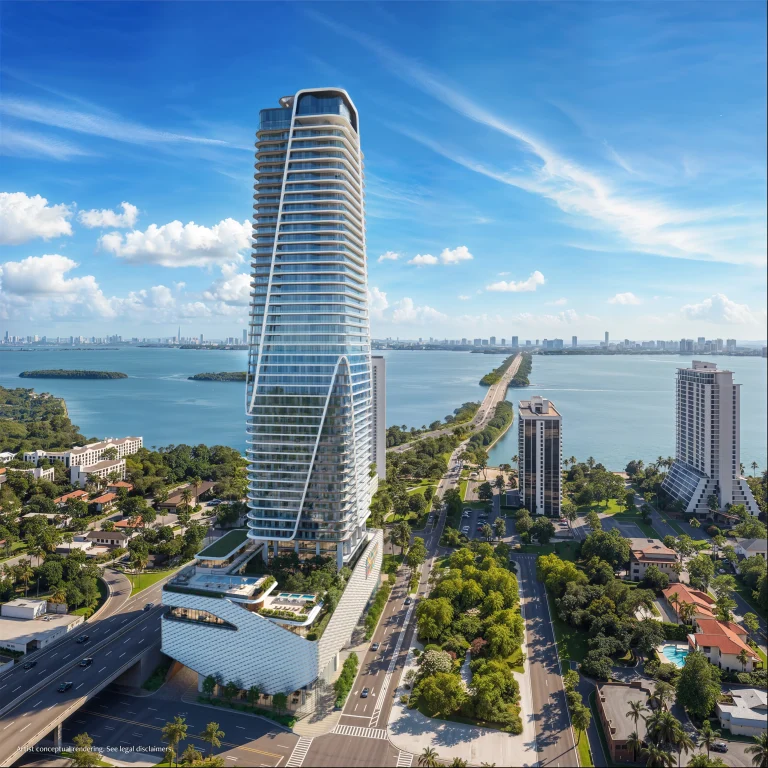
The development blends hospitality and residential functions within a single structure. It reflects broader shifts in architecture across global coastal cities. Developers continue to prioritize density, views, and mixed-use programming in prime urban locations. Meanwhile, Miami strengthens its reputation as a testing ground for hybrid luxury models.
A Vertical Community Model
The tower will include 100 private condominium residences and 120 resort residences eligible for hotel use. In addition, the plan lists approximately 50 hotel suites, although official figures vary slightly. This layered structure allows owners to integrate private living with short-term hospitality operations.
A rooftop helipad crowns the building. A dedicated vitality and longevity center anchors the wellness program. The concept emphasizes recovery, movement, and nutrition within a controlled environment. Such programming aligns with the growing intersection between hospitality and urban planning, where vertical communities function as self-contained ecosystems.

The tower rises above Edgewater with Biscayne Bay and the Miami skyline in the background. Image © Courtesy of Anantara Miami Resort & Residences / GLADSTONE IMMERSIVE
Design Strategy and Interior Direction
The tower’s exterior seeks to align with Miami’s contemporary waterfront identity. However, it incorporates subtle Southeast Asian spatial cues within its planning. The façade and massing respond to the surrounding skyline while maintaining a distinct presence among neighboring buildings.
The project places strong emphasis on curated interior design. Residential and hotel spaces focus on experiential living rather than traditional opulence. Designers prioritize spatial flow, material contrast, and wellness-oriented layouts. Moreover, the development integrates lifestyle amenities directly into residential floors, reinforcing its hybrid identity.
Wellness Infrastructure as a Market Driver
The project frames wellness as core infrastructure rather than an added feature. It merges longevity research with hospitality services. Therefore, it reflects a broader transformation within luxury construction and real estate development.

The resort courtyard featuring natural timber cladding, curated landscaping, and a central sculptural element. Image © Courtesy of Anantara Miami Resort & Residences / GLADSTONE IMMERSIVE
This model responds to demand for flexible ownership and health-focused environments. It also signals how branded residences continue to reshape hospitality-driven news cycles. As developers experiment with integrated living concepts, Miami remains a focal point for high-density lifestyle projects.
A Quick Architectural Snapshot
Location: Edgewater, Miami
Height: 50 stories, 650 feet
Program: Condominiums, resort residences, hotel suites
Key Features: Rooftop helipad, longevity center, waterfront site
Concept: Hybrid hospitality and residential tower integrating wellness and urban density
✦ ArchUp Editorial Insight
The Anantara Miami development illustrates how high-density architecture functions as a response to specific fiscal and regulatory pressures. By layering private ownership, flexible resort residences, and boutique suites, the structure maximizes the land-use efficiency of the Edgewater waterfront. This spatial arrangement serves as a financial hedge; developers mitigate risk by diversifying the building’s revenue streams between long-term residential equity and short-term hospitality cycles. Furthermore, the integration of a longevity center reflects the commodification of wellness within urban infrastructure, shifting health from a public amenity to a private, vertical service. The tower does not merely provide shelter or leisure but acts as a concentrated economic tool designed to extract value from a constrained geographic footprint.
This project is the logical outcome of escalating land values + the globalization of branded real estate + the market demand for health-as-infrastructure.

★ ArchUp Technical Analysis
Technical and Documentary Analysis of the Anantara Miami Residences & Resort Project – Miami, Florida, USA:
This article presents an architectural analysis of the Anantara Miami project as a case study in integrating luxury residential living with wellness amenities within a vertical urban environment. To enhance its archival value, we would like to present the following key technical and design data.
The project rises 50 stories to a height of 650 feet above Biscayne Bay in Miami’s Edgewater neighborhood, between the Design District and Wynwood. The tower houses 100 private residential units, 120 hotel units that can be operated within the resort system, and approximately 48 hotel suites.
The building is crowned with a private helipad, featuring a dedicated vitality and longevity center focused on recovery, movement, and nutrition within an integrated indoor environment. The configuration allows owners to combine private residence with the possibility of hotel rental within a single system, with wellness and service amenities distributed across multiple levels.
The exterior form harmonizes with the contemporary character of the Miami waterfront while drawing some spatial elements from Asian inspiration.
Related Insight: Please refer to this article to understand the context of modern architectural preservation:
Mixed-Use Towers in Coastal Cities: Strategies for Integrating Residential, Hospitality, and Wellness Amenities.





✅ Official ArchUp Technical Review completed for this article.