
Arthur Ross Awards 2027: Submissions, Eligibility and Review

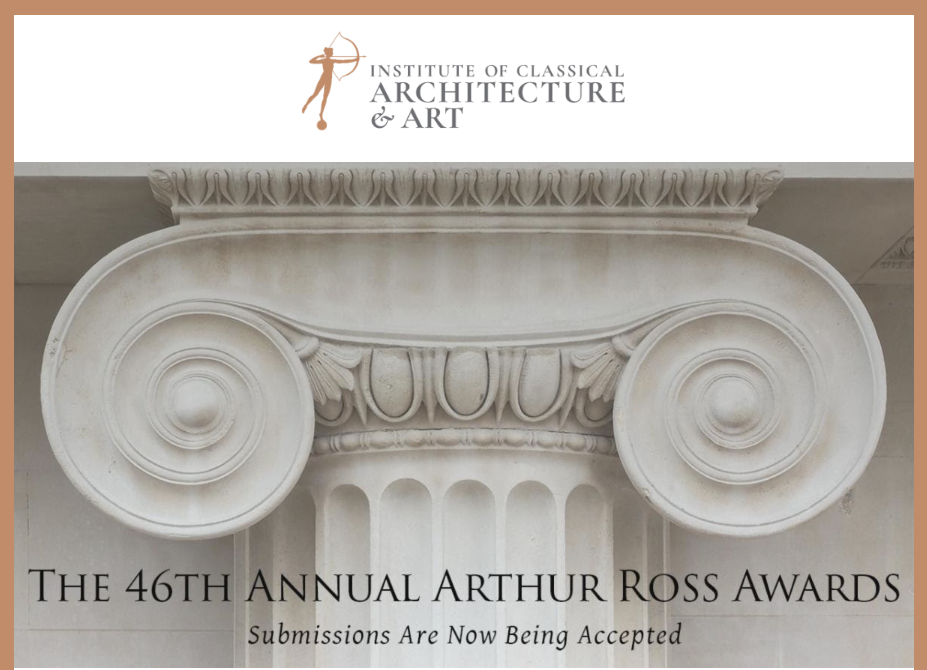
The Institute of Classical Architecture & Art (ICAA) is accepting submissions for the 2027 Arthur Ross Awards, with a deadline of 11 December 2026. The programme recognizes sustained achievement in the classical tradition across architecture, art, craft and the professions that support the built environment. It belongs to the category of professional recognition: the object of assessment is a career or body of work, rather than a new design produced in response to a site brief.
For an architectural practice, this changes the submission question. A single striking building cannot, by itself, explain a coherent contribution over time. A convincing dossier needs to establish what the nominee has developed, how that work has matured, and why it matters beyond the appearance of the selected photographs.
Award essentials
| Organizer | Institute of Classical Architecture & Art — ICAA |
| Programme | 46th annual Arthur Ross Awards; 2027 cycle |
| Submission deadline | 11 December 2026; closing hour and time zone are not specified in the published call |
| Eligible nominees | Individuals, firms, institutions and organizations; international nominations are accepted |
| Submission route | Electronic submission; consult the official format and category requirements |
| Entry fee | Not stated in the reviewed guidance; do not assume a fee or advertise confirmed free entry |
| Cash award | No monetary award amount is stated in the reviewed call |
| Ceremony | 10 May 2027, Cipriani 42nd Street, New York |
Fields of recognition
The categories cover architecture; artisanship and craftsmanship; community and civic design and city planning; education; fine arts; writing, editing and publishing; interior design; landscape design and gardening; patronage; and stewardship. This breadth recognizes that architectural culture is also made through teaching, making, maintaining and explaining buildings.
What to prepare
Submit one PDF to RossAwards@classicist.org: a one-page nomination letter, a one-page profile where relevant, contacts, a visual-highlights page, and up to 25 further illustrated pages. Writing-related entries may include up to four excerpts, each limited to ten pages. Self-nomination needs a reference letter; disclose AI use. Check the official instructions for category exceptions and repeat nominations.
Treat the page allowance as an editorial constraint. Sequence the work around an argument, identify collaborators and distinguish the nominee’s contribution from that of the wider team. Plans, sections and material details can substantiate decisions that a finished exterior photograph leaves unexplained. A concise caption should identify the project, context and contribution, rather than repeat the award application’s general claims.
Jury and document review
The selection committee combines ICAA board members with related professionals. The named jury displayed under the 45th annual awards belongs to the previous cycle; it should not be presented as the confirmed 2027 panel. The current ceremony page names co-chairs, which is a different role.
One instruction needs clarification: the current invitation requires electronic submissions and excludes physical packages, while the general guidance still discusses supporting printed books. Applicants considering books should ask ICAA how that provision applies this year. The call also omits an exact closing time, so no UTC countdown is justified.
ArchUp assessment: demonstrate a contribution, not just a style
The award’s strongest editorial proposition is its attention to continuity of practice. Classical architecture is often discussed through recognizable composition and ornament, but a serious submission can also demonstrate how proportion organizes use, how construction sustains craft knowledge, and how a building contributes to a street or landscape. These are questions a portfolio can answer through evidence rather than adjectives.
The principal risk is a beautifully photographed dossier that treats stylistic consistency as proof of architectural achievement. An entry becomes more persuasive when it explains difficult decisions: reconciling a traditional composition with contemporary access, adapting a historic setting without reducing it to scenery, or maintaining the quality of workmanship across different commissions. This is ArchUp’s assessment of how to present architectural evidence, not a claim that ICAA publishes those points as a numerical scoring system.
The opportunity is most relevant to an established body of work and to applicants able to document authorship carefully. A smaller practice should first test whether its selected projects establish a sustained contribution; enlarging the image count will not compensate for an unclear argument. The value offered is professional recognition. It should not be described as a cash-prize competition or confused with the separate earlier call to design the Arthur Ross trophy.
Sources and related reading
Reviewed on 18 November 2026: ICAA’s current awards guidance, its 46th annual ceremony page, and the submission invitation supplied for this call. The previous jury and book-submission wording have been distinguished from confirmed current-cycle requirements. See also our review of CarlottaxArchitettura 2027 for a different architecture-award format.
Image: call-for-submissions poster for the 46th Annual Arthur Ross Awards, Institute of Classical Architecture & Art.
Participation deadline
11 December 2026. The organizer has not specified an exact closing hour or time zone; no countdown is displayed.


