Baghdad Sustainable Forests: An Urban Eco-District with One Million Trees

Gensler, the global architecture studio, has unveiled plans for an ambitious urban district in Baghdad, Iraq, designed to merge ecological restoration with urban living. Named Baghdad Sustainable Forests, the project envisions transforming a 10-million-square-metre former military campsite, which contains over 45 million tonnes of waste, into a vibrant district featuring parks, green corridors, and one million trees. The masterplan combines residential, retail, and commercial zones with extensive forests, aiming to set a new benchmark for sustainable urban development in one of the world’s most historic cities.
The project responds to the pressing need for environmental regeneration while addressing urban density. By integrating mixed-use hubs within a vast forested landscape, Baghdad Sustainable Forests proposes a model for urban resilience, combining environmental, social, and economic goals. Gensler emphasizes that the district will not only restore the land but also act as a catalyst for regeneration, inspiring both local communities and global audiences interested in sustainable architecture and planning.

Masterplan Overview
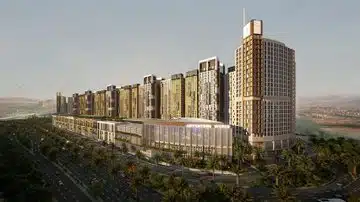
Occupying a former military site, the 10-million-square-metre district will be dominated by green spaces interspersed with “lifestyle villages” designed for living, working, and leisure. The villages will offer 1.5 million square metres of retail and commercial space, acting as community hubs for education, culture, and business activities. Streets and plazas are shaded to encourage walking, cycling, and e-scooter usage, ensuring mobility is human-centered and sustainable.
Landmarks and Urban Features
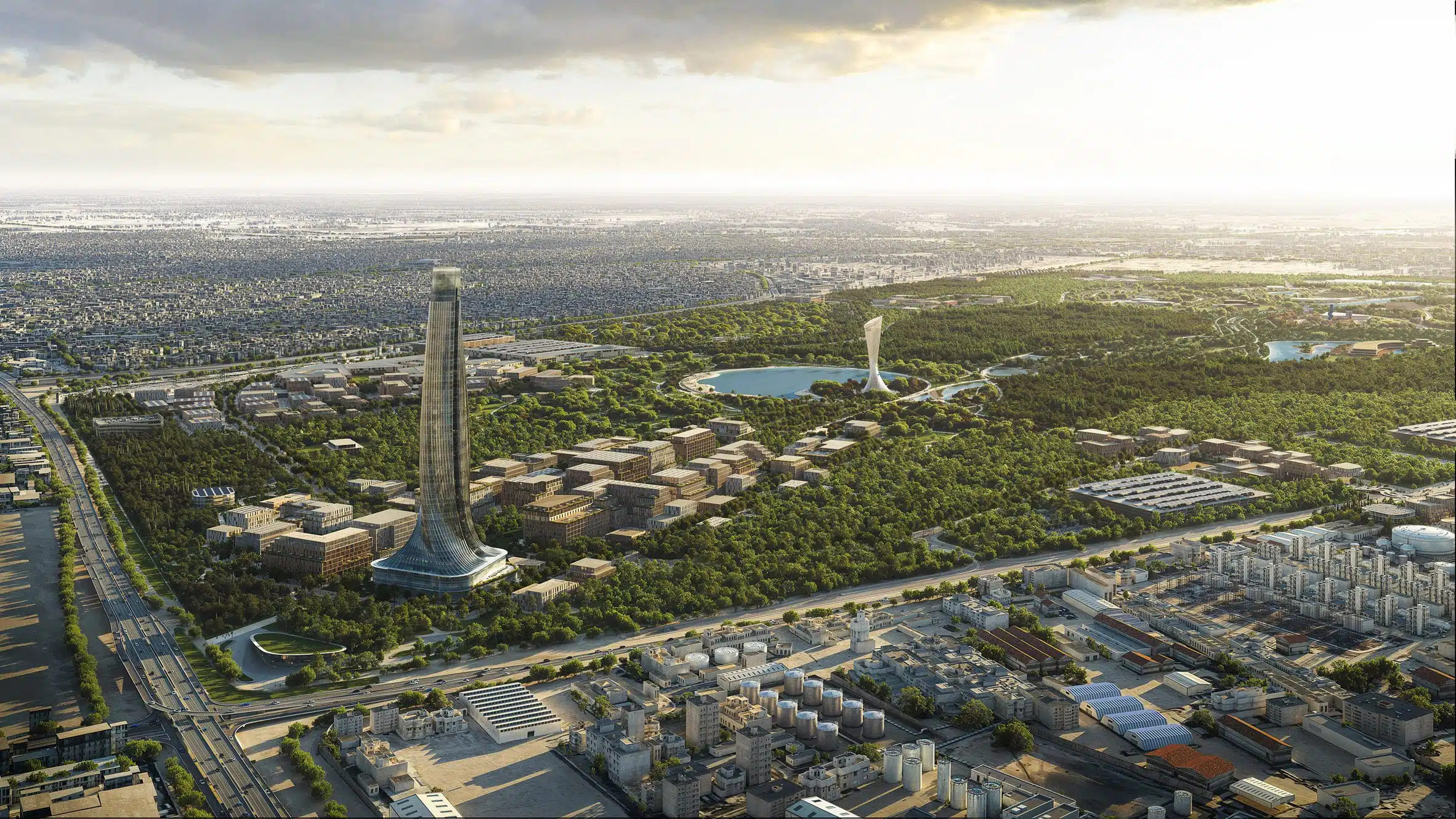
The district will feature landmark towers, including the 260-metre-tall Al Rasheed Gateway, with a curved form tapering towards its peak and raised on a round-edged square base. Other signature buildings include the 110-metre National Pavilion, which will serve as a civic symbol of renewal. Key urban features include a sequence of gateways marking entrances and reconnecting the public to the Tigris River via the River Gateway.

Themed Forests
The design integrates themed forests to create distinct experiences within the district. These include the Arts and Culture Forest, the Health and Wellness Forest, the Kids and Entertainment Forest, and the Sports and Fitness Forest. The plan retains some wild areas to encourage biodiversity, while other zones provide trails, plazas, and gardens for daily community use, blending natural ecosystems with urban amenities.
| Feature | Description | Size / Scale |
|---|---|---|
| Forest and Green Corridors | Extensive greenery surrounding urban spaces | Majority of the 10 million m² site |
| Lifestyle Villages | Mixed-use community hubs | 1.5 million m² retail & commercial space |
| Al Rasheed Gateway | Landmark tower with curved tapering form | 260 metres |
| National Pavilion | Civic symbol and cultural landmark | 110 metres |
| Themed Forests | Specialized green zones for activity and leisure | Multiple hectares across the district |
Architectural Analysis
Baghdad Sustainable Forests exemplifies the integration of ecological design with urban planning. The project redefines neglected land by introducing a layered landscape where natural systems guide urban development. The spatial layout prioritizes human circulation through shaded streets and plazas while establishing visual and physical connections to nature. Mixed-use hubs are strategically embedded to maintain density without compromising green space. The scale of the trees and forests acts as a unifying element, mediating between large architectural forms and public spaces. Critical reflection arises regarding the feasibility of maintaining such extensive greenery in an arid urban context, prompting questions on water management and long-term sustainability, yet the project sets an ambitious benchmark for ecological urbanism.

Project Importance
The Baghdad Sustainable Forests project demonstrates how urban design can be regenerative rather than extractive. For architects and designers, it emphasizes the potential to integrate ecological principles into dense urban fabrics, creating multifunctional districts that support biodiversity and human well-being. By using forests as a structuring element, the project offers insights into adaptive planning, typologies for mixed-use districts, and innovative approaches to urban resilience. In the current era of climate change and rapid urbanization, such models are crucial for transforming degraded sites into productive, culturally and environmentally responsive urban ecosystems.
✦ ArchUp Editorial Insight
Baghdad Sustainable Forests showcases a thoughtful fusion of urban density and ecological regeneration. Visuals highlight the contrast between expansive green corridors and carefully placed landmark towers, while the thematic forests provide spatial diversity. One critical consideration is the management of water and maintenance for large-scale greenery in Baghdad’s climate, raising practical sustainability questions. Nevertheless, the project offers a compelling vision for future urban development where environmental restoration is central to architectural planning and community life, reinforcing the role of architecture as a tool for ecological transformation.

Conclusion
The Baghdad Sustainable Forests masterplan represents an ambitious experiment in merging architecture, urbanism, and ecology. By converting a former military site into a million-tree forested district with mixed-use villages, the project offers a model for regenerative urban design. Shaded streets, plazas, and thematic forests create a human-centered environment that encourages active transportation, social interaction, and a connection to nature. Landmark structures such as Al Rasheed Gateway and the National Pavilion serve as symbolic markers for civic pride and urban renewal. For architects and urban planners, the project provides a case study in ecological research applied at scale, demonstrating how resilient, aesthetically rich, and socially inclusive districts can emerge from previously neglected sites, setting a precedent for sustainable city-making in the region and globally.

Explore the Latest Architecture Exhibitions & Conferences
ArchUp offers daily updates on top global architectural exhibitions, design conferences, and professional art and design forums.
Follow key architecture competitions, check official results, and stay informed through the latest architectural news worldwide.
ArchUp is your encyclopedic hub for discovering events and design-driven opportunities across the globe.
Brought to you by the ArchUp Editorial Team
Inspiration starts here. Dive deeper into Architecture, Interior Design, Research, Cities, Design, and cutting-edge Projects on ArchUp.