

Campus Housing: A New Residential Complex Reshapes the First Year Experience at the University of Miami

A Journey That Begins by the Lake:
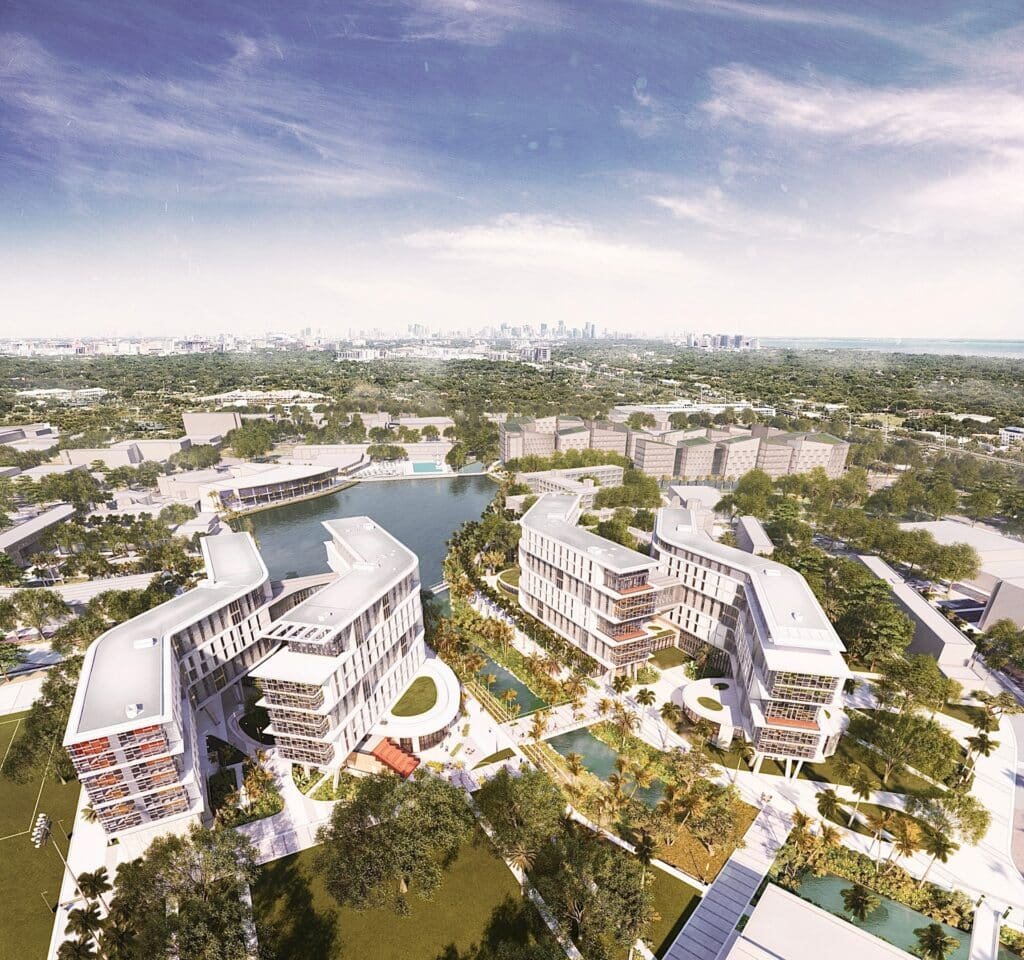
The experience begins at the edge of a calm lake positioned at the center of the campus. The new campus housing buildings appear to extend along a visual line that interacts directly with the water. From the first steps, the main pathway guides visitors through open corridors overlooking the lake’s surface, where shifting reflections meet wooden decks and frame a clear connection between nature and architecture.
Students move through spaces designed to lead them naturally toward a series of shared courtyards. Secondary paths open onto small seating terraces and informal gathering points. This movement relies on a horizontal flow that adapts to the daily rhythm of academic life. The student feels as though they are joining a continuous journey across the site, where paths intersect and spontaneous encounters form at every transition.

: A Social Core Within the Campus
The masterplan transforms campus housing from a mere living facility into a social nucleus. The layout gathers five volumes around interconnected outdoor courtyards, creating a central zone linked visually and physically to the lake and to nearby academic centers.
The design uses varied building heights to create subtle visual gradients that respond to the terrain and vegetation. These transitions foster calm pedestrian movement while ensuring that common areas remain accessible throughout the day. The intention is not to showcase decorative elements but to support realistic daily needs, turning campus housing into an integrated component of student life.
: Short Transitions Shaped by Interaction
Students navigate short distances between living spaces and academic routes. The corridors allow daylight to pass through most of the day, reducing dependence on artificial lighting. Vertical circulation relies on exposed staircases and elevated walkways that offer alternative routes and encourage spontaneous interactions.
Seating nodes line the corridors and shared areas, enabling students to use them for studying or resting. This distribution reinforces a direct relationship between daily movement and campus rhythm, transforming campus housing into an active point of passage and interaction.
Environmental Integration:
The design benefits from the environmental role of the lake, which helps regulate local temperatures. Green landscapes surrounding the buildings enhance natural airflow across pathways, while façades are oriented to capture daylight without excessive glare. Shaded walkways and elevated connections contribute to comfortable outdoor movement.
The layout maintains a clear link between students and the surrounding environment. The open paths and elevated decks provide a visual sequence that moves between buildings and the water’s surface. The project avoids ornamental approaches and instead focuses on practical responses to climate conditions and student behavior.
: Materials That Operate With Practical Purpose
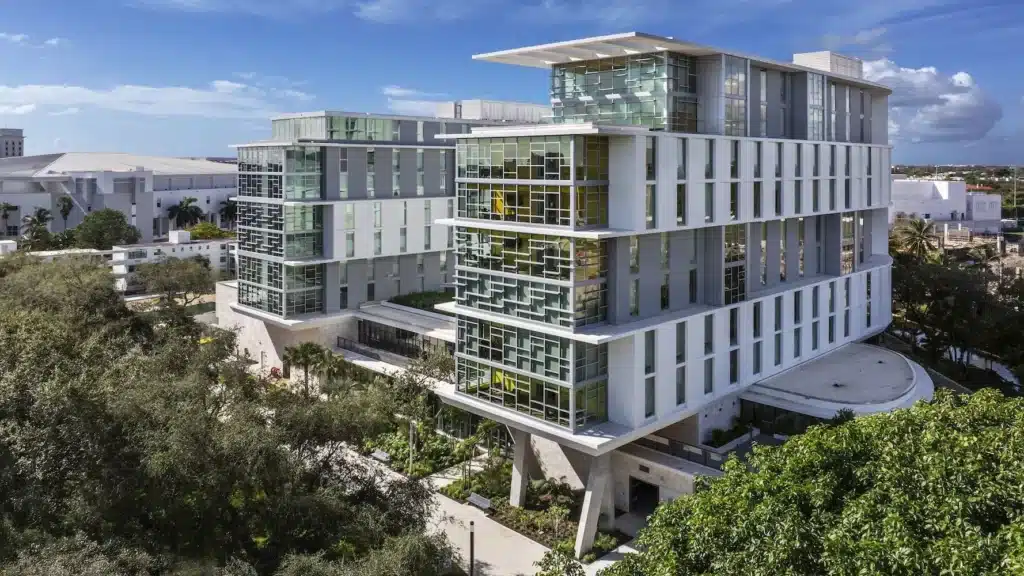
The façades rely on a combination of glass, treated wood, and exposed concrete. Glass panels introduce daylight while maintaining controlled transparency. Wood is used in high-traffic areas to provide a warm visual texture. Concrete forms the structural backbone of side façades and elevated walkways, ensuring durability under continuous student use.

Materials and Techniques Used :
- Glass: Covers 40% of façade surfaces, improving natural lighting and reducing artificial light usage.
- Treated Wood: Used in approximately 25% of corridors and exterior decks, supporting high daily circulation.
- Polished Concrete: Represents around 35% of structural and circulation elements.
- Natural Ventilation Pathways: Designed to achieve about 60% airflow efficiency across open corridors.
- Green Landscape Zones: Occupy nearly 30% of the perimeter, supporting temperature control and air distribution.
The selection of materials prioritizes functionality and long-term performance geared toward the reality of campus housing use.
: A Starting Point for a Connected Academic Life
The project provides over 2,000 beds dedicated to first-year students, positioning campus housing as an anchor for early campus engagement. The layout encourages immediate social integration by clustering movement routes and shared zones within short walking distances.
The project introduces a model of campus housing that merges environmental awareness, practical materials, and everyday student movement. The lake becomes a defining part of the experience, while spatial organization strengthens the connection between student life and the broader academic environment.
The result is a documented approach to shaping a first-year residential community built around accessibility, interaction, and environmental coherence.
ArchUp continuously documents leading architecture exhibitions and conferences, offering verified coverage of international competitions and official results within an open-access database.
✦ ArchUp Editorial Insight
The project presents an architectural approach shaped by layered volumes and a direct visual relationship with the lake, creating clear transitions from pathways to open courtyards. Its façades combine glass, wood, and concrete in a balanced palette that merges transparency with structural durability. Elevated walkways highlight how daily circulation aligns with the surrounding landscape. However, the plan relies heavily on central courtyards, which may limit the diversity of spatial experiences in certain areas. Even so, the development offers notable value by supporting a socially cohesive environment for first-year students, connecting natural movement patterns with the broader campus setting.


