

Chicago O’Hare International Airport Embarks on Construction of New SOM-Designed Concourse Inspired by the Midwest Landscape

Chicago, Illinois The massive development plan for O’Hare International Airport has entered a new, tangible phase with the official announcement of the start of construction on the new Concourse D. The ambitious project is led by global design firm Skidmore, Owings & Merrill (SOM), in collaboration with other leading architectural practices.
This project, first proposed in 2019 as part of the huge O’Hare 21 investment program, represents the cornerstone of the airport’s comprehensive expansion plan. The design aims not only to increase capacity to handle over 80 million passengers annually but also to redefine the travel experience through sustainable, human-centric architecture, with construction scheduled for completion in late 2028.
An Architectural Vision That Redefines the Passenger Journey
The design concept was developed around the idea of “spaciousness and nature,” drawing inspiration from the historical legacy of the land the airport occupies, which was formerly farmland and orchards. The design aims to create a seamless and intuitive environment that gently guides passengers from the terminal entrance to the aircraft gate.
“Our vision for the new Concourse D considers the passenger’s entire journey from curb to gate,” says Scott Duncan, Design Partner at SOM. “From skylit spaces to grove-inspired columns, every element contributes to a bright, easy-to-navigate environment designed to elevate the travel experience and leave a lasting impression of O’Hare.”
Design Elements Inspired by the Midwest Landscape
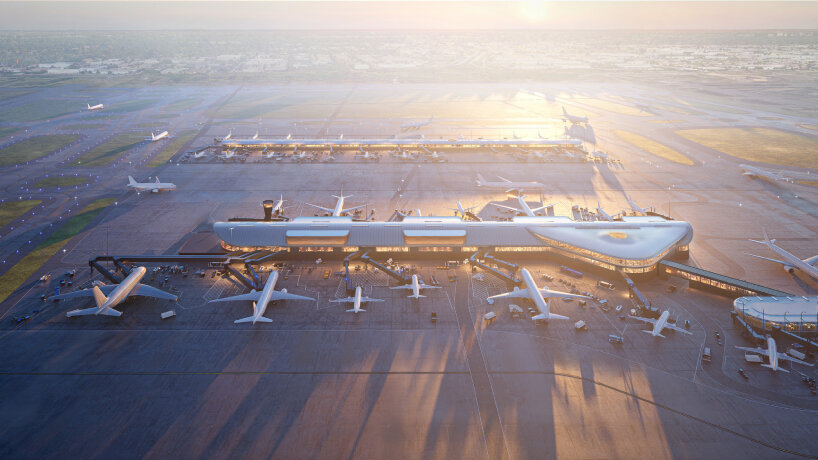
At the heart of the concourse is a multi-level central atrium (Oculus) that acts as a focal point and main entrance. This dome brings natural light down to the lowest floors, creating a connection to the outdoors and reducing reliance on artificial lighting. This atrium serves as a meeting point for passengers arriving from the adjacent Concourse C via a pedestrian bridge, as well as from the underground tunnel leading to the future O’Hare Global Terminal.
The floorplan layouts feature soft, curved lines directly inspired by the oxbow bends characteristic of Midwest rivers. These organic curves are not only aesthetically pleasing but also clearly define different functional zones, such as relaxation areas, restaurants, retail stores, and children’s play areas.
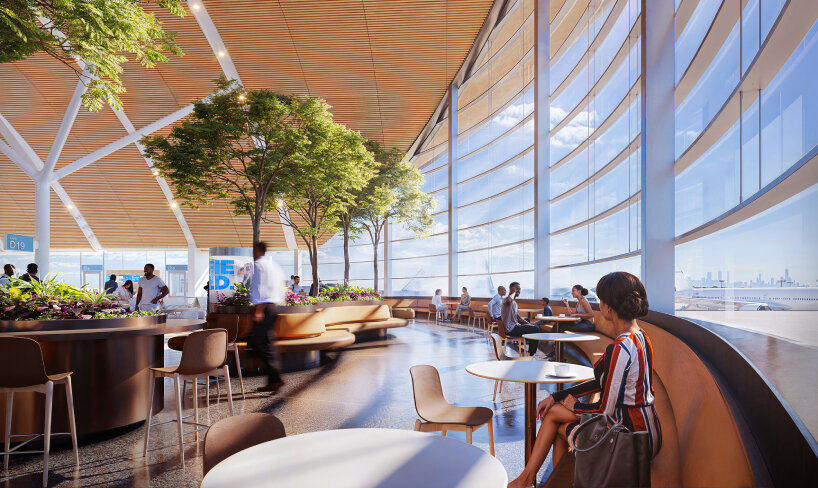
To enhance the sense of place, extensive landscaped areas are integrated indoors. These green “islands” divide the space into distinct “relaxation zones,” using a palette of colors, materials, and plantings derived directly from Illinois’ native landscape, creating a unique and calming sensory experience.
Structural Innovation and Environmental Sustainability
The project also stands out for its innovative structural system. Engineers designed branching columns that resemble tree trunks, reducing the need for numerous traditional vertical supports. This design not only recalls the site’s history as an orchard but also improves sightlines and opens up wide visual vistas across the entire concourse, preventing a feeling of congestion.
Sustainability principles are integrated into the project’s core. The roof profiles and facades have been optimized to respond passively to the Chicago climate, helping to regulate internal temperatures and reduce energy consumption. Furthermore, the optimized structural design reduces the amount of material used, significantly contributing to lowering the building’s Embodied Carbon footprint.
A View Toward the Future
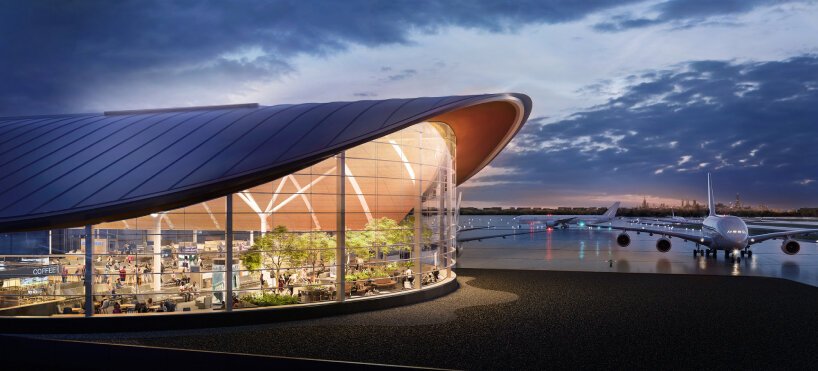
At the southern end of the concourse, a bright, open space features a double-height glass wall providing panoramic views of the airfield and the distant Chicago skyline. This area, surrounded by six gate lounges, is designed to be a tranquil, light-filled sanctuary, offering diverse seating options to suit all needs: comfortable seating for family groups, caf-style tables for quick meals, and high-top seats with counters for comfortable working.
Upon completion, the new Concourse D is poised to become one of the most modern and environmentally conscious concourses in the United States, solidifying O’Hare’s position as a leading global gateway for the 21st century.
(✦ ArchUp Editorial Insight)
This project reimagines the airport concourse not as a mere transit corridor but as a serene, nature-inspired destination that actively reduces travel stress. The design’s profound connection to the regional landscape through its oxbow-inspired curves and native plantings is a masterstroke in creating a sense of place. However, the heavy reliance on vast, open atriums and double-height glazing, while stunning, prompts constructive scrutiny regarding long-term energy efficiency in Chicago’s extreme climate; the projected savings from passive design must be rigorously validated post-occupancy. Ultimately, its greatest success lies in prioritizing passenger well-being through biophilic principles, potentially setting a new, more humane benchmark for terminal design worldwide that values experience over sheer throughput.
Brought to you by the ArchUp Editorial Team
Inspiration starts here. Dive deeper into Architecture, Interior Design, Research, Cities, Design, and cutting-edge Projectson ArchUp.


