The Taptab Illusion: Rushed Construction and the Defiance of Building Physics

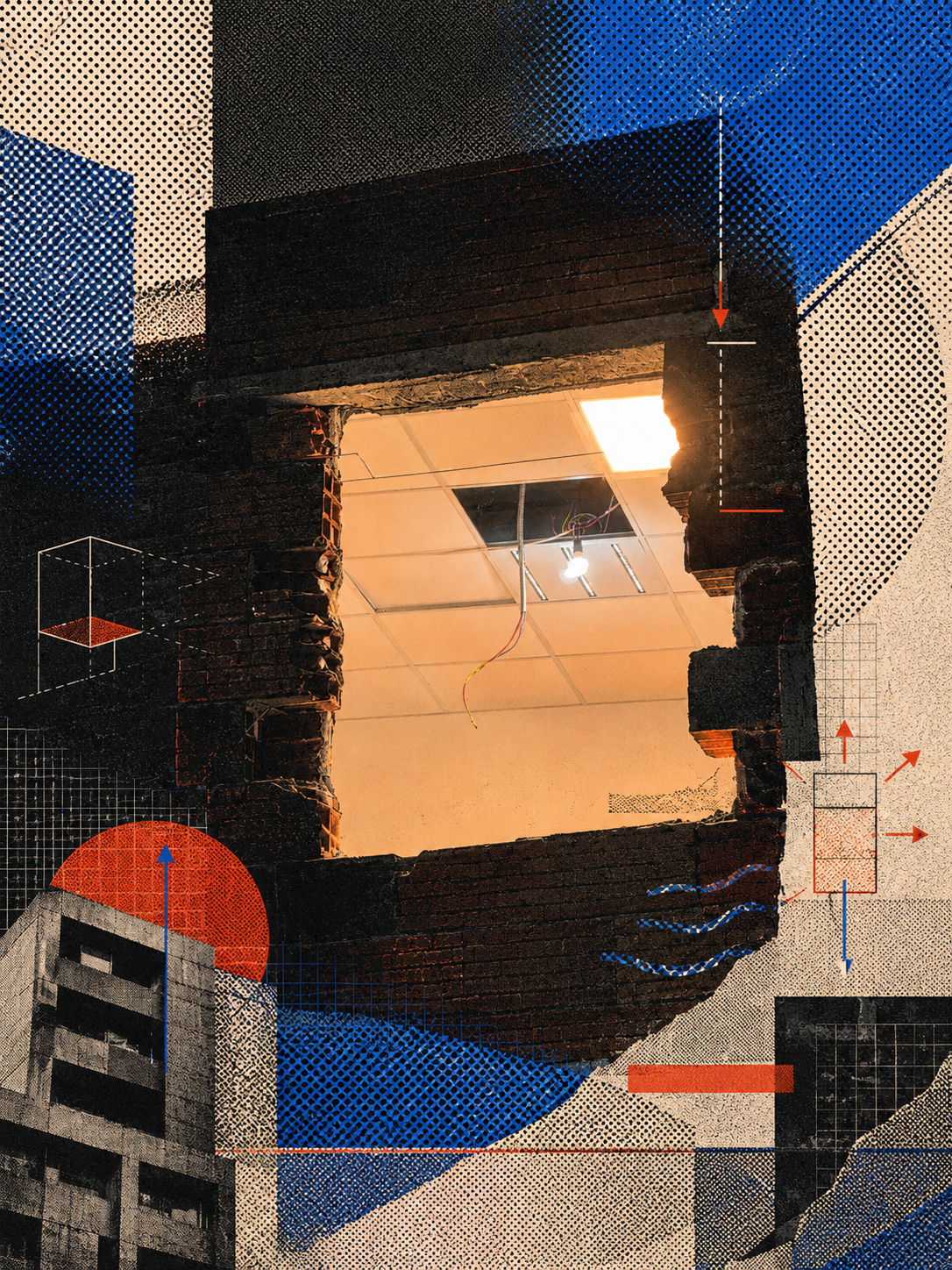
A sixty-day construction emergency involving a fifteen-thousand-square-meter commercial project tested the physical and professional limits of accelerated building. Client pressure to maintain constant visible workforce activity collapsed the standard sequencing of trades, forcing simultaneous operations across all disciplines within the same space.
Material science became a primary tool for managing the risks of compression, with polymer additives, hydrophobic coatings, and nanostructured materials used to mitigate moisture damage and cracking. The account concludes that certain structural laws cannot be overridden by urgency, and that the true cost of extreme acceleration is absorbed by the builders themselves.
When I reached my mid-thirties, I chose to focus seriously on physical conditioning. During that initial period of intense training, a personal trainer shared an observation with me that I did not fully comprehend until years later inside active construction zones. He noted that a competitive athlete occasionally stops thinking about the joints, the cartilage, or the long-term wear on the skeletal framework, because their mind is entirely occupied by the podium. The priority shifts completely from systemic health to the immediate, visible result. Years later, I discovered that certain architectural undertakings enter this exact psychological state. This reality defines the structural crises of hyper-accelerated schedules, where the traditional boundaries of the profession are tested by the relentless pressure of a fixed deadline.
This operational intensity became the defining reality of my practice over a recent sixty-day state of emergency, involving the completion of a fifteen-thousand-square-meter commercial project. The undertaking was governed by a compressed timeline, an impending institutional visit, and an inflexible inauguration date. The client operated under a singular behavioral drive, refusing to see the site inactive for even a single day. The primary directive was to never halt a contractor and to ensure that the visible workforce remained constant. This approach stems from a common misconception among clients that a high headcount automatically equates to linear progress. To an external observer, a successful site is one where hundreds of workers are in perpetual motion, regardless of whether that motion aligns with the logical sequencing of building physics.
There is an old Egyptian colloquial proverb used to describe rushed, careless workmanship: Taptab wa layyes, yitla’ kwayyes. Translated literally, it means to pat down and plaster over, under the assumption that the final product will look acceptable. It is the ultimate critique of superficial acceleration, an ideology where cosmetic speed is used to mask structural compromise. In any standard development, a strict structural hierarchy governs the timeline. The concrete must reach its specified design strength over a mandatory twenty-eight-day hydration cycle before subsequent vertical loads are introduced. This is followed by a deliberate sequence where mechanical systems begin, followed by electrical wiring, ceiling installations, plastering, painting, and final systemic testing. In this compressed environment, that structural hierarchy collapsed completely, turning the site into a living monument to the Taptab illusion.
Every trade operated simultaneously within the same spatial coordinates. The electrician worked alongside the painter, while the mechanical engineer was suspended above the ceiling framework before the base treatments had fully cured. The site transformed into a high-pressure chamber where the traditional separation of technical disciplines dissolved. This operational compression forced a radical return to the fundamental properties of matter, requiring a rigorous review of core chemistry and the parameters of contemporary Architectural Research. When you compress the dimension of time, the material itself becomes your final line of defense against structural failure. In professional academies, they instruct you on how to build correctly under optimal conditions, but they rarely prepare you for the reality of construction when time itself collapses. This is where true Architecture begins, at the violent intersection of human urgency and physical limitations.
The initial revelation of this experience is that certain structural elements refuse to negotiate, regardless of client pressure. Concrete does not recognize human emotion or political urgency. The hydration of tricalcium silicate requires a specific duration to cure, formwork must remain undisturbed for a calculated period, and structural treatment cannot be bypassed without risking long-term micro-cracking. You can increase the labor force or optimize the logistics, but you cannot accelerate the fundamental laws of chemistry. This remains a critical blind spot for those operating outside the technical boundaries of Construction. While certain superficial phases of a project can be accelerated through sheer human density, the core structural milestones remain strictly bound by the laws of physics.
However, the intermediate layers of the building envelope allow for a degree of tactical negotiation through material science and intelligent execution. In the plastering phase, it was evident that immediate subsequent applications would trap moisture, leading to systemic efflorescence and osmotic blistering in the future. To mitigate this risk, we integrated advanced acrylic and latex polymers into the mixtures, enhancing structural adhesion, reducing the probability of shrinkage cracks, and accelerating the relative stabilization of the substrate. In the application of surface coatings, we relied on hydrophobic layers and nanostructured materials that provide an additional barrier against moisture migration. Every material became an independent research project, requiring constant validation to ensure that the accelerated pace did not compromise long-term Sustainability.
Under these conditions, the management of manpower transforms into a complex engineering equation. The site density spiked from a balanced team of forty to a suffocating presence of two hundred and fifty workers within a confined footprint. This saturation violated the basic spatial threshold required for safe industrial tool operation, turning the project from a standard exercise in architectural Design into an exercise in the management of human exhaustion. The most draining aspect was the systemic risk of overlapping trades. In a compressed timeline, a minor error does not remain localized. A discrepancy in the ceiling layout instantly delays the electrical infrastructure, which halts the drywall installation, subsequently freezing the painting and flooring phases. The entire site becomes a highly sensitive network of interconnected nerves, where a single mistake cascades through the entire system.
Yet, despite the friction, the project reached completion. This outcome challenges the conventional belief within the profession that high quality can only be achieved through prolonged timelines. While that assumption holds true in balanced ecosystems, extreme pressure can occasionally produce a sharper, more disciplined form of execution. It forces a level of focus and structural courage that is rarely seen in conventional Projects. However, this intensity is only sustainable if the practitioner knows exactly where the material can be pushed and where the physical laws demand an absolute halt. The true danger does not reside within the active construction phase; it manifests after the site has been cleared.
The profound irony of modern development is that municipal frameworks and regulatory processes do not accelerate to match the speed of private capital. A team can successfully navigate a complex building cycle through sheer physical endurance, only to find the finished structure sitting dormant for weeks while waiting for utility connections or official permits. This administrative bottleneck is a frequent subject in global architectural News. It forces the practitioner into a painful retrospective calculation, wondering why the concrete was denied those extra days to cure, or why the plaster was not allowed to breathe if the building was destined to wait for a bureaucratic signature. This inquiry is never permitted during the conflict itself; it only emerges in the silence that follows.
This operational reality is reshaping how we evaluate development within contemporary Cities. As we look at the entries for major international Competitions, there is a noticeable shift toward prefabrication and modular systems that attempt to remove the unpredictability of on-site chemical processes. The goal is to replace the chaotic theater of construction with the controlled precision of the factory. This evolution represents a significant branch of modern research, as the industry attempts to reconcile the human demand for immediate completion with the absolute permanence of the built environment.
Ultimately, the experience of the past two months confirms a definitive professional thesis. Architecture is not merely the capacity to visualize form, but the ability to survive under the weight of compressed time. Certain structures are raised with cement, while others are built out of the raw nerves of their creators. In this specific undertaking, the resource that was most intensely consumed was not the stone or the steel, but the human asset. Architecture remains the art of delaying disappearance, but when we compress time past its logical limit, we must accept that we are trading the health of the builder for the speed of the monument. The true measure of a project is not who possesses the most powerful tool, but who understands how to preserve the integrity of the architecture when the world demands that it stop breathing.
✦ ArchUp Editorial Insight
What this account presents as a test of professional endurance is more precisely a field report on the structural consequences of misaligned power between client capital and material physics — a misalignment that recurs with such regularity across development contexts that it can no longer be treated as exceptional. The client’s refusal to permit site inactivity is not an irrational personality trait; it is the behavioral outcome of a financing model in which idle time converts directly into visible debt, and in which the inauguration date carries institutional or political stakes that override technical sequencing logic entirely. Concrete’s twenty-eight-day hydration cycle is not a professional preference — it is a chemical boundary, and the decision to approach it through polymer additives and nanostructured coatings rather than calendar adjustment reveals precisely where the true negotiation occurs: not between architect and client, but between the procurement timeline and the material’s tolerance for abuse. The observation that the regulatory apparatus then imposes its own delay after the physical work is complete — forcing a building that was denied curing time to wait weeks for a bureaucratic signature — is the most diagnostically significant detail in the piece, because it exposes a structural irony that this pattern of compressed construction observed earlier in The Manufacture of the Icon also touches: the speed demanded by private capital produces outcomes that the public institutional framework was never designed to absorb, and the gap between those two timelines is ultimately absorbed by the labor of the builders themselves.