Thinking Through Drawing: What Designerly Knowledge Means

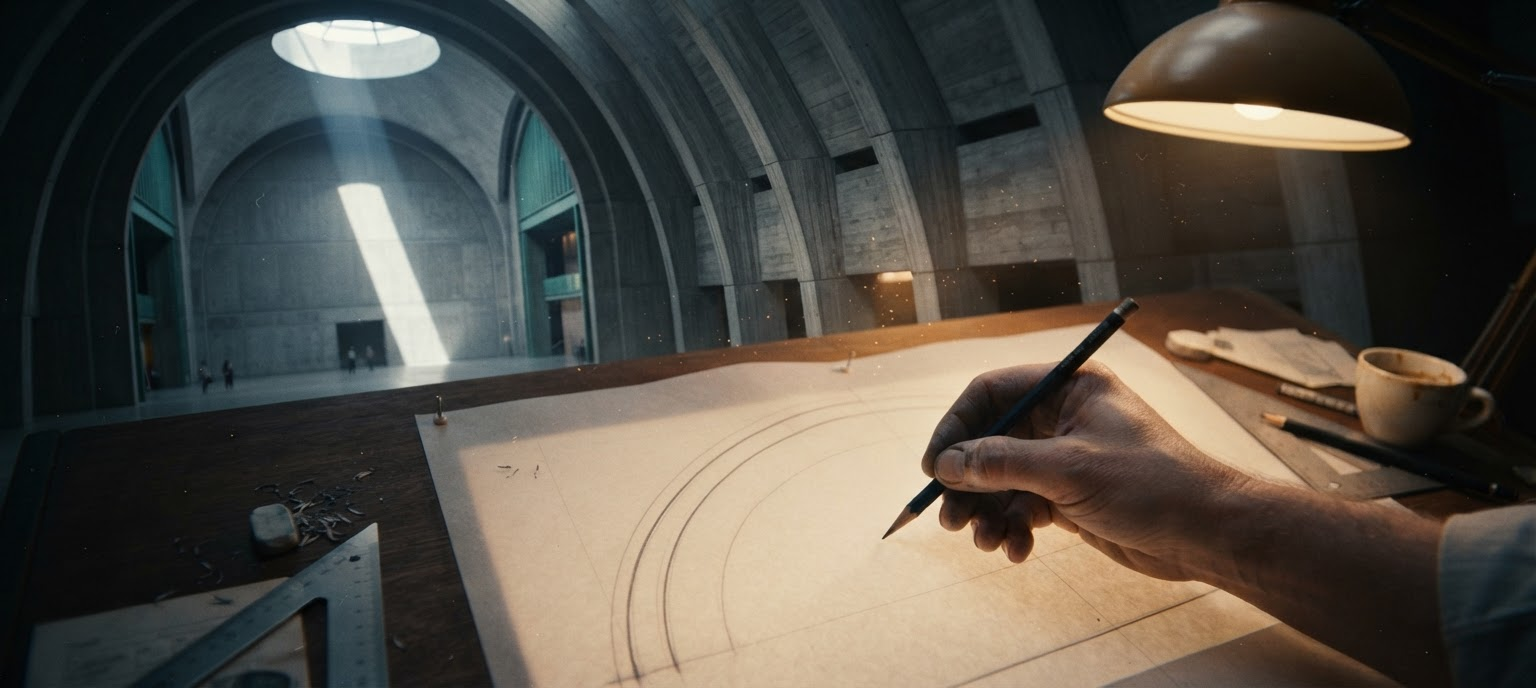
An unfinished line can contain a question that a polished rendering has already concealed. In the cover illustration, a hand draws beneath the image of a monumental interior. The relationship is useful precisely because it is conceptual: the drawing is not evidence that the imagined building works. It is the place where relationships can first become visible, debatable and changeable. This is where the term designerly becomes relevant to architecture and design.
Designerly describes ways of knowing and acting characteristic of designing: framing an uncertain situation, proposing an arrangement, representing it, and learning by examining what the proposal makes possible. It does not mean fashionable, visually sophisticated or decorated by a professional. Nor does it confer immunity from evidence. A designerly proposition earns its value through the quality of the questions it opens and the tests it survives.
A distinct contribution, not a closed intellectual territory
Nigel Cross gave the concept a foundational formulation in his 1982 paper Designerly ways of knowing. He situated design alongside science and the humanities as an educational culture, drawing attention to modelling, synthesis and practical appropriateness. His argument helped make design legible as intellectual work rather than merely the execution of someone else's ideas. [1]
That distinction should not be turned into a caricature in which scientists only analyse, artists only express themselves and designers alone invent. Cross's comparison is an explanatory model. Real architectural work combines physical evidence, social interpretation, calculation, material judgement and invention. Its distinctive challenge is to assemble these resources into a proposal that can be inhabited, made and maintained.
An architect may know the dimensions of a room without yet knowing how to arrange its entrance. The missing knowledge is not necessarily another measurement. It may emerge when several entrance positions are drawn and their consequences become apparent. This is the practical meaning of knowing through design: the proposal becomes an instrument of inquiry, rather than simply a container for conclusions reached elsewhere.
The brief changes when a solution appears
Consider a hypothetical small library asked to provide more seats. A literal response packs additional chairs into the plan. A designerly investigation asks what makes the existing seats unavailable: poor light, uncomfortable proximity, lack of power, circulation crossing the reading area, or a mismatch between quiet study and group activity. These are possible explanations to investigate, not findings about a particular library.
A first plan might separate movement from reading. A second might distribute small groups around the perimeter. A third might reduce the total seat count while making more seats usable throughout the day. Comparing them changes the brief from providing furniture to supporting different forms of occupation. The problem and the proposal develop together.
This does not authorize a designer to disregard the client. Reframing must be discussed with the people affected. Otherwise a useful intellectual operation becomes a way of substituting professional preference for actual need. The design team should be able to explain which observation prompted the change, whose experience supports it and what remains uncertain.
Drawing is a test with a particular range
A plan makes adjacency and route choice available for inspection. A section makes vertical relationships, daylight openings and changes of level easier to examine. A physical mock-up brings reach, weight, resistance and bodily negotiation into the discussion. None reveals everything. Choosing a representation means choosing which questions can become answerable.
In the library example, a plan may suggest that two people can pass behind occupied chairs. A full-scale arrangement can reveal bags, coats and sideways movements that the plan omitted. A daylight simulation may then test a different question, while observation after occupation establishes whether people actually choose the places that were intended for them. These methods are complementary, not interchangeable.
The important distinction is between a representation that helps someone decide and one that merely persuades someone to approve. A beautiful image may conceal a weak threshold, an inaccessible handle or an unresolved service route. Designerly intelligence is demonstrated when the team changes the representation to expose those problems, even at the cost of making the presentation less flattering.
Proposals are conjectures with consequences
Design reasoning often proceeds by proposing something that might resolve a situation. A recessed entrance might produce shelter and a clearer address. A movable partition might allow a room to accommodate incompatible activities at different times. These are conjectures. Their plausibility does not establish that they work under every condition.
The next question must be what would count against the proposal. Does the recess obstruct visibility? Can the partition actually be moved by the available staff? Where is it stored? Does its acoustic performance remain adequate after repeated use? A productive design process makes possible failure explicit early enough for change to remain affordable.
Iteration is therefore more than making many versions. Ten nearly identical images may produce less knowledge than one awkward model tested against a difficult requirement. Each iteration should identify a question, introduce a meaningful difference, and record what that difference revealed. Without this discipline, iteration can become repetition disguised as exploration.
Judgement is accountable to more than the designer
Peter Lloyd's account of design research describes a social turn that expanded the study of designing beyond an exclusively objective model of individual problem solving. It brings attention to the plurality of practices and perspectives through which design is understood. [2] For architecture, the consequence is practical: a proposal cannot be evaluated solely through the account of the person who drew it.
A cleaner knows which corners retain dirt. A wheelchair user knows which approach requires an exhausting detour. A facilities manager knows which ceiling access panel cannot be reached without closing a room. Their knowledge does not simply arrive after the design as feedback. It can help define the problem before the proposal becomes fixed.
Participation still needs structure. Different users may want incompatible things, and attendance at a workshop does not prove that influence was shared. A useful design record identifies whose input changed the proposal, which requests were not adopted, and why. This connects empathy to decisions rather than treating empathy as a declaration of professional virtue.
Good design and good research are different achievements
An original chair can be a successful design without establishing a general claim about sitting. A well received entrance can solve one commission without proving a universal theory of wayfinding. The step from practice to research requires a question, an explicit approach, evidence and an argument that another person can examine.
Beck and Stolterman's study of knowledge claims in design research makes the diversity of such claims visible. [3] A statement about what people do differs from a statement about what a profession should value. A proposed framework differs from evidence that the framework improves outcomes. These distinctions matter when a design studio describes its work as research.
For a practice-based investigation, the rejected alternatives may be as informative as the final object. The record can show what was held constant, what changed, how a judgement was made, and which circumstances limit its transfer to another project. The building then contributes to an argument; it does not replace the argument with an impressive photograph.
Teaching the ability to question a proposal
Design education can make this knowledge visible by assessing decisions as well as outputs. Students can be asked to show an initial assumption, an alternative that challenged it, an observation that changed the project and a remaining uncertainty. A presentation becomes a trace of learning rather than an account of inevitable progress toward the final form.
For professional practice, a similar discipline improves design reviews. Begin with the decision to be made. State the options and the criteria. Use representations appropriate to those criteria. Invite the people who bear the consequences. Record the reason for selection. This sequence does not eliminate creative judgement; it gives judgement a structure through which it can be discussed.
Tools that generate visual alternatives quickly make this distinction more important. The availability of more images does not establish that the brief has been understood or that the selected image describes a feasible building. The team's responsibility remains to connect representations with materials, dimensions, use and consequences. Speed is useful when it expands inquiry, not when it closes it prematurely.
The drawing should return a better question
Designerly knowledge is most valuable where information alone does not determine an arrangement. It enables people to construct possibilities and learn from them. Its strength is not a mysterious talent that cannot be explained, but a practiced movement between imagination, representation, testing and judgement.
The unfinished line in the cover therefore matters more than the apparent certainty of the imagined hall. A line can still move. It can expose an assumption, invite another person's knowledge and redirect the project. Design becomes intellectually rigorous when that freedom is used to make decisions more answerable to the world they will change.
Sources
- Cross N. Designerly ways of knowing. Design Studies. 1982;3(4):221–227. DOI: 10.1016/0142-694X(82)90040-0. Related original research note: Design Education Research Note 9, The Open University, January 1982.
- Lloyd P. You make it and you try it out: Seeds of design discipline futures. Design Studies. 2019;65:167–181. DOI: 10.1016/j.destud.2019.10.008.
- Beck J, Stolterman E. Examining the Types of Knowledge Claims Made in Design Research. She Ji. 2016;2(3):199–214. DOI: 10.1016/j.sheji.2017.02.001.
Cover: conceptual illustration from the ArchUp archive. It illustrates drawing and spatial imagination, not a documented built project.