The Dome That Once Held Up the Sky and Now Projects It

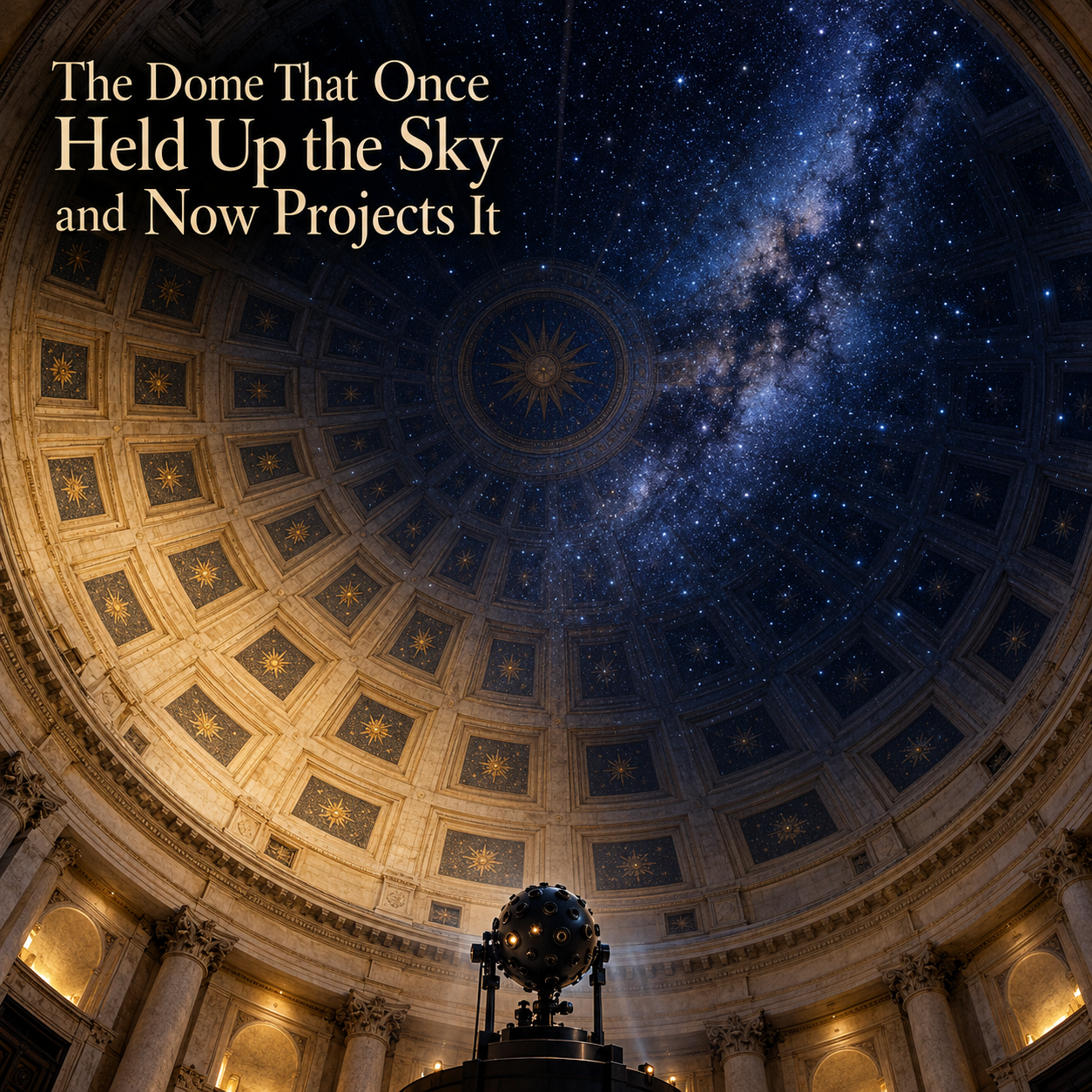
Stand in the center of the Pantheon in Rome and look up, and you are standing under the largest unreinforced concrete dome on earth, a hemisphere nearly two thousand years old with a single round opening at its crown through which the real sky pours. The genius of that building is entirely structural and entirely spiritual at once, and the two cannot be separated, because the dome had to defeat gravity in order to mean anything, and it meant the heavens precisely because it had conquered the weight that should have brought it down. In many monumental building traditions, this was what a dome could represent. It was among the hardest structural problems a culture could set itself, a roof that spanned a great space without a single column beneath it, and because it was the hardest thing to build it became, in many traditions, a form associated with sacred and civic authority. The dome held up the sky. That was its job, and its difficulty was its meaning.
We have been thinking about domes because of a small and very technical thing, a method for throwing a projected image onto the inside of a dome using nothing more than an ordinary projector and a curved mirror, and the more we looked at that modest piece of optical engineering the more it seemed to us a marker of something large and almost unnoticed. The dome, over recent decades, has quietly changed what it is for. The structure that was built for two thousand years to hold weight up against the sky is now, increasingly, built to display a sky on its inner surface. One of the most demanding monumental forms in architecture has been turned, gently and without much comment, from a feat of structure into a screen, and we want to follow that reversal carefully, because it says something about where building itself is going.
The Age When the Dome Was a Structural Confession
To feel the size of the change you have to remember how costly the dome once was, how much a civilization had to confess about itself in order to raise one. The Romans poured the Pantheon’s hemisphere in concrete that grew lighter toward the top, mixing heavy aggregate at the base and porous volcanic stone near the crown, thinning the shell as it rose, as part of an approach to controlling its weight and structural forces. A thousand years later, under the dome of Hagia Sophia in Constantinople, the builders floated a shallow hemisphere on a ring of windows so that it seemed, to everyone beneath it, to hang from heaven on a chain of light, and when it fell, as it did, they built it again steeper and wiser, having learned from the collapse what the mathematics could not yet tell them. In Florence, Brunelleschi raised a dome over a cathedral that had stood open for decades because no one knew how to span it, and he solved it with a double shell and a herringbone brick pattern that let the structure build itself without a centering scaffold, a problem so hard that its solution made him a defining figure in the emergence of the modern architect, a man whose authority rested on knowing how to make the impossible stand.
Every one of these was a structural confession, a statement in stone and brick about exactly how much a society understood of force and material and geometry. The dome could not be faked. You could not decorate your way to a dome or wish one into being. It stood or it fell, and because it so visibly might fall, its standing was a kind of proof, which is why the dome gathered to itself the deepest meanings a culture had, the temple, the cathedral, the mosque, the seat of the state. The construction of a dome was the hardest sentence a civilization could speak, and the sentence often invoked the heavens, because to span a great void without support was the closest that building ever came to the act of making a sky.
The First Reversal, When the Sky Came Indoors
The first crack in this ancient arrangement came from an unexpected direction, not from building at all but from astronomy. In the early twentieth century, someone had the idea of reproducing the night sky on the inside of a dome, projecting the stars and their motions onto a hemisphere so that an audience could sit beneath a manufactured heaven and watch it turn. The planetarium was born, and with it a quietly revolutionary inversion. Domes had long carried painted skies and cosmological imagery. The planetarium made a different reversal possible: a mechanically projected sky whose apparent motion could be demonstrated to an audience. The structure remained, of course, the hemisphere still had to stand, but its reason for being had split in two. It was still a roof, but now it was also a surface, and the thing projected onto that surface, rather than the structural triumph of the surface itself, was becoming the point.
For most of the twentieth century this remained a specialist affair, the planetarium an unusual building, its projection a complex and expensive apparatus at the center of the room. But the logic, once loosed, did not stay contained. The dome as a surface for immersion, a hemisphere that wraps the human field of vision so completely that the viewer loses the edge of the image and feels inside it rather than in front of it, turned out to answer a desire far larger than astronomy. The same geometry that let the Pantheon mean the heavens, the way a hemisphere fills the whole upward field of view and has no corner for the eye to escape to, is precisely the geometry that makes an immersive image overwhelming. The dome was always, it turns out, a device for surrounding the human being with something larger. For two thousand years that something was structure and God. Now it could be an image of anything at all.
The Democratization of the Projected Sky
Here is where the small technical marker enters, because one of the developments that helped make dome projection more accessible was not a grand architectural movement but a piece of humble optical cleverness. The traditional way to fill a dome with a single projected image required an expensive fisheye lens, which kept the immersive dome a thing of institutions and budgets. Then, in the middle of the two thousands, a method was described and popularised that used instead a single ordinary projector aimed at a spherical mirror, the mirror spreading the light across the whole dome, with software pre warping the image so that it landed correctly on the curved surface and correcting the brightness where the light had farther to travel. It was ingenious, and it was cheap, and like most important simplifications it was less a lone invention than the clarifying of something several people had been circling, earlier convex mirror systems having reached for the same idea before it was given its most usable form. The honest way to credit it is the way the careful literature credits it, as the popularising of an influential low cost method rather than the sole invention of the principle, and we find that modest accuracy more interesting than a myth of a single inventor, because it is how most real advances actually happen, by the patient refinement of a shared idea until it becomes available to everyone.
What that cheap mirror did was democratize the projected sky. Suddenly a small planetarium, a school, an artist, a studio could fill a dome with an immersive image with a smaller optical equipment budget, and the immersive dome began to escape the planetarium entirely, into art installations, into entertainment, into the experience economy of the cities, into the exhibition pavilion and the themed attraction. The projects that now raise domes are often not raising them to span a sacred void at all. They are raising them as screens, as surfaces to be filled with projected worlds, and the dome has completed a journey that would astonish Brunelleschi, from the hardest structure a civilization could build to a commodity surface wrapped around a paying audience.
What Is Gained and What Quietly Leaves
We want to resist the easy lament here, because there is something genuinely wonderful in this, and an architecture that only mourns is a useless one. The immersive dome recovers, for a mass audience, exactly the bodily overwhelm that the great sacred domes once delivered only to the faithful, the sense of being surrounded and made small beneath something vast. A child lying back under a planetarium dome watching the real constellations wheel overhead, or an audience inside a projected deep sea or a projected nebula, is having a version of the experience the Pantheon was built to produce, the human being placed bodily inside a cosmos. The design intelligence in this is real, and the cheap mirror that made it widely available is a democratizing gift, bringing the immersive sky to budgets and places that could never have afforded the structural or the optical grandeur of the older forms. To sneer at it would be to misunderstand what the dome was always secretly for, which was never the structure for its own sake but the surrounding of a person by something larger than themselves.
And yet something does leave in the exchange, and an honest architectural research has to name it rather than pretend the trade is free. When the dome’s meaning lived in its structure, the meaning could not be faked, and that unfakeability was the source of its power. The Pantheon means the heavens because it genuinely defeated the weight that should have destroyed it, and you feel that victory in your body even if you cannot name it, the slight awe of standing under a thing that by rights should fall. The projected dome need not make structural achievement its principal message. Its hemisphere may use a relatively light frame and fabric, although stability, fire safety, acoustics, maintenance and public access still demand serious engineering. The meaning has migrated to the surface, to the image thrown onto it, and an image can be anything and therefore, in a sense, is nothing in particular. In the reading we are proposing, the old monumental dome made its image of the heavens inseparable from material effort. The new dome can display every sky and so is committed to none, and in that freedom there is a loss of exactly the gravity, in both senses of the word, that made the dome the most sacred form in the history of building.
The Dome as a Sign of Where Building Is Going
This is why the little mirror matters beyond itself, because the reversal it marks is happening across all of architecture, not only in domes. The dome is simply the clearest and most poetic case of a general migration, the movement of meaning out of structure and into surface, out of the thing that is built and into the image displayed upon it. We are learning, across the whole discipline, to treat the built shell as a neutral armature and to invest the meaning in the media layer wrapped around it, the projection, the screen, the responsive facade, the digital skin. The dome makes this shift particularly visible because it was always the form in which structure and meaning were most tightly fused, so their separation shows most starkly there. When the hardest structure in the world becomes a cheap frame for a projected image, you are watching, in miniature, the thing that is happening to building everywhere, the demotion of structure from the carrier of meaning to the mere support for a surface that carries it instead.
The clever mirror is the occasion for this story. The dome is its subject, because it holds the whole arc in a single form. The news will keep announcing the newest immersive attraction and the brightest projection, and the architecture competitions will keep rewarding the spectacular surface and the enveloping image, and almost no one will pause to notice that the form being filled with these wonders is the same hemisphere that once represented the summit of what a civilization could structurally achieve, now often valued above all for the shape of its embrace. The real question the dome poses to us, in its long journey from the Pantheon to the mirror, is whether a building can keep its depth of meaning once that meaning no longer has to be earned in structure, and we do not think we yet know the answer. The genuine sustainability of architectural meaning may depend on remembering that the Pantheon moves us through the effort required to make it stand, independently of any image that might be projected onto it, and that a sky you merely display is not quite the same as a sky you have actually, against all the odds of gravity, built. The dome once held up the sky. Now it projects one, and the distance between those two verbs, to hold and to project, is the quiet measure of everything our age has gained in access and lost in weight.
Prepared by the ArchUp Research Team.
Reading Note
This is an architectural interpretation, not a comprehensive history of domes or a comparative performance study. The technical discussion was checked against published abstracts and selected descriptions of projection systems; it does not claim a full reading of every paper. The contrast between structure and image is the research team’s interpretation, not a finding demonstrated by those optical studies.
Sources
- Bourke P. Using a spherical mirror for projection into immersive environments (Mirrordome). Proceedings of the 3rd International Conference on Computer Graphics and Interactive Techniques in Australasia and South East Asia, 2005, pp. 281–284.
- Bourke P. Spherical mirror (Mirrordome): A new approach to hemispherical dome projection. Planetarian, 34(4), 2005.
- Hashimoto W, Iwata H. Ensphered Vision: Spherical Immersive Display using Convex Mirror. Transactions of the Virtual Reality Society of Japan, 4(3), 1999, pp. 479–486.
- Pantheon Roma. The Pantheon Dome: A Marvel of Ancient Roman Architecture, 2026; and Pantheon History. Institutional architectural descriptions.
- Opera di Santa Maria del Fiore. August 7: Start of Work of the Dome; and museum documentation of the herringbone brick dome model. Institutional architectural descriptions.