When the Building Soars Alone: How the Architectural Symbolism of the Eagle Becomes a Daily Anxiety for City Dwellers

A study in analytical psychology reveals how design built on dominance and height creates a gap between a building’s imposing image and the experience of those who live in its shadow
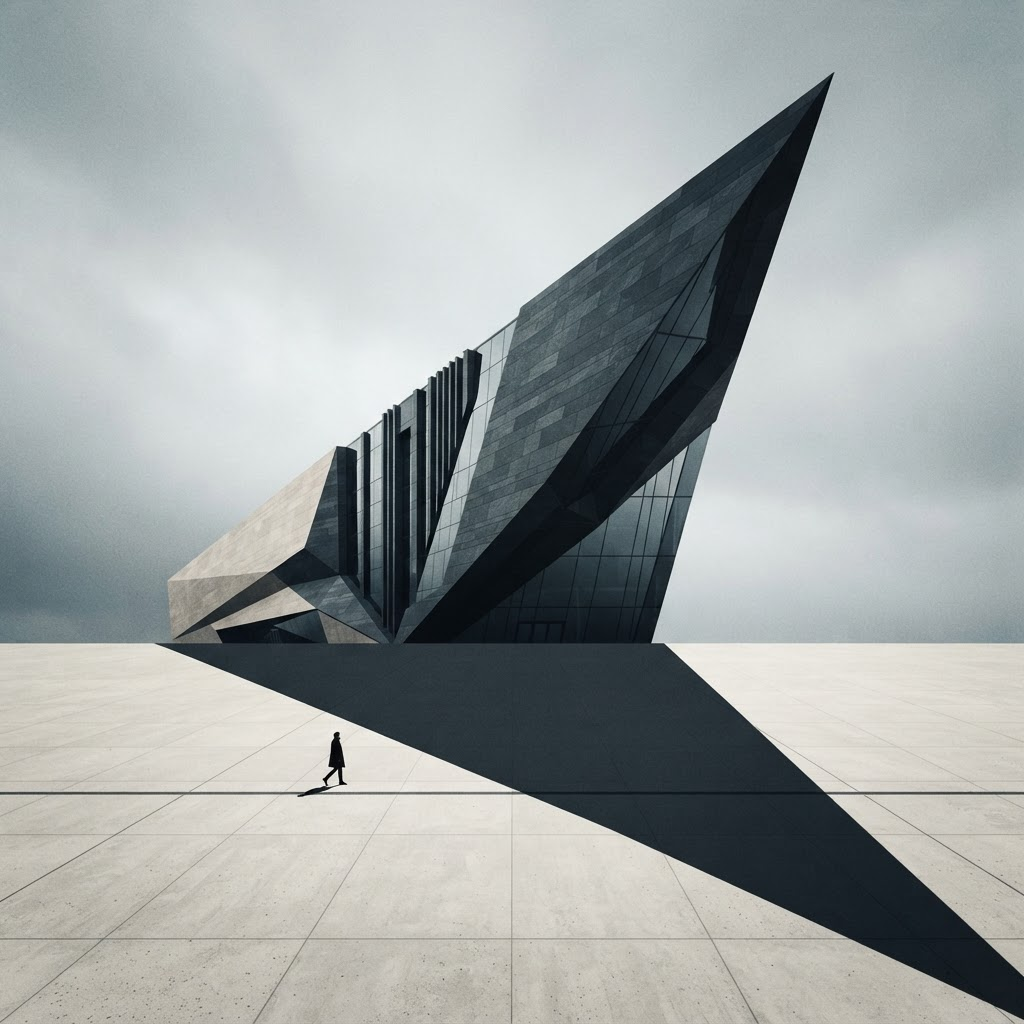
In the heart of every major city, there is at least one building that refuses to look at the street. Its sharp glass facade cuts through the skyline, its massive entrance receives you as though you were approaching an audience with a god, and its height is calculated with precision to make you, the small passerby, feel your true size in the face of “greatness.” This building was not designed to be inhabited, but to be feared. What we witness here is nothing short of architectural dominance. And here lies the uncomfortable question: does architectural grandeur, when it becomes a central design identity, heal the city or make it sick?
The answer, drawn from an unexpected field, the analytical psychology founded by Carl Jung, may come as a surprise: the eagle, with all its symbolism of power, elevated vision, and sovereignty, when it becomes an archetype that an individual identifies with excessively, does not grant strength but instead severs the person from reality, producing ego inflation, emotional isolation, and a denial of human vulnerability. The question that has not yet been asked is this: what happens when it is not a single individual who identifies with this model, but an entire building, or even an entire urban district?
The Archetype That Never Descends
In analytical psychology, archetypes are universal, inherited patterns within the human psyche, empty forms that shape our experiences and symbols across cultures. Among these patterns, the eagle occupies a special position: it symbolizes celestial power, sovereignty, breadth of vision, and the capacity to see everything from above. Researcher Myers, in her study on adolescent identification with symbolic animals, found that the eagle received the highest positive identification score among young people, specifically because of its association with three qualities: freedom, power, and total knowledge.
These same three qualities are precisely what every architect seeks when designing a landmark tower, a government headquarters, or the facade of a multinational corporation. Height visually delivers “total knowledge”: whoever stands on the fiftieth floor sees the city as a map beneath their feet. Glass and sharp lines deliver “freedom” from the weight of traditional materials. And a mass that dominates the skyline delivers “power.” But the problem, as analytical psychology warns, does not lie in invoking the symbol, but in identifying with it excessively, without balance.
When the Facade Contracts “Spiritual Intoxication”
Jungian psychologist Deborah Wesley describes a psychological state that afflicts those who identify too strongly with a powerful archetype, calling it “spiritual intoxication”: a shift in perspective, an inflated sense of specialness, and a loss of connection to daily life and tangible reality. Wesley recounts how she began having dreams in which she found herself trapped atop a tower, afraid of falling, before she realized she had lost her psychological balance.
This exact condition can be observed in a number of architectural projects designed to impress rather than to house. A building that identifies with the eagle archetype contracts what might be called “architectural intoxication”: an exterior facade that seeks continuous spectacle, height that escalates without clear functional justification, and a growing disconnect from human scale, the term referring to the proportioning of spatial dimensions to the human body and its natural movement. As Jacobson warns, identification with a given model leads to a loss of control over one’s perceptions and actions, and an architect who identifies excessively with the notion of “visual dominance” may lose the ability to assess whether the design still serves those who will live or work inside it.
Architectural Superiority: When Grandeur Becomes Collective Narcissism
Research by Funk and Weiser on what is called “spiritual superiority,” the feeling that one is more advanced than others, offers a useful framework for understanding a parallel phenomenon in architecture. Their study showed that people who engage in a particular spiritual practice tend to feel superior to those who do not, and that this feeling is closely tied to what they call “communal narcissism,” the belief that one is especially good, wise, and useful to others, even when one’s behavior suggests otherwise.
The architectural equivalent of this phenomenon might be called “starchitect narcissism,” in which a government or institutional building is designed to announce the superiority of the owning entity or the genius of the designer, rather than to serve its users. And the irony, as Funk and Weiser observed in their psychological context, is that practices supposedly meant to serve others, such as “humane” or “sustainable” design in marketing discourse, often end up reinforcing the designer’s image more than serving the actual occupant. A building constructed under the banner of “redefining the urban skyline” may hide, behind its glossy facade, cold interior spaces, long corridors that strip visitors of any sense of direction, and massive entrances that diminish the human being rather than welcome them.
Architecture That Bypasses the Problem Instead of Solving It
Researcher Toussaint explores the concept of “spiritual bypassing,” the use of spiritual practices to avoid confronting unresolved emotional problems, much like taking a painkiller for a wound that needs real cleaning. Psychologist James Hillman criticizes this tendency sharply, considering that transcendence without integrating the shadow side of experience is a form of denial, indeed a “disguised psychopathology.”
This diagnosis applies with unsettling precision to a number of major urban projects in which iconic architecture is used to “soar above” real problems instead of solving them: a housing crisis, a fractured social fabric, or crumbling infrastructure. Instead of confronting these problems through urban planning that addresses root causes, a single towering skyscraper is built and presented as a symbol of “renaissance” or “progress,” while the surrounding neighborhoods remain unchanged. What psychology calls “living a provisional life,” remaining suspended while waiting for ideal conditions rather than committing to reality, finds its architectural embodiment in projects that constantly proclaim “the future” while ignoring the city’s present and its residents.
When the Building Forgets to Be as Fragile as Its Users
In Myers’s own study on children, it is worth noting what older adolescents rejected when they chose the eagle: the rabbit, a symbol of weakness, smallness, and dependency, which younger children loved but which older adolescents held in contempt. This rejection of vulnerability, when projected onto architecture, explains a familiar phenomenon: buildings designed with a logic of dominance rarely accommodate the elderly, people with disabilities, children, or simply human beings in moments of fatigue and need for rest. An entrance that requires climbing long flights of stairs to produce “a sense of arrival,” vast lobbies devoid of seating, and glass facades that prevent any sense of privacy or shelter, all reveal a design that refuses to acknowledge that its users are finite human beings, not eagles capable of tireless flight.
Psychologist and theologian Edward Edinger explains that excessive identification with a powerful archetype produces an “inflation” in which the person loses connection with their limited humanity. A building that inflates symbolically in the same way turns into an architectural mask, one that hides, behind its grandeur, a complete absence of consideration for the simple daily needs of those who will actually live in its shadow.
The Tower That Soars Alone Above the Urban Fabric
The eagle flies alone, unlike animals that live in groups, such as wolves or pigeons. Scott suggests that the individual’s journey within ancient shamanic traditions is fraught with risk and should not be romanticized, since one who seeks “the view from above” may face states of disconnection from reality if they lack a solid foundation of integration with their surroundings.
In urban planning, this is exactly what happens when a skyscraper is designed as an isolated element that refuses dialogue with the surrounding urban fabric: facades closed off at street level, entrances disconnected from pedestrian flow, and an architectural scale that creates a sharp visual rupture with neighboring buildings. Such a building adopts “individualism” as a supreme design value, becoming an isolated icon photographed for tourism publications, yet impoverishing the daily experience of those who walk beside it, leaving them feeling that the city was designed to be seen from an airplane, not lived on the ground.
Toward an Architecture That Knows When to Descend
The solution, according to the same body of psychological literature, does not lie in rejecting the symbolism of the eagle altogether, but in using it consciously and in balance with other archetypes. A healthy psyche, as research on personal development indicates, does not identify with a single model but moves among several archetypes: the Innocent, the Warrior, the Caregiver, the Sage. This is precisely what the contemporary city needs: an architecture of the eagle that represents ambition and vision, but complemented by an architecture of the “rabbit,” meaning proximity to the human being and ease of access, an architecture of the “hen,” meaning simple daily functionality, and an architecture of the “dog,” meaning loyalty to the context and memory of place.
Wesley also recommends the practice of “returning to the ground” after every moment of inspiration, which can be translated architecturally into established design principles: an entrance that welcomes at human scale before the building rises, a ground floor open to the street that engages passersby rather than ignoring them, and interior spaces that accommodate sitting, comfort, and waiting, not spectacle alone. And the willingness to integrate the “shadow,” acknowledging design shortcomings instead of hiding them behind a glossy facade, is what distinguishes mature architecture from architecture that fears admitting its limits.
The truly wise building is not the one that soars above the city’s clouds refusing to come down, but the one capable of rising when height is functionally and aesthetically justified, then choosing to descend gently toward the street, to greet passersby with an entrance that matches their scale, not the scale of its ambition alone.
✦ ArchUp Editorial Insight
The article’s Jungian framing performs a genre departure from ArchUp’s structural method, described in ArchUp’s editorial guidelines: it treats “dominance” as a psychological compulsion residing in the architect, when the more traceable cause sits upstream, in financing and status signaling.— Paragraph break —A tower’s height is rarely an aesthetic decision; it is frequently a debt-service instrument, additional floors justified to a lender or a board through projected lease income, or a status commitment written into a government’s brief before a design competition is even announced.— Paragraph break —What the article reads as “the eagle archetype” is, in procurement terms, a deliverable: visual authority specified by a client who needs the building to signal creditworthiness, sovereignty, or institutional permanence to an audience that will never occupy the lobby.— Paragraph break —The closed ground floor, the oversized entrance sequence, the corridor that disorients rather than orients, these are not symbolic overreach but cost-allocation outcomes, since ground-level retail frontage, lobby seating, and pedestrian-scaled detailing consume budget without contributing to the floor-area metrics investors price the asset against.— Paragraph break —This is the same liability transfer this archive traced at La Défense, where vertical capital was rewarded while horizontal civic experience absorbed the deficit, and at The Rent You Pay After the Rent, where the true occupancy cost of a design decision lands on parties absent from the room where it was approved.— Paragraph break —The psychological burden the article names is a downstream symptom; the decision that produced it was financial, made and exited long before anyone stood beneath the entrance it authorized.
References
Myers, G. “Symbolic Animals and the Developing Self.” Anthrozoös, 2002.
Jacobson, K. H. “Organization and the Maternal Archetype.” Administration and Society, 1993.
Freeman, D. R. “Archetypal Identification: An Alternative for Assessing Spiritual Well-Being.” Journal of Religion and Spirituality in Social Work: Social Thought, 2015.
Toussaint, M. “Transcendence and Its Shadow: A Depth Psychological Inquiry into Transcendence, the Transcendent Function, and Spiritual Bypassing.” Psychological Perspectives, 2023.
Funk, R., and Weiser, A. “Exploring Spiritual Superiority: The Paradox of Self-Enhancement.” European Journal of Social Psychology, 2021.
Wesley, D. “Spiritual Intoxication: Returning to Reality.” Psychological Perspectives, 2019.
Semetsky, I. “Interpreting the Signs of the Times: Beyond Jung.” Social Semiotics, 2010.
Scott, E. “The Visionary Psyche: Jung’s Analytical Psychology and Its Influence on Shamanic Imagery Theories.” Anthropology of Consciousness, 2014.

![Bathroom Bundle Kit [Flat End] – Walnut / Walnut / Steel Ring & Screws](https://archup.net/wp-content/uploads/2021/12/13200-bathroom-bundle-kit-flat-end-walnut-walnut-steel-ring-screws-scaled.jpg)