The Rent You Pay After the Rent

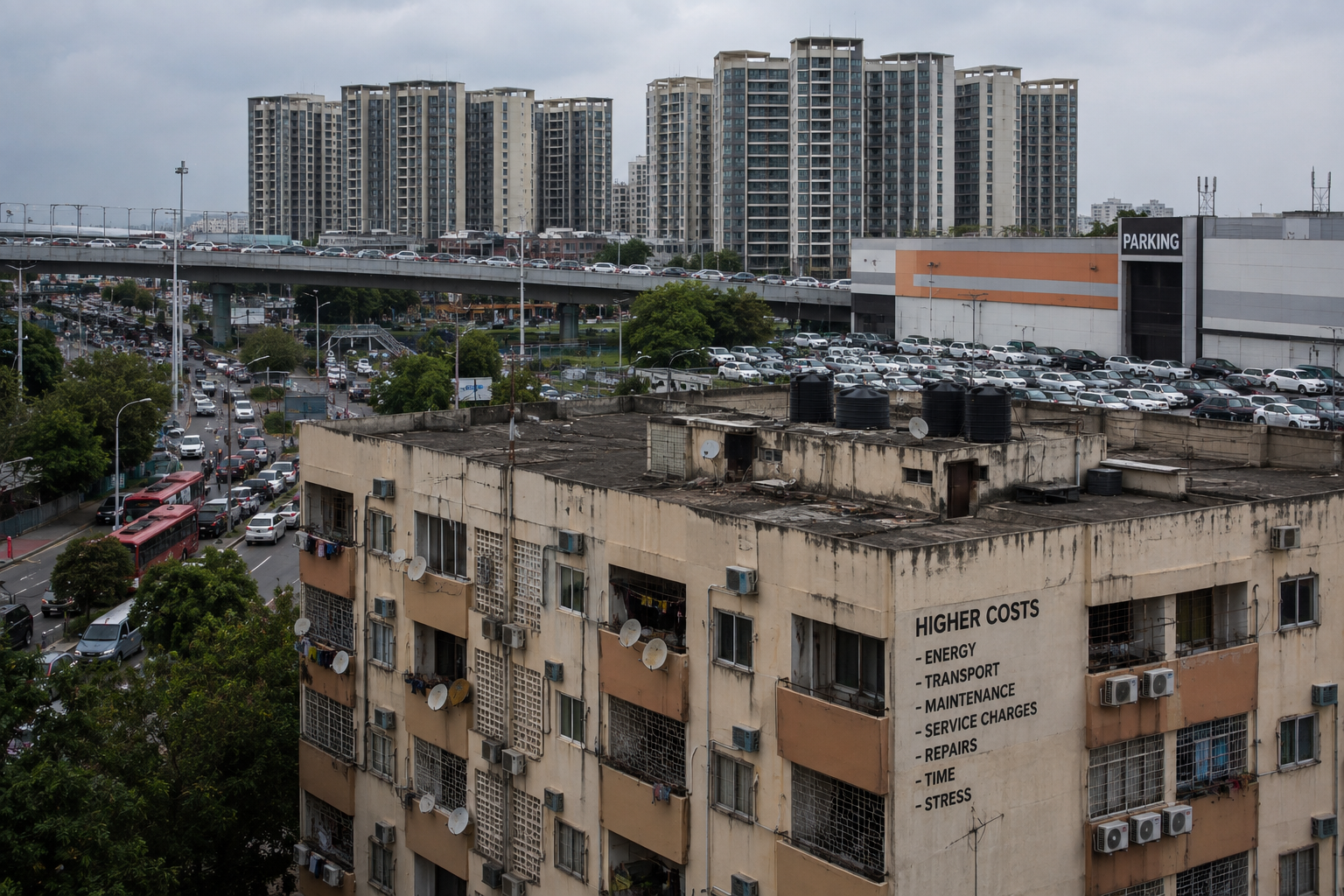
Beyond basic rent, housing costs include hidden expenses driven by architectural and planning decisions. This poverty premium forces low-income households to pay more for energy, transportation, and maintenance. These recurring costs are structurally embedded in the built environment, creating significant financial burdens that rent-to-income ratios often fail to capture.
Energy inefficiency, remote locations, and mandatory parking requirements exacerbate financial instability. Addressing these issues requires a shift in housing policy toward total occupancy costs. Solutions include improving building insulation, reforming parking mandates, and prioritizing transit-rich locations to reduce the long-term financial strain on vulnerable families.
Ask someone what their apartment costs and they will tell you the rent. It is the wrong number, and the gap between that number and the true one is where a great deal of poverty is quietly manufactured. The rent is only the visible price of shelter. Behind it stands a second, larger, and almost invisible bill, the cost of heating a leaky envelope, of driving because the layout left no other option, of the parking space bundled into the lease whether or not a car exists to fill it, of the deferred repair that becomes a catastrophic one, of the deposit that never returns, of the commute that eats an hour and a tank each way because the affordable home sat where the jobs did not. This is the total cost of occupancy, and the built environment sets almost all of it. The most consequential decisions about what a family will pay to live somewhere were made by an architect and a planner years before that family arrived, and they were made in materials and distances, not in dollars, which is exactly why nobody recognizes them as the price they are.
There is a name for the pattern this produces, borrowed from economics and sharpened by housing research. The poverty premium. It describes the well documented reality that the poor pay more for the same essential goods than the affluent do, through worse quality at similar prices, higher prices for similar quality, or catastrophic spending burdens they cannot avoid. Housing is the textbook case, and architecture is the mechanism. Because poor households cannot pay large sums upfront, they take the older, smaller, less efficient dwelling. Because they lack credit and liquidity, they cannot switch, repair, or relocate to escape. Each of these constraints converts, silently, into a stream of recurring costs that never appear in a rent to income ratio and are nonetheless very real. The premium is not a moral failing or a market accident. It is designed in, and it recurs every single month for the life of the building.
The Bill Hidden in the Walls
The clearest architectural driver of recurring poverty is the energy performance of the dwelling, because it turns a one time design decision into a permanent monthly tax. Using actual building energy data for around thirteen thousand multifamily buildings across five American cities, researchers found that the average low income household carries an energy cost burden of seven percent of income against two percent for higher income households, and that for some of the poorest the burden reaches twenty percent. The most revealing finding is what happens within a single income band. Households in predominantly minority neighborhoods paid energy burdens up to twenty seven percent higher than households of the same income elsewhere, which means the burden is not a function of income at all. It is a function of the building, its insulation, its glazing, its heating system, the quality of the envelope someone specified and someone else approved. Two families with identical paychecks pay different energy bills because they live inside different design decisions.
And fuel poverty does not arrive alone. It interacts with housing cost in a sequence the research describes with unusual precision. Housing costs pull a household below the poverty line, and then energy costs push it deeper, because the same dwelling that consumes half the income in rent is also the leaky, single glazed, electrically heated stock that consumes the most to keep warm. In England, housing and energy together have consumed around a fifth of average income, and millions of households fall into fuel poverty concentrated precisely in the oldest and least efficient construction. The consequences are not merely financial, and they too are costs. Excess winter deaths run nearly three times higher in the coldest quarter of housing than the warmest. Children in cold homes are more than twice as likely to suffer respiratory illness. A quarter of adolescents in cold homes show mental health problems against one in twenty in warm ones. A national health service spends hundreds of millions a year treating illness generated by bad thermal design, which is to say the leaky wall bills the family in winter and bills the public in medicine, every year, without end.
The Cost of Being Sent to the Edge
Where a building sits is as expensive as how it is built, and here the poverty premium takes the form of distance. Housing and transport together consume more than half of a typical household budget, and for poor households the combined burden is the highest share of income of any group. The cruelty is in the arithmetic of the trade. Poor households in dense, transit rich neighborhoods spend around a third less on transportation than comparable households in sprawling developments, but they pay nearly a third more for housing in those same neighborhoods, so the total does not fall. The market has already capitalized the location’s efficiency into its rent. The savings exist, but they have been priced away before the poor household arrives, and it cannot capture them without assistance it rarely receives.
When the central location is unaffordable, the household is pushed outward, and transport poverty becomes a permanent fixture of its budget. Research in one European metropolitan region found that low income movers in a tight market simply take what they get, unable to optimize for access to work and services, and end with longer, costlier, more time consuming commutes on top of rents already consuming forty percent of income. One resident’s summary of the trap is hard to improve upon, that when you earn less, you are pushed toward the fringes of the city. And the fringe is engineered for the car. For the carless poor, the group least able to absorb the cost, transit access is a direct line to employment, and affordable housing built in transit poor locations systematically raises their cost and time of reaching a job. The cities that build cheap housing far from work and far from transit have not helped the poor. They have relocated the poverty premium from the rent line to the fuel line and called it affordability.
The Tax on the Car You Do Not Own
Among all the ways planning inflates the cost of living, minimum parking requirements are the most concrete and the least noticed. A bundled garage space adds roughly seventeen percent to residential rent, a figure so large it deserves to be read twice, and much of that cost falls on households that own no car and gain nothing from the space. In one American analysis, carless households saddled with a garage earned about half the income of other households, which means the mandate transfers money from the poorest toward the storage of vehicles they do not have. In New York City, zoning has required an average of fifty eight parking spaces per hundred new housing units, each structured space costing tens of thousands to build on land that can run above a hundred thousand for a small lot, and developers build to the minimum, which tells you the requirement exceeds what the market wanted. Even where parking is unbundled, tenants who rent no space often subsidize their neighbors’ through the rent they pay anyway. A regulation written to manage cars ends up as a levy on the carless poor, inflating every rent, forcing density down, and doing it so quietly that almost no tenant knows the line item exists inside their lease. The projects that could house people affordably are made more expensive by a rule that has nothing to do with shelter and everything to do with the automobile.
The Repair That Waits Until It Cannot
Maintenance is the slowest of the premiums and among the most punishing, because it compounds. Low income homeowners overwhelmingly buy older houses, more than half over thirty years old, and maintenance cost rises steeply with age, roughly quadrupling between a ten year old home and a fifty year old one, with a sharp jump around twenty five to thirty years when the major systems fail together. Yet most owners of homes with serious physical problems spend almost nothing on routine upkeep, not from negligence but from impossibility, and only a tiny fraction of major repairs by low income owners ever receive any subsidy. The economics of this are stark. For the poor, maintenance is a hidden investment that must be constantly rationed against food and rent, its spending rising measurably with every extra dollar of stable income, while for the affluent the same relationship is statistically flat, because they simply maintain. So the poor household defers, and deferral is never free. It converts into health hazards, into accelerated decay, and eventually into a catastrophic bill or the abandonment of the family’s single largest asset. For renters the same force appears as service charges, preparation deposits that do not return, higher deposits demanded of thin credit, and the recurring choice between paying rent and paying for heat. The building ages faster than the family can afford to slow it, and the difference is billed to them in full.
The Sum, and the Levers
Assembled, the poverty premium of the built environment is the sum of burdens that are not merely additive but structurally locked together. Energy at seven to twenty percent of income. Housing at a third to half and often past the poverty line on its own. Transport forced by low density and thin transit. Parking bundled invisibly into rent. Maintenance rationed until it detonates. The health cost of cold homes paid in bodies and in public budgets. The latent costs of deposits and fees and the sequential costs of instability, eviction, debt, a housing history that makes the next home more expensive still. And the reason these fall together rather than separately is the deepest point of all. The same households paying the highest rent burden live in the least insulated stock. The same neighborhoods affordable to the poor are the most transport dependent. The same regulations that inflate housing cost also mandate the car dependence that drains what little the rent left behind. A family sitting just above the poverty line is pulled under by housing cost, pushed deeper by energy, and then struck by transport and maintenance it cannot defer forever. The premium is a system, and it was built.
Which means it can be unbuilt, and this is where the argument turns from indictment to instruction. Building efficiency is not an environmental luxury but a direct anti poverty tool, since energy retrofits with short payback periods can cut a low income household’s energy burden by as much as half without anyone relocating, making insulation and an airtight envelope a form of income support delivered through the wall. Location efficient planning genuinely lowers transport cost, but only if housing supply keeps pace so the savings are not captured by rent and the poor are not exiled to the car dependent edge. Parking reform, unbundling the space from the rent and abolishing the minimums, cuts housing cost immediately and most for the carless poor. And the metrics themselves must change, because a profession that measures affordability by rent alone is measuring the smallest part of the bill. The honest measure is the total cost of occupancy, rent plus energy plus transport plus maintenance, assessed together, and any serious architectural research or housing policy that still evaluates a home by its rent line is complicit in hiding the rest. This reframes sustainability as well, since the efficient, well located, durable building is not only lighter on the planet but lighter on the household that can least afford the alternative. The news will keep reporting rents and headline prices, and the more truthful story, the one a design competition ought to reward, is which building costs least to actually live in over ten years, a number almost no one publishes.
So the conclusion is sharper than a call for cheaper housing. The built environment does not merely house poverty. It charges rent to it, a second rent, levied after the first, in fuel and distance and deferred repair and the storage of absent cars, falling hardest on the households least able to pay and least able to see where the money is going. A building is not affordable because its rent is low. It is affordable because the total cost of living inside it is low, and the difference between those two definitions is where millions of families are quietly made poorer by decisions they never voted on, made in materials and distances by people they never met, and paid for every month until the day they finally cannot.
✦ ArchUp Editorial Insight
The minimum parking requirement that adds seventeen percent to residential rent is not a planning error awaiting correction — it is the spatial translation of a political economy in which the automobile lobby, the suburban development model, and the municipal finance system that depends on low-density land consumption have each written their interests into the zoning code as though they were technical standards, and the carless poor household that pays the resulting levy has no seat at the table where any of those interests were encoded. The article’s most structurally consequential contribution is its reframing of affordability as a total occupancy cost rather than a rent-to-income ratio, because that reframing exposes the precise mechanism by which a building can be legislated as affordable while functioning as the opposite: the rent line satisfies the subsidy threshold, the energy bill satisfies nobody, the transport cost is not measured, and the maintenance deferral accumulates invisibly until it detonates in a single unaffordable event that the household’s savings, already consumed by the other premiums, cannot absorb. This is the systemic architecture that The Architecture of Not Enough identified at the level of the self-built wall — tenure insecurity producing rational underinvestment — now operating at the level of the entire regulatory and planning apparatus: in both cases the design decisions that determine what a poor household will actually pay to inhabit a space were made by parties who will never inhabit it, measured by metrics that will never capture it, and enforced by institutions whose definition of success stops precisely at the point where the family’s real costs begin.
Sources
- Burlinson A, Giulietti M, Battisti G. The elephant in the energy room: establishing the nexus between housing poverty and fuel poverty. Energy Economics, 2018, 72, 135 to 144.
- Kontokosta CE, Reina VJ, Bonczak B. Energy cost burdens for low income and minority households. Journal of the American Planning Association, 2019, 86(1), 89 to 105.
- Schouten A. Residential location and household spending: exploring the relationship between neighborhood characteristics and transportation and housing costs. Urban Affairs Review, 2021, 58(6), 1554 to 1584.
- Sterzer L. Does competition in the housing market cause transport poverty? Interrelations of residential location choice and mobility. European Transport Research Review, 2017, 9(3).
- Duke-Lucio J, Peck LR, Segal EA. The latent and sequential costs of being poor: an exploration of housing. Poverty and Public Policy, 2010, 2(2), 83 to 102.
- Mendoza RU. Why do the poor pay more? Exploring the poverty penalty concept. Journal of International Development, 2010, 23(1), 1 to 28.
- Gabbe CJ, Pierce G. Hidden costs and deadweight losses: bundled parking and residential rents in the metropolitan United States. Housing Policy Debate, 2016, 27(2), 217 to 229.
- McDonnell S, Madar J, Been V. Minimum parking requirements and housing affordability in New York City. Housing Policy Debate, 2011, 21(1), 45 to 68.
- Kutty NK. A new measure of housing affordability: estimates and analytical results. Housing Policy Debate, 2005, 16(1), 113 to 142.
- Saunders P. Housing costs, poverty and inequality in Australia. Housing Studies, 2016, 32(6), 742 to 757.
- Wise J. Number of excess winter deaths is three times as high in coldest homes as in warmest. BMJ, 2011, 342, d2910.
- Stafford B. The social cost of cold homes in an English city: developing a transferable policy tool. Journal of Public Health, 2014, 37(2), 251 to 257.
- Acquaye L. Low income homeowners and the challenges of home maintenance. Community Development, 2011, 42(1), 16 to 33.
- Hernandez MA, Trupkin DR. Asset maintenance as hidden investment among the poor and rich: application to housing. Review of Economic Dynamics, 2021, 40, 128 to 145.
- Hu L, Wang L. Housing location choices of the poor: does access to jobs matter? Housing Studies, 2017, 34(10), 1721 to 1745.