The Hidden Cost of Breathing: How Maintenance Dictates the Financial Viability of Building Air Quality

ArchUp Desk —
In contemporary architectural discourse, indoor air quality (IAQ) is recognized as a fundamental metric for user well-being, especially in highly polluted urban environments. However, translating this vision into built reality often hits the wall of financial viability. Recent research in building economics reveals that the success of advanced air treatment systems does not rely on the initial capital expenditure of construction, but is almost entirely governed by one critical variable: lifecycle and facility management costs.
The Initial Cost Trap (CAPEX vs. OPEX) Financial modeling of electromechanical systems—specifically medical air conditioning (maAC) systems—demonstrates that the transition from a negative to a positive net present value (NPV) depends fundamentally on “maintenance cost.” This aligns with extensive literature on preventive health technologies, emphasizing that continuous operational expenditures (OPEX) frequently dominate lifecycle costs and determine the economic attractiveness of a project for real estate developers.
In many contexts, merely reducing upfront construction costs (CAPEX) is insufficient. The sustainability of “healthy” buildings requires design strategies that minimize operational burdens. Consequently, targeted government subsidies aimed at reducing maintenance costs by 15–25% play a pivotal role in ensuring these systems function continuously without overwhelming the operational budgets of the facilities.
Smart Design as Financial Leverage How can an architect or an MEP (Mechanical, Electrical, and Plumbing) engineer mitigate these long-term expenses? The answer lies in integrating technology and material specifications during the earliest design phases:
- IoT and Predictive Maintenance: Shifting from “scheduled maintenance” to “condition-based maintenance” relies on integrating smart wireless sensor networks within air ducts. Studies demonstrate that IoT-powered fault detection systems achieve over 95% accuracy in anticipating refrigerant leaks or compressor anomalies. This proactive approach reduces energy losses by 15–30% and significantly extends the equipment’s lifespan.
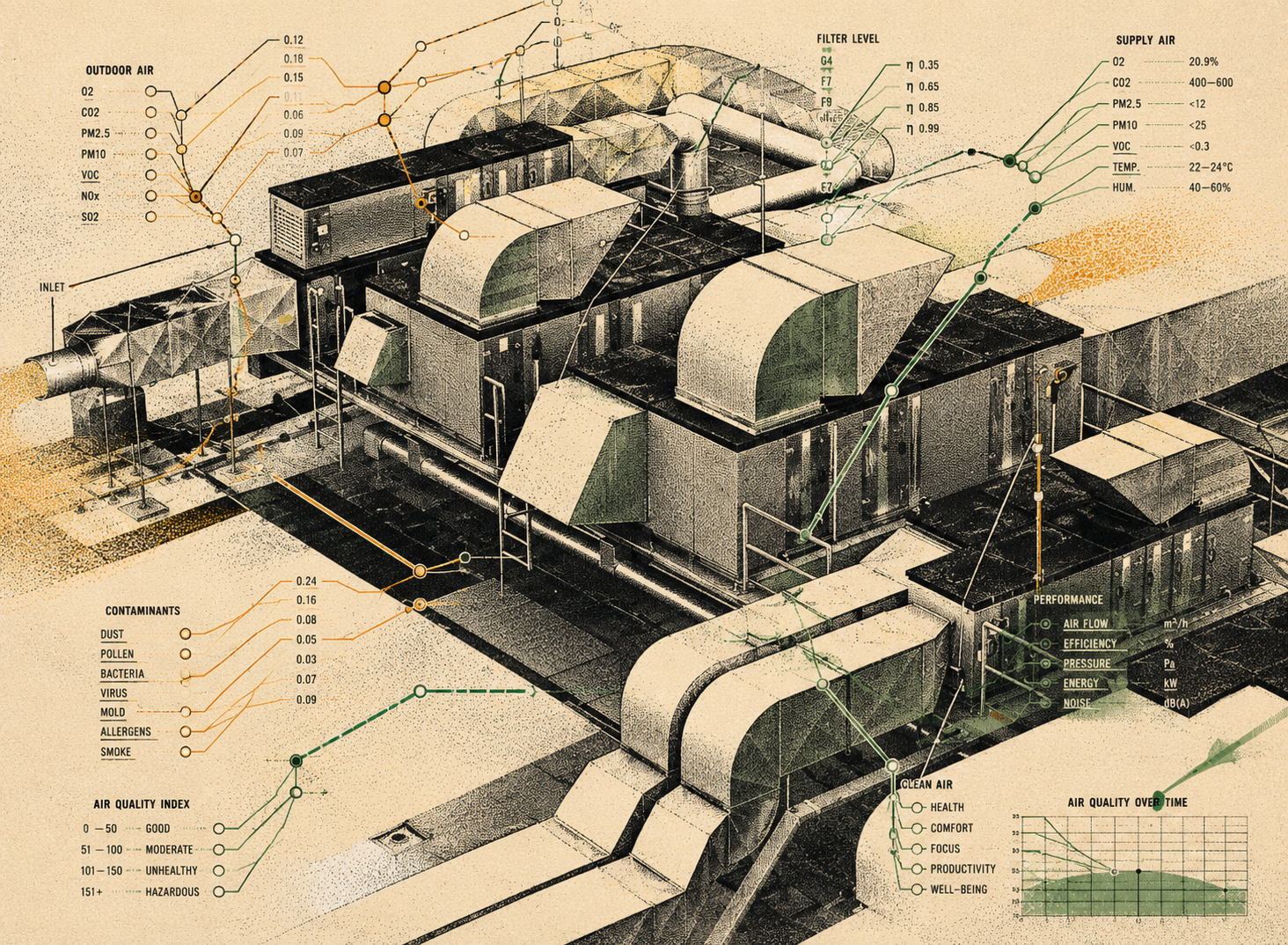
- Filter Media Specifications: The total operational cost of air filtration systems is closely tied to filter replacement rates, which in turn depend on the filters’ dust-holding capacity. Specifying durable, high-capacity filters reduces replacement frequency and the associated labor costs. Optimizing the change-out timing to the lowest annual cost point yields massive financial savings that go well beyond merely adhering to default manufacturer recommendations.
ROI in Human Lives: Architecture that Saves Occupants When evaluating the “cost-effectiveness” of health-promoting architectural systems, the return on investment must be measured not only in electricity savings but in its direct impact on occupant health and productivity. When comparing the cost of medical ventilation systems against World Health Organization (WHO) benchmarks—which define the cost threshold for averting a year of health disability or life loss—these systems achieve extraordinary viability.
Even when calculating a full 20-year lifecycle cost (including cumulative operation and maintenance), the expense remains 22 times lower than the WHO threshold. These ratios substantially outperform previous architectural interventions. For instance, upgrading commercial building filters to the MERV 13 standard achieves a benefit-to-cost ratio of up to 133, while utilizing air purifiers in highly polluted areas also shows remarkably strong positive ratios.
On the end-user level, the cost is surprisingly affordable. When CAPEX is amortized and OPEX is distributed across a residential space serving a compact community, the added financial burden equates to less than 1% of the median per capita income. This aligns perfectly with economic recommendations to avoid financial strain on residents, proving that the monetized health benefits of proper air filtration exceed costs by up to a factor of ten.
Perspective For architectural studios and real estate development firms, this analysis proves that “healthy building design” is not merely a luxury item or a green-washing marketing tool; it is a digitally and financially proven investment. The real challenge lies in the conceptual design phase. Today’s successful architect views the building’s envelope and massing in tandem with the “lifecycle cost” of its mechanical systems. Integrating smart sensors (IoT) and specifying sustainable operational materials transforms facility management from a “financial liability” into an “investment asset” that extends the building’s lifespan and protects its inhabitants.
✦ ArchUp Editorial Insight
The gap between CAPEX and OPEX in building air quality systems is not a technical miscalculation — it is the structural outcome of a real estate development model that separates the party who finances construction from the party who inhabits the consequences. The developer who minimizes capital expenditure on mechanical systems exits the asset at sale; the operational cost burden transfers entirely to the building manager, the tenant, or the public health system that absorbs the downstream morbidity. What the article correctly identifies as a “maintenance cost trap” is therefore a liability-transfer mechanism encoded into the building at design stage, one that IoT sensors and predictive maintenance frameworks can mitigate but cannot eliminate without realigning the incentive structure that produced it. The WHO cost-effectiveness ratios cited are analytically compelling, but they measure value in a currency — averted disability-adjusted life years — that does not appear on a developer’s balance sheet, which is precisely why the subsidies the article recommends are necessary: they are an attempt by public institutions to translate a health externality back into the financial language that governs procurement decisions. This pattern connects directly to what was examined in The Driver’s Room: in both cases, the occupant with least contractual leverage — the service worker, the low-income tenant — inhabits the space where environmental standards were resolved last and funded least, while the building’s public face performs a quality that its mechanical infrastructure, left unmaintained, cannot sustain.
Credits / References Robinson LA, Hammitt JK, Chang AY, Resch S. Understanding and improving the one and three times GDP per capita cost-effectiveness thresholds (Health Policy and Planning, 2016) — Montgomery JF, Reynolds CCO, Rogak SN, Green SI. Financial implications of modifications to building filtration systems (Building and Environment, 2015) — Cameron D, Ubels J, Norström F. On what basis are medical cost-effectiveness thresholds set? (Global Health Action, 2018) — Whittington D, et al. Setting Priorities, Targeting Subsidies among Water, Sanitation, and Preventive Health Interventions (World Development, 2012) — Fisk WJ, Chan WR. Effectiveness and cost of reducing particle-related mortality with particle filtration (Indoor Air, 2017) — Es-sakali N, et al. Advanced predictive maintenance and fault diagnosis strategy for enhanced HVAC efficiency in buildings (Applied Thermal Engineering, 2024) — Sadiki S, et al. Impact of intelligent wireless sensor network on predictive maintenance cost (IEEE, 2018) — Pillai RK. Health economics: Theoretical considerations and scope for application in the Indian context (Clinical Epidemiology and Global Health, 2013) — Bilinski A, et al. When cost-effective interventions are unaffordable (PLOS Medicine, 2017) — Liu Y, et al. Health benefits and cost of using air purifiers to reduce exposure to ambient fine particulate pollution in China (Journal of Hazardous Materials, 2021) — Montgomery JF, et al. Predicting the energy use and operation cost of HVAC air filters (Energy and Buildings, 2012).