L-Shaped House: Massing and Context Strategy

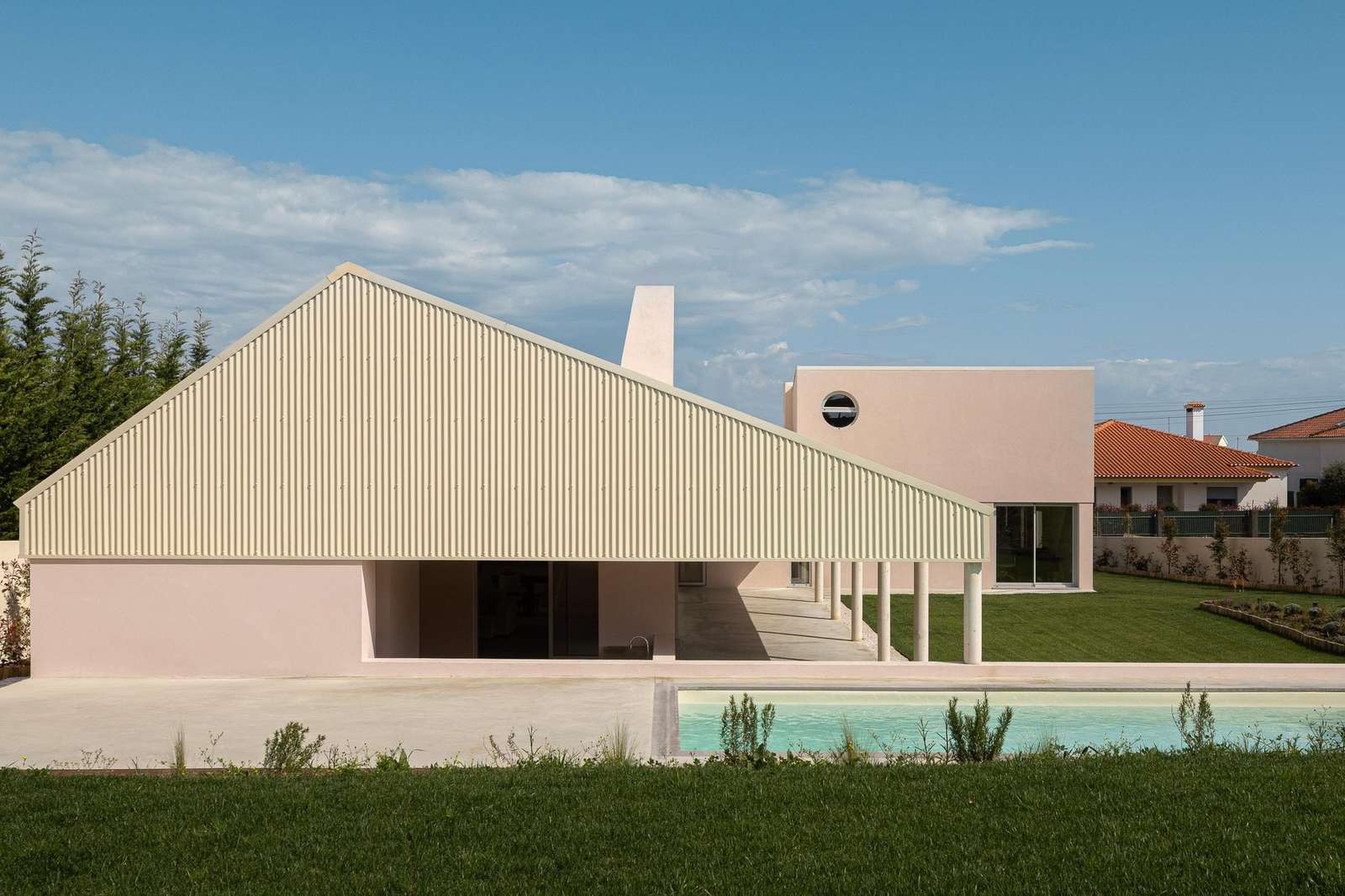
Mass Forming and the Relationship with Context
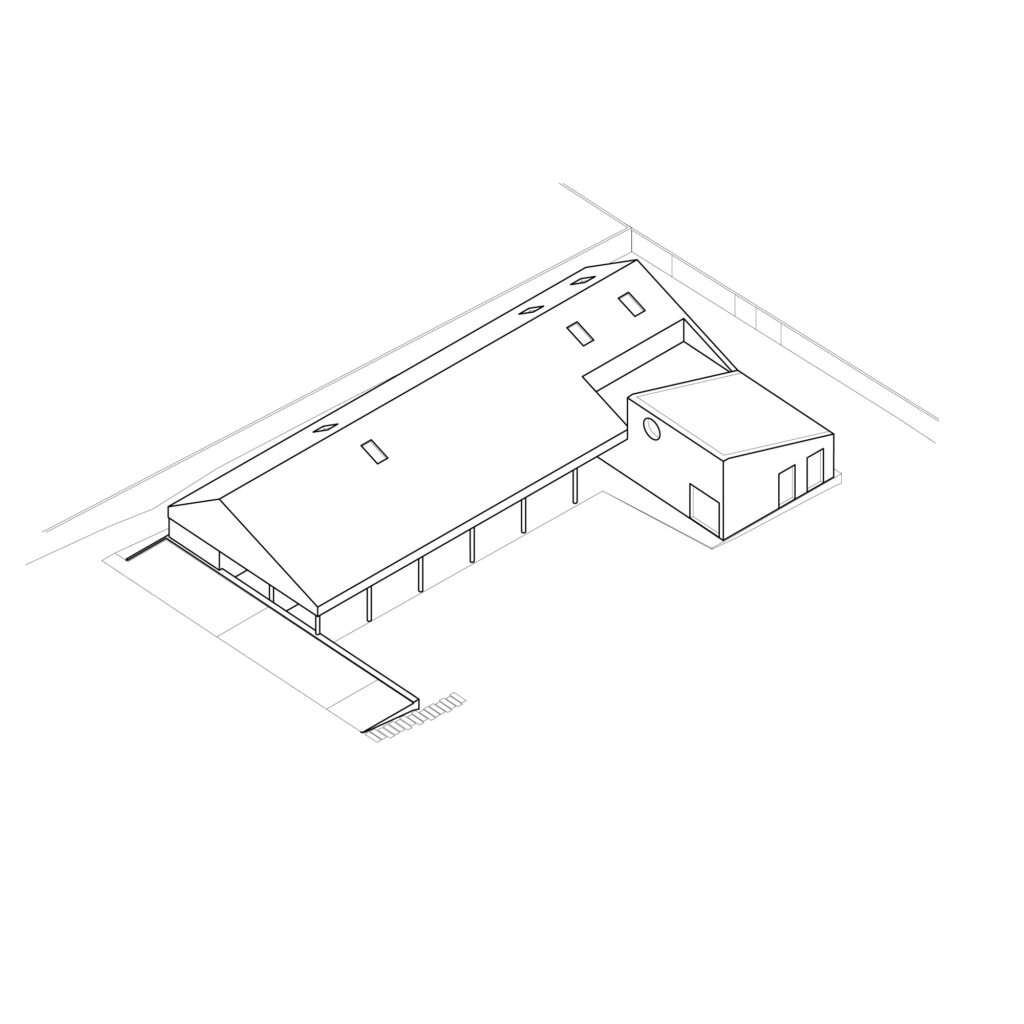
The project’s planning strategy engages with a contradictory urban context, where the surroundings oscillate between the randomness of residential fabric and the presence of massive industrial structures. Based on these conditions, the building plan is organized around an L-shaped massing strategy, functioning simultaneously as a directional device and a visual and protective mediator. From the street side, the volume presents a calm presence that blends with the prevailing urban logic without revealing the true scale of the building. On the other hand, the longitudinal wing operates as a solid defensive wall that “turns its back” to the industrial complex located to the north, transforming the visual and climatic obstruction into an opportunity to reorient all interior spaces toward a protected courtyard.
Spatial Experience and Kinetic Scenography
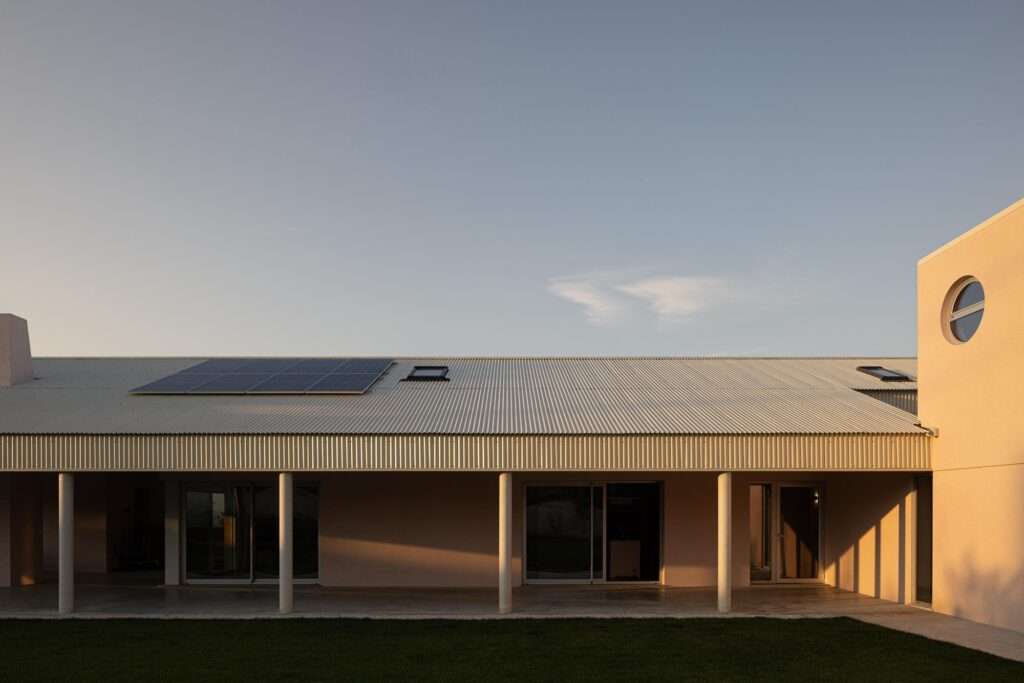
The human experience within the space is shaped by this protective enclosure and directed openness. Upon transitioning from the street environment or passing the solid mass, the interior space is gradually revealed through a kinetic path that follows the longitudinal wing of the house. All shared living spaces are oriented toward the south, allowing users to experience the transformation of natural light throughout the day, where sharp shadows cast by extended roof planes intersect with solid masses, turning the southern façade into a living scenographic screen that captures the movement of the sun and the flow of air. This transition from complete northern enclosure to continuous southern openness enhances the sense of security and organic connection with the inner courtyard, achieving a psychological and material balance that isolates the inhabitant from the disturbing industrial surroundings.
Functional Articulation and the Central Core
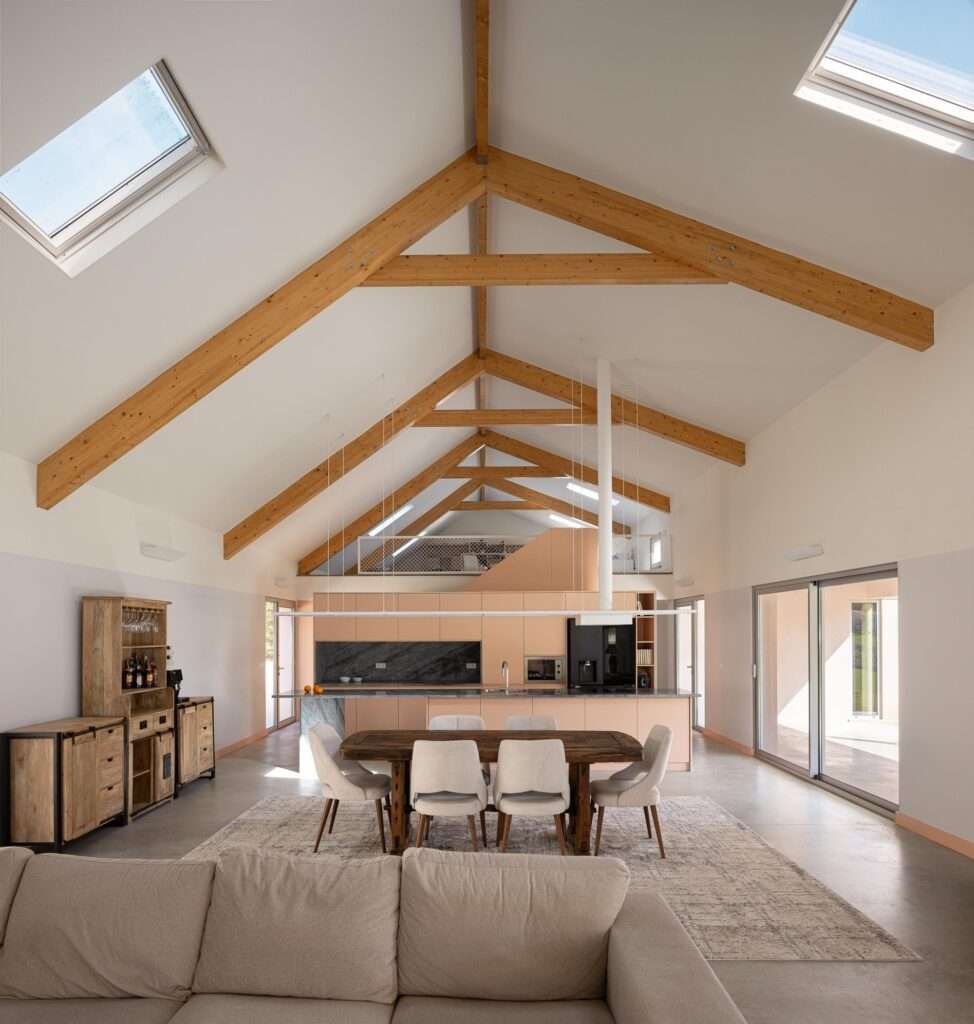
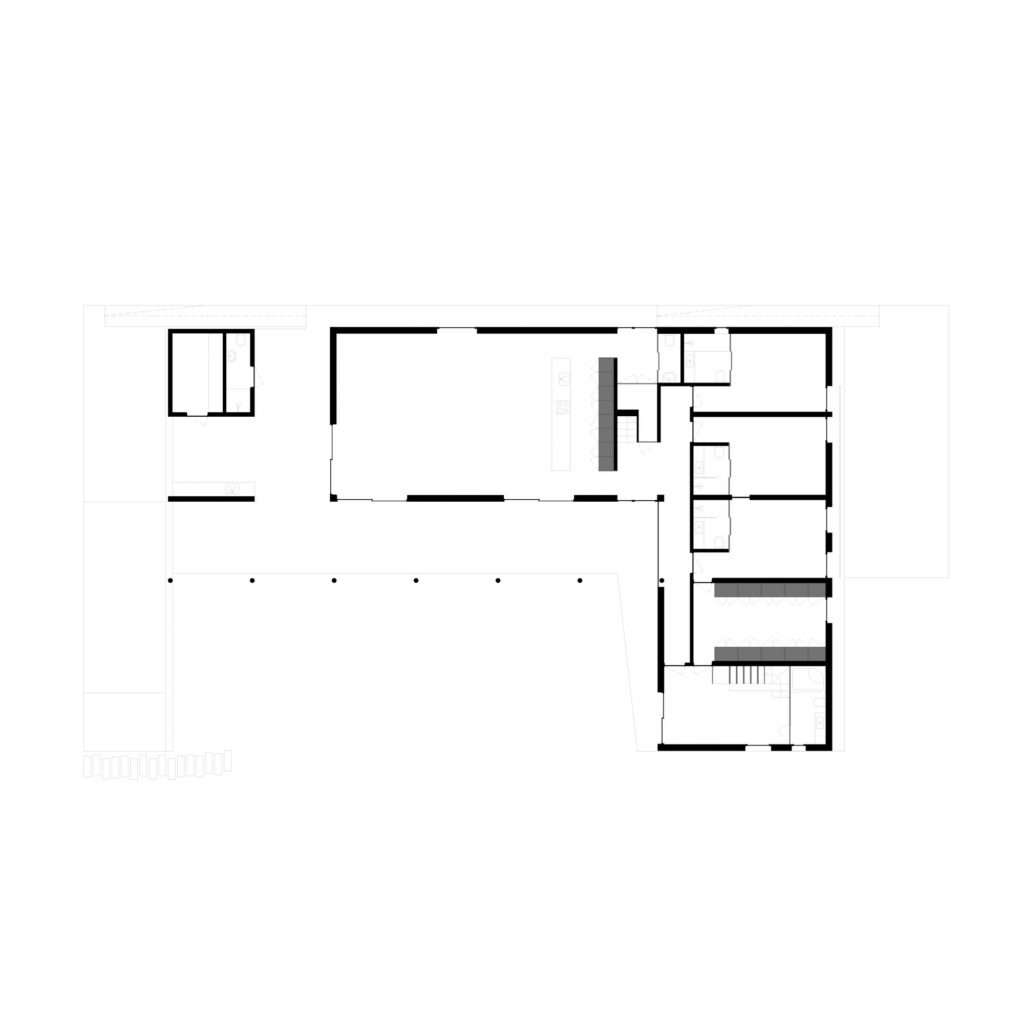
The L-shaped horizontal plan governs the functional distribution of the dwelling according to the sun path; sleeping areas are isolated within the eastern wing to receive the first morning light, while shared living spaces extend along the southwestern axis to maximize exposure to daylight. This mass distribution creates a protected outdoor courtyard, which becomes the living central core of the building. This central void integrates privacy and visual openness in a balanced manner and acts as a light magnet organizing the relationship between interior spaces and the exterior.
Continuous Corridor and Kinetic Dynamics
Along the entire length of the main wing runs a continuous horizontal corridor facing south, extending beyond its traditional role as a transitional element to become a multi-functional scenographic space. This corridor merges living and circulation, acting as a climatic buffer that protects the glazed façades from direct sunlight while allowing the flow of air and shadows. In response, the design adapts to the site’s topography through a natural slope that follows the ground inclination; this ramp connects the varying external levels, embedding human movement within a continuous spatial fabric that enriches the experience of transition between different parts of the house.
Programmatic Detailing and Spatial Separation
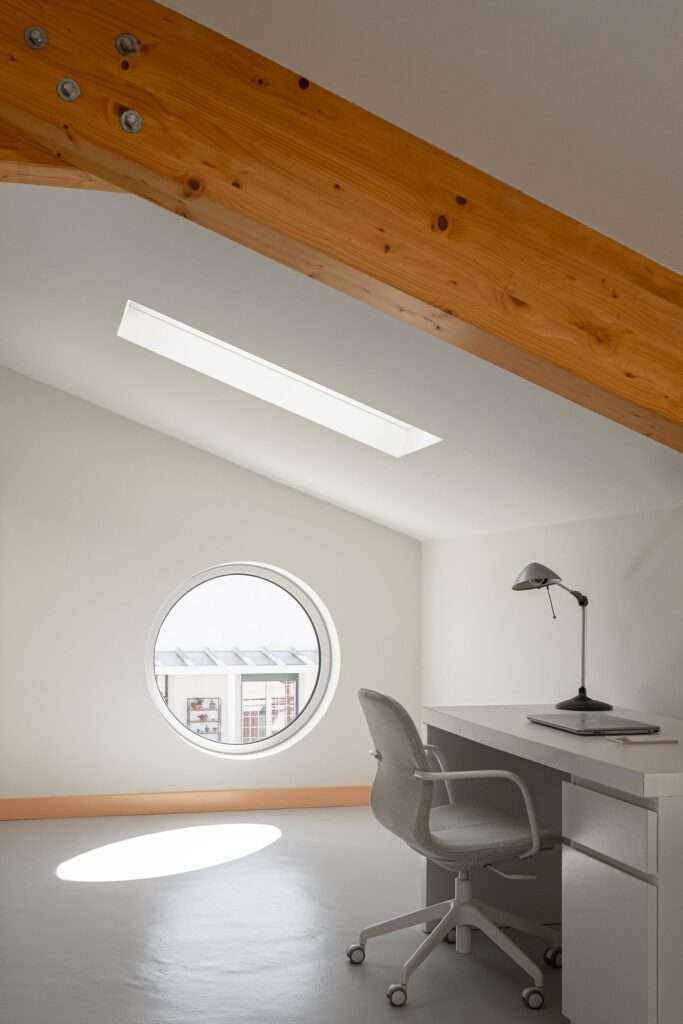
The programmatic organization of the house is achieved through a clear architectural separation between social and private zones; the social spaces occupy the larger longitudinal volume, while the private rooms are contained within the shorter mass. Both volumes are unified through the structural logic of the sloped roof, which is not treated merely as an external covering element, but is instead utilized to create two additional usable attic spaces, enriching the building’s vertical section and giving the spaces varying volumetric depth.
Spatial Fluidity and Points of Intersection
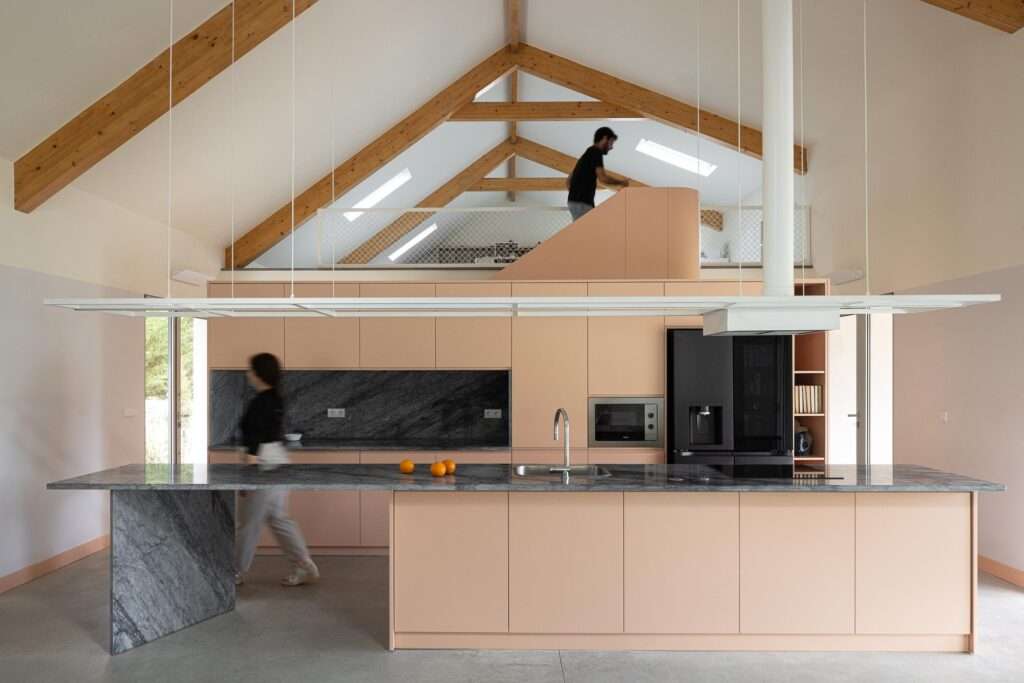
Beneath the expansive sloped roof, the living room and kitchen form a continuous open space without any visual barriers, enhancing the sense of openness and horizontal as well as vertical fluidity. Perpendicularly, the four private bedrooms are arranged as independent suites, each ending with an en-suite bathroom, with a shared dressing room integrated between two bedrooms. The geometric intersection point between the two volumes becomes a central circulation and service hub, containing transitional corridors, storage, a guest bathroom, and the staircase leading to the attic of the main volume. This corner thus becomes a scenographic joint linking horizontal and vertical movement within the house.
Functional Duality and Smart Solutions
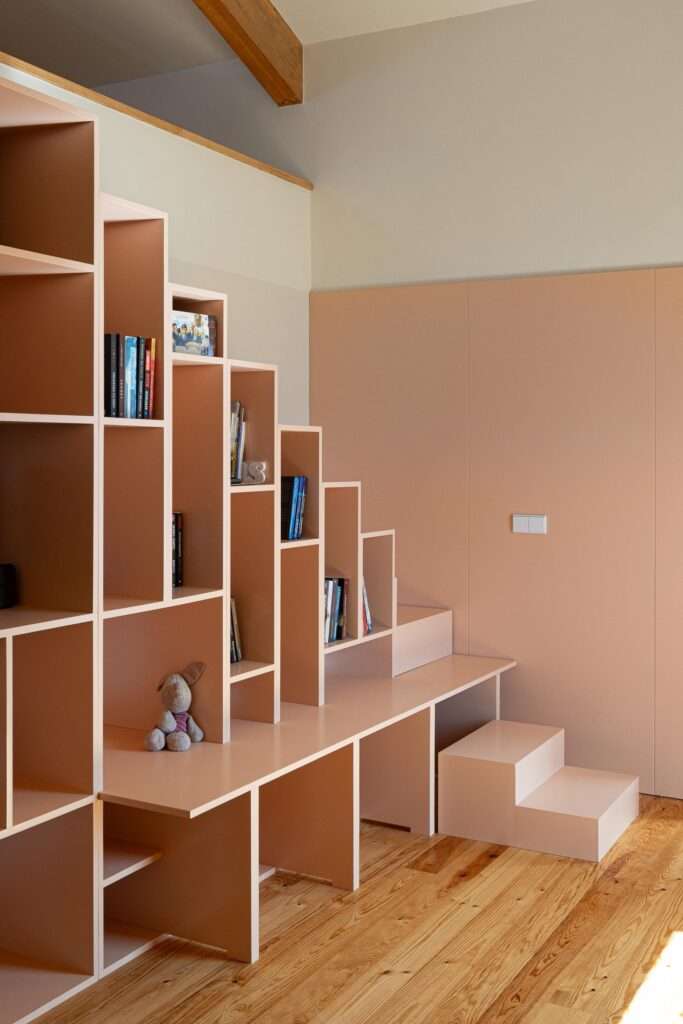
The attic of the smaller volume is transformed into a private vertical extension accessible exclusively through the bedroom located at the end of the wing, reinforcing a sense of isolation and privacy. Here, the architectural solution is expressed through a custom-designed wooden staircase that serves a dual function; it is not only a vertical circulation element but is structurally integrated to become a wardrobe and bookshelf, turning the act of movement into a functional piece of furniture that saves space. Meanwhile, the technical infrastructure of the building is efficiently separated at roof level, where a concealed technical terrace accommodates all equipment and systems necessary for the mechanical and electrical operation of the house without compromising the visual purity of the volumes.
Topography and External Spatial Gradation
The external plan responds to site levels through a carefully designed topographic gradient that distributes auxiliary functions efficiently; the extension of the main roof slope is used to accommodate external service spaces, including a laundry room and an additional bathroom, keeping them close to outdoor activities while protected from weather conditions. The recreational experience is elevated to an upper platform housing the swimming pool as a dominant visual and climatic element, while the terrain slopes down toward the lowest level near the street-facing frontage, where the front parking court for three cars is located, achieving a complete functional separation between entrance/service areas and upper relaxation zones.
✦ ArchUp Editorial Insight
The project employs an L-shaped defensive mass to adapt to the fragmented suburban topography, successfully isolating domestic life from the visual extension of industrial structures. By transforming structural barriers into climatic filters and integrating built-in wooden patterns, the design converts a residual plot into a precise thermal and programmatic refuge that restores the human scale within industrial expansion.
However, this inward-oriented spatial strategy reveals a clear architectural escapism; rather than integrating or reinterpreting the raw industrial building materials or surrounding forms, the dwelling opts for complete visual purification as an isolated enclave. It treats the adjacent territory as a burden to be excluded rather than engaging with the complex and gray reality that characterizes the edges of contemporary cities.