Environmental Reuse: Eco-Luxury Hospitality Project Launches in Kalba, UAE

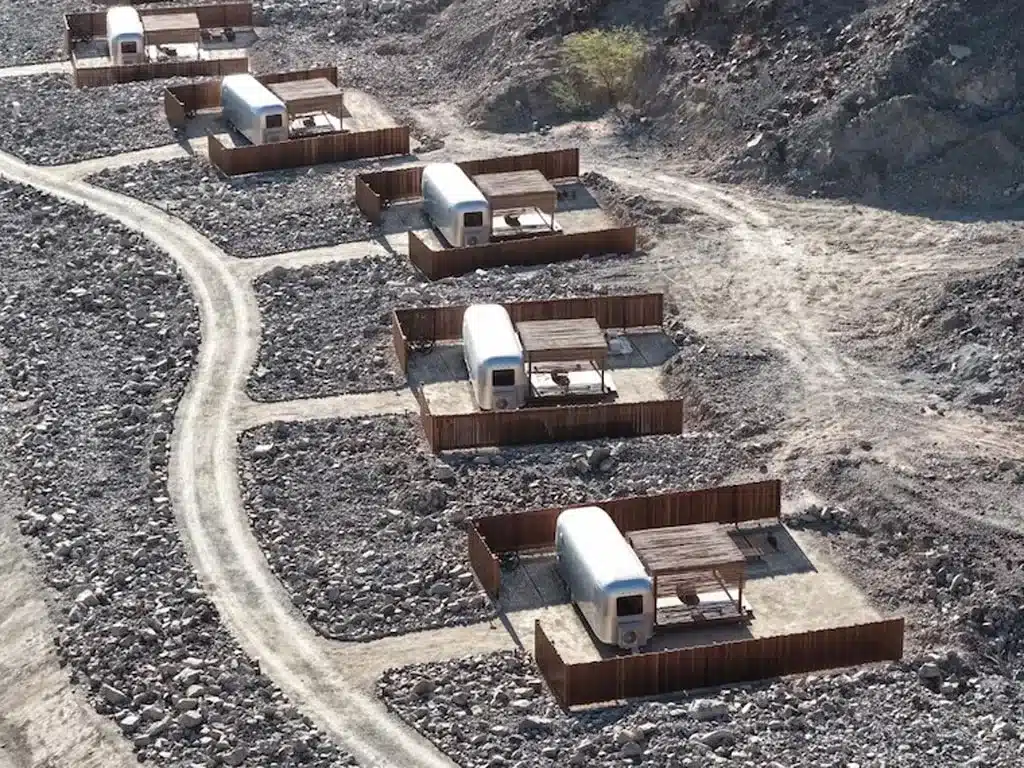
Environmental reuse anchors the architectural strategy of Nomad, which opened in Kalba The project embeds 20 off grid accommodation trailers into mountainous terrain without grading or altering natural contours. Sharjah Hospitality Group manages the site and replaces conventional resorts with a low-density, experience driven model.

Minimal footprint, maximum seclusion
Designers dispersed units across the slope to preserve sightlines and privacy.
Paths follow the existing topography and minimize earthworks.
A hybrid solar system powers the entire site off grid.
This approach aligns with sustainability protocols that value ecological continuity over built mass.
The site includes 7.44 km of hiking trails 5 km for general use and 2.44 km climbing to mountain peaks.
It also features 4.39 km of dedicated mountain biking routes.
Separating these paths reduces visual clutter and improves safety in sensitive construction zones.

Activities follow natural cycles
Programs like birdwatching, outdoor yoga, and stargazing follow daylight and seasonal patterns.
They avoid digital schedules.
Local regulations shape how built interventions engage with protected landscapes, as regional research confirms.
This intentional disconnection offers a rare hospitality model in the Gulf. It draws from contemporary architectural design that treats time as a spatial variable.

Environmental reuse across contexts
Nomad joins six other retreats operated by Sharjah Hospitality Group.
Each applies environmental reuse across deserts, mangroves, and heritage sites.
The platform documents their methodology in its public archive.

Operational logic over aesthetics
The team prioritized depth of experience over scale.
They designed trailer units as modular and demountable.
This allows future removal with almost no site residue.
The method aligns with flexible approaches to buildings in fragile or temporary settings.
Interiors use angled walls and strategic glazing to expand spatial perception in tight footprints.
Designers followed functional interior design principles.
They selected raw, locally sourced materials to avoid chemical treatments and high-maintenance finishes.
Environmental reuse guides more than architecture.
It shapes trail routing, energy sourcing, activity sequencing, and guest protocols.
The fourth and final reference to environmental reuse reaffirms its role as a foundational framework not an afterthought.
Architectural Snapshot: Nomad in Kalba executes environmental reuse by inserting demountable units into undisturbed mountain terrain with zero grading, preserving original landform integrity.
✦ ArchUp Editorial Insight
The piece documents Nomad’s opening in Kalba with factual clarity, framing environmental reuse as both method and message. It avoids promotional language and sticks to spatial and operational specifics. Yet it leans heavily on Gulf eco tourism tropes off-grid, disconnection, raw materials without interrogating their scalability or social access. The retreat’s exclusivity contrasts with the universal rhetoric of sustainability. Still, its precise detailing of trail metrics and demountable units offers rare technical transparency. Whether such models become benchmarks or boutique exceptions depends on regulatory evolution, not just design intent.