Expansion of the Vero Beach Museum of Art: An Ambitious Architectural Transformation on Florida’s Coast

A Cultural Gem on the Treasure Coast
While cities like Miami and Palm Beach hold prominent positions on Florida’s artistic map, the Vero Beach Museum of Art (VBMA) emerges on the so-called “Treasure Coast” as a vibrant, if less famous, cultural center. This museum is no longer content to remain in the shadows; it is preparing to begin a new and bold chapter in its history. Through a massive $85 million redevelopment project, the museum aims to transform its campus from a collection of disparate buildings into a cohesive and resilient artistic institution, addressing present challenges and anticipating the future of art on the coast.
From Educational Center to Leading Museum: A Journey of Growth
The museum was founded in 1986 as the “Arts Center,” initially a modest institution focused on art education. Over the years, it grew steadily, not only in physical size—doubling its footprint more than once in the late 1990s and in 2010—but also in stature. Its permanent collection expanded to focus on two important areas: American Modernism and Global Contemporary Art, attracting a wider audience and earning a rating as one of the best small art museums in the country. However, this very success revealed the limitations of the current infrastructure.
Present Challenges: Infrastructure Failures and Campus Isolation
The primary motivation for the development project lies in the functional and formal constraints of the current campus. Previous expansions, while necessary at the time, resulted in a “patchwork” style that left the campus lacking architectural cohesion. Furthermore, many of the existing single-story buildings suffer from structural problems, including leaky roofs and aging HVAC systems, threatening the safety of the valuable art collection. Most importantly, the current site layout resembles a “gated complex” disconnected from the community, limiting its interaction with the surrounding public space in Riverside Park.
Vision for the Future: The $85 Million Redevelopment Project
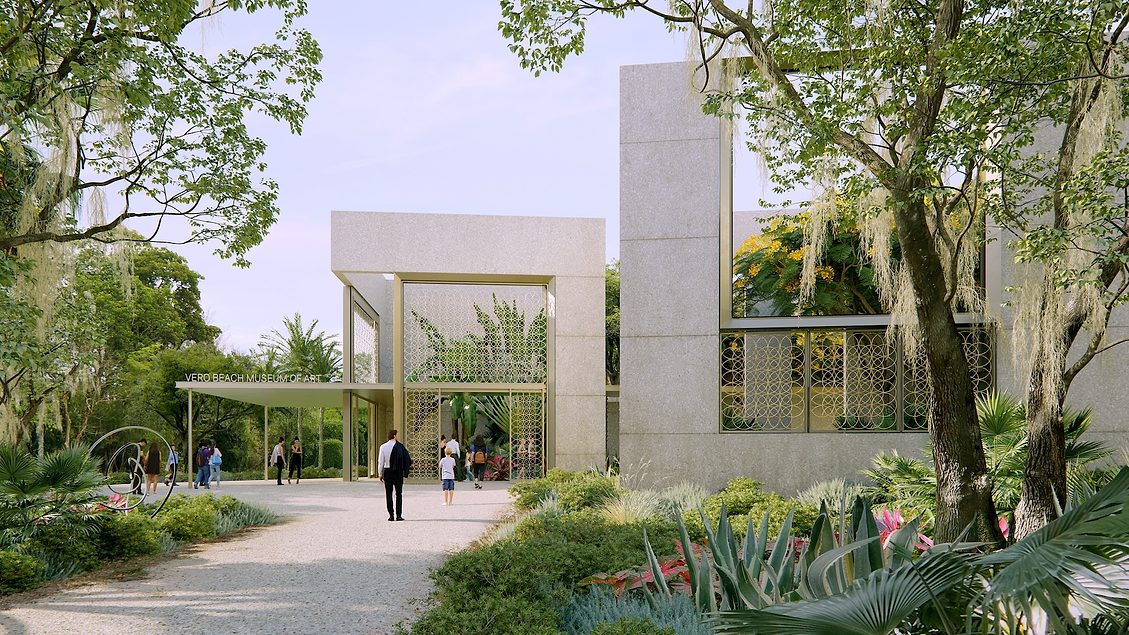
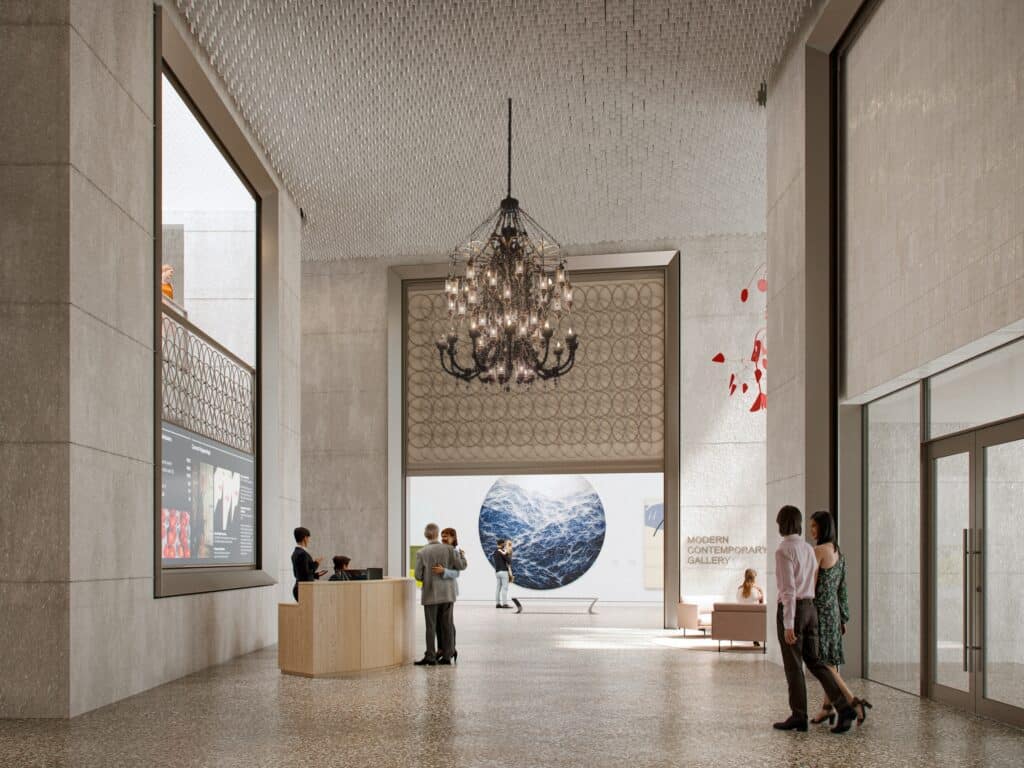
The new project represents a comprehensive qualitative leap. Instead of patching things up, most existing buildings will be demolished (while retaining the art storage building for functional reasons) to make way for a new two-story structure. This will not only reduce the total building footprint but also increase public green spaces. Key components of the project include:
· Vast Exhibition Space: Adding 68,000 square feet of new construction, including 22,000 square feet dedicated to permanent and temporary exhibitions, doubling the current space.
· Community and Educational Infrastructure: This includes an educational wing with modern studios for the museum’s art school, a flexible hall with retractable seating for events, a café, and a rooftop terrace.
· Integration with Nature: Creating 14,400 square feet of terraces and courtyards that integrate the museum with the banks of the Indian River.
The Architectural Team: A Creative Alliance Led by Allied Works
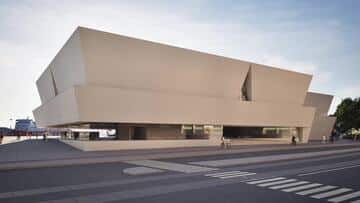
To lead this transformation, a distinguished alliance was chosen, led by Allied Works Architecture, whose notable cultural projects include the Museum of Contemporary Art in St. Louis and the Palmer Museum of Art. They are joined by the studio Unknown, specializing in urban design and landscape architecture. This team was selected from among four finalists in 2022 for its ability to address the fundamental question: “How do you create a museum building that is resilient in the face of hurricanes, while simultaneously opening up to the surrounding park?”
Design Strategy: Environmental Resilience and Community Openness
The design philosophy is based on two fundamental principles:
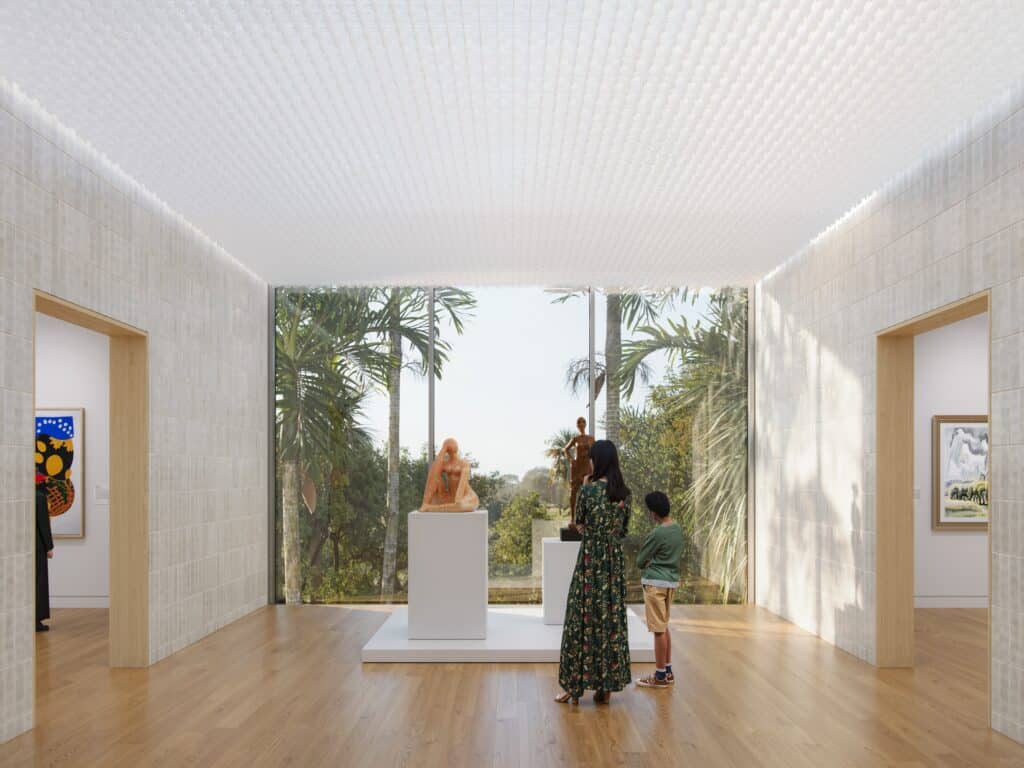
- Environmental Resilience: Instead of building directly on the ground, the team will “build the land,” raising the museum’s foundations nine feet above sea level as a protective barrier against floods and hurricanes. This is not just an engineering measure but part of the design aesthetic.
- Dismantling the “Fortress” Concept: As the designers explained, the goal is to reverse the current feeling of isolation. By creating a series of gardens defined by terraced concrete walls and landscaped slopes, the museum becomes an integral part of the journey through the park. Brad Cloepfil of Allied Works says, “We used the landscape to create a feeling of welcome where people don’t necessarily have to come to the museum.”
Spatial Distribution: A Carefully Crafted Visual and Functional Journey
The interior spaces will be thoughtfully organized:
· Ground Level: Will house community and educational facilities (café, hall, studios), making it an open and direct interface for the public.
· Second Level: Will be largely dedicated to gallery spaces, offering visitors panoramic views of the river and park through bridges and architectural openings, creating what Cloepfil described as a “kind of labyrinthine quality” that connects art with nature.
✦ Archup Editorial Insight
The article discusses the redevelopment project of the Vero Beach Museum of Art (VBMA), which transforms its campus from a group of disparate buildings into a cohesive entity focused on environmental resilience and openness to the community. Through an architectural reading, it is noted that the design solution based on raising the ground level to form an earthen base presents an issue in its relationship with the human scale and the urban context of the area; this elevation may create a high threshold that reproduces a feeling of symbolic isolation which the project seeks to avoid, rather than achieving genuine integration with the area’s low-lying urban fabric. Furthermore, the reliance on a series of gardens “defined” by concrete walls, despite their intent to create transitional spaces, carries an internal contradiction that may hinder the desired visual and kinetic fluidity between the interior and exterior spaces. On the positive side, the project features a clear functional separation between levels, with the ground floor dedicated to community and educational activities, a distribution that practically reinforces the idea of the museum as an open institution rather than a closed fortress.
Brought to you by the ArchUp Editorial Team
Inspiration starts here. Dive deeper into Architecture, Interior Design, Research, Cities, Design, and cutting-edge Projectson ArchUp.