FABRICATE 2027

Competition Brief
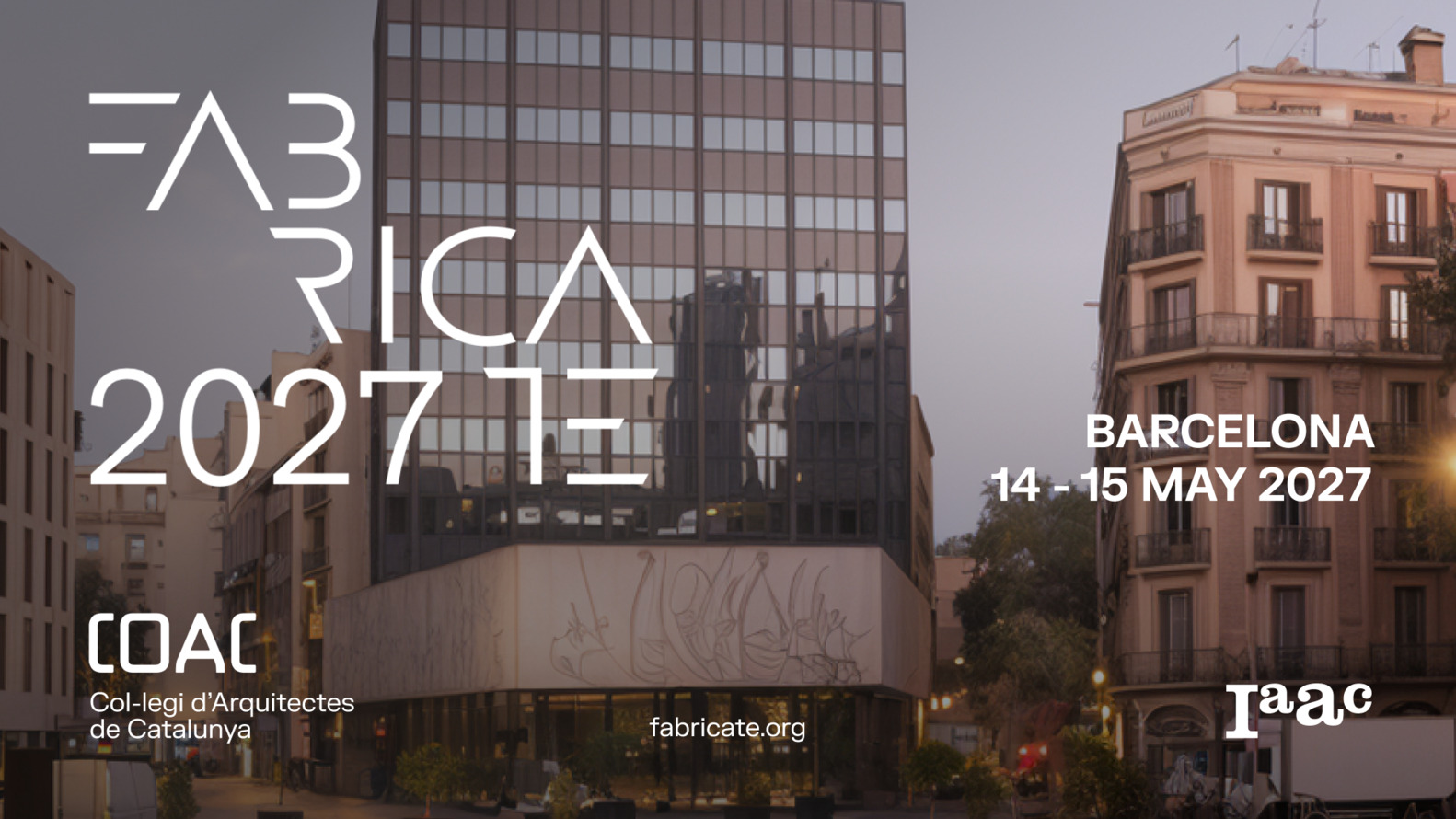
FABRICATE 2027 Call for Works is an open international call organised by the Institute for Advanced Architecture of Catalonia (IAAC), hosted at COAC in Barcelona, Spain. Now in its sixth edition, the triennial conference and peer-reviewed publication series invites built and prototyped projects that advance the design and fabrication of architecture. The 2027 edition broadens its scope beyond advanced manufacturing to encompass craft, circularity, material intelligence, and the democratisation of tools — with particular interest in work from authors, institutions, and geographies that have not previously submitted. Abstract deadline: 3 July 2026. Submission is free; 32 selected projects advance to full paper stage.
Intent
The 2027 edition reframes fabrication as a question of equity and access as much as technology. Co-chairs Areti Markopoulou and Xavier De Kestelier invite projects that challenge extractive models of architectural production, centre local knowledge, and empower broader communities of designers and builders. The conference explicitly moves beyond its historical association with robotics and advanced manufacturing to include embodied craft knowledge, social and ecological accountability, and geographies underrepresented in previous editions. Submissions must present documented innovation on built, substantially prototyped, or in-progress projects — renderings are not accepted.
Who Can Participate?
The call is open internationally to architects, engineers, researchers, fabricators, educators, and industry practitioners. Teams and institutions are eligible. First-time submitters from new geographies, industries, and academic contexts are especially encouraged. Submitted work must be original and unpublished — papers under consideration elsewhere are ineligible. All authors must agree to FABRICATE’s Terms & Conditions on EasyChair, which govern intellectual property and copyright. AI tool use in text or images must be declared at submission; undisclosed use may result in rejection.
Essential Data
| Field | Detail |
|---|---|
| Organiser | IAAC — Institute for Advanced Architecture of Catalonia |
| Host Venue | COAC, Col·legi d’Arquitectes de Catalunya, Barcelona, Spain |
| Type | International Call for Works — peer-reviewed conference + publication |
| Eligibility | Open internationally — professionals, researchers, students, institutions |
| Registration / Submission Fee | Free — selected presenters receive one complimentary conference ticket |
| Stage 1 Deadline | 3 July 2026, 11:59 PM |
| Conference Dates | 14–15 May 2027 |
| Submission Platform | EasyChair (online only — no email or postal submissions accepted) |
| Official Website | fabricate.org |
About the Conference
Founded in 2011 at UCL Bartlett School of Architecture, FABRICATE is a non-profit triennial conference and peer-reviewed publication series dedicated to the intersection of design thinking and material making. Over five editions — London, Zurich, Stuttgart, Online, and Copenhagen — it has documented more than 160 built projects from over 100 AEC organisations and 50 academic institutions, with publications reaching 390,000+ downloads across 193 territories. The sixth edition moves to Barcelona, organised by IAAC in partnership with COAC Foundation, and is expected to draw approximately 2,000 delegates from across the global architecture and engineering community.
What Is Required?
Submissions must demonstrate documented innovation in the design and fabrication of built architecture. Eligible work includes completed projects, substantially prototyped proposals, or documented stages in between. The organizers are particularly interested in advances across: fabrication and production methods, craft practice, ethical frameworks, circular approaches, tool democratisation, material intelligence, reuse strategies, and localisation. The submission is structured as a two-stage academic process — a short illustrated abstract followed, for selected projects only, by a full paper. All submissions must be BLIND: no author names, institutional affiliations, or collaborator credits anywhere in the document or file name.
Submission Materials
Stage 1 — Abstract (All Applicants)
| Element | Specification |
|---|---|
| Format | Single PDF file |
| Word Count | 600–800 words |
| Images | 10–15 embedded images — fabrication process images predominant; 3–4 of completed work; high resolution; no renderings |
| Structure | 1. Project Description & Aims / 2. Research Question or Challenge / 3. Research Methods / 4. Research Outcomes & Relevance |
| File Naming | F27_[projectname]_[date] |
| Image Naming | fig_001, fig_002, fig_003 … |
| Blind Review | No author names, institutions, or collaborators anywhere in document or file name |
| Platform | EasyChair — online submission only |
Stage 2 — Full Paper (32 Selected Projects Only)
| Element | Specification |
|---|---|
| Format | Single .zip file containing three items |
| Text | .doc format — 2,000–2,500 words — UK English — third person — Harvard referencing — no footnotes or endnotes |
| Images | 10–15 high resolution or raw files (updated versions permitted) |
| Captions | Separate text file with captions and credits, numbered to match images |
| Image Naming | [project_title]-1.tiff, [project_title]-2.tiff … |
| Copyright | All image rights cleared by author prior to submission |
Important Dates
| Milestone | Date |
|---|---|
| Submission system opens | 1 May 2026 |
| Stage 1 abstract deadline | 3 July 2026, 11:59 PM |
| 32 projects selected for Stage 2 | Not confirmed — verify at fabricate.org |
| Stage 2 full paper deadline | Not confirmed — verify at fabricate.org |
| FABRICATE 2027 Conference | 14–15 May 2027, Barcelona |
Prizes and Rewards
| Award | Benefit |
|---|---|
| Stage 1 — All submitted projects | Double-blind peer review by 50+ international experts |
| 32 Stage 2 selected projects | Invitation to submit full paper for conference and publication |
| Final selected presenters | One complimentary conference ticket per accepted paper + inclusion in peer-reviewed FABRICATE publication |
No cash prizes are offered. The primary value is peer-reviewed publication in an internationally distributed volume and presentation at a global conference with 2,000+ delegates from 45+ countries.
Jury / Review Panel
| Name | Role |
|---|---|
| Areti Markopoulou | Co-Chair, FABRICATE 2027 — Academic Director, IAAC |
| Xavier De Kestelier | Co-Chair, FABRICATE 2027 — Head of Design, Hassell |
| Founding Chairs (unnamed) | Co-coordinating peer review alongside conference chairs — individual names not published |
| Peer Review Pool | 50+ international reviewers — names not published |
The review structure is a rigorous double-blind academic process coordinated by recognised practitioners and academics. Individual reviewer identities follow standard academic peer-review convention and are not disclosed. The co-chair appointments carry genuine institutional weight in computational design and global practice leadership.
Intellectual Property
All authors must agree to FABRICATE’s Terms & Conditions document on EasyChair prior to submission. This document governs intellectual property and copyright arrangements. The specific terms — including who retains rights to submitted work and under what conditions submitted projects may be published — are contained in that document. Participants should read the Terms & Conditions carefully on EasyChair before submitting. The full text is not reproduced on the public competition page; verify directly at fabricate.org/submission-guidelines-2027.
✦ ArchUp Competition Review
FABRICATE 2027, organized by IAAC and COAC, provides a structured platform focusing on material intelligence and applied architectural research. By mandating built prototypes and excluding digital renderings, the brief successfully prioritizes tangible construction methodologies over theoretical exploration. The academic double-blind peer-review framework suggests a rigorous selection process aimed at maintaining high technical standards. However, this physical prototyping requirement introduces notable resource constraints. As the prize structure relies entirely on symbolic publication rather than financial compensation, the model may naturally favor well-funded academic institutions and established architecture practices capable of absorbing material costs. Additionally, while anonymous peer review aligns with academic conventions, it limits external visibility into the panel’s composition. Ultimately, the call appears highly viable for supported research teams, though independent practitioners should carefully weigh the required investment.
Submission Deadline
Brought to you by the ArchUp Editorial Team
Inspiration starts here. Dive deeper into Architecture, Interior Design, Research, Cities, Design, and cutting-edge Projects on ArchUp.