Hanza Project Reinterprets Historic Urban Memory

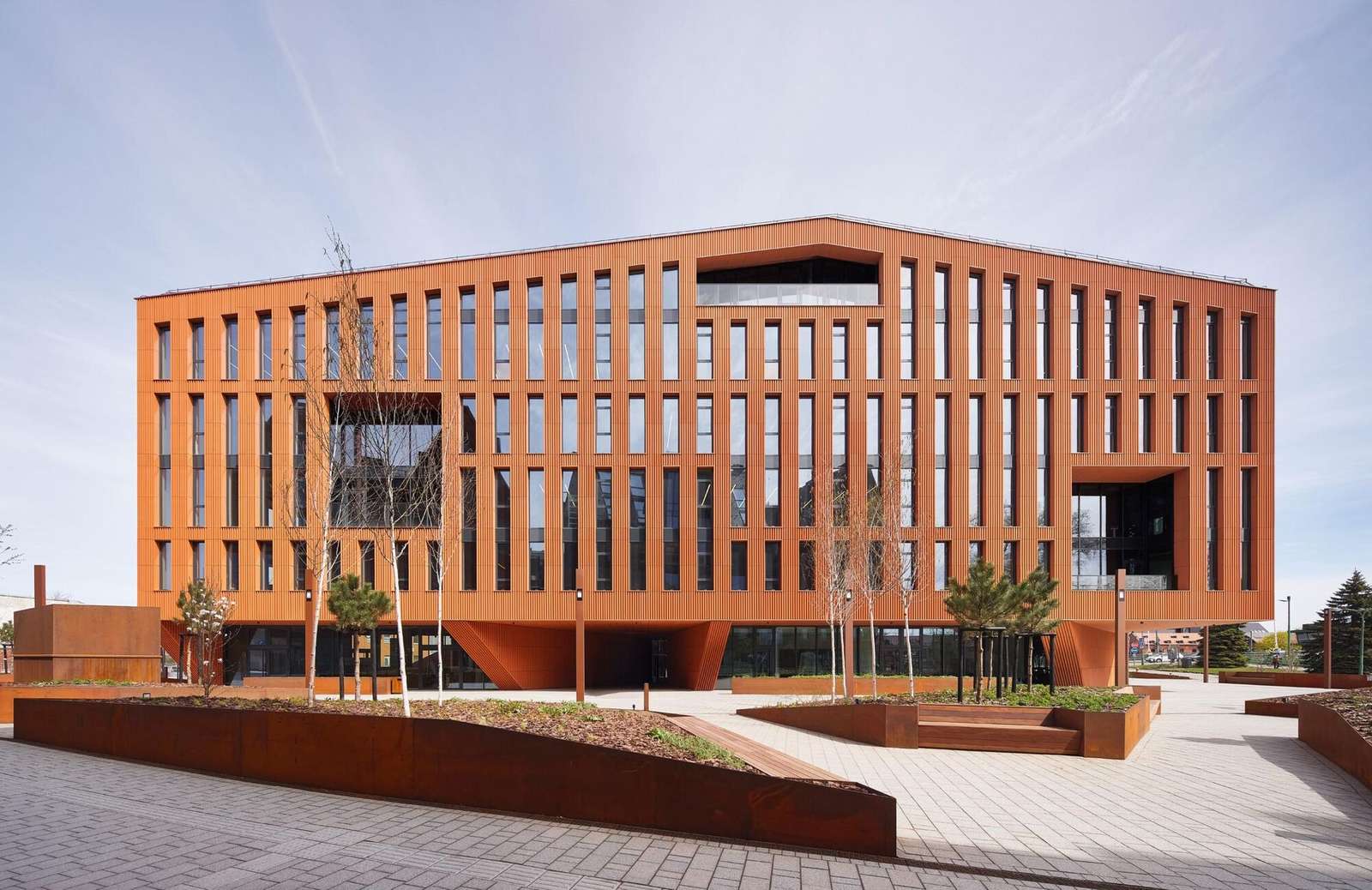
Massing Composition and Historical Contextual Reinterpretation
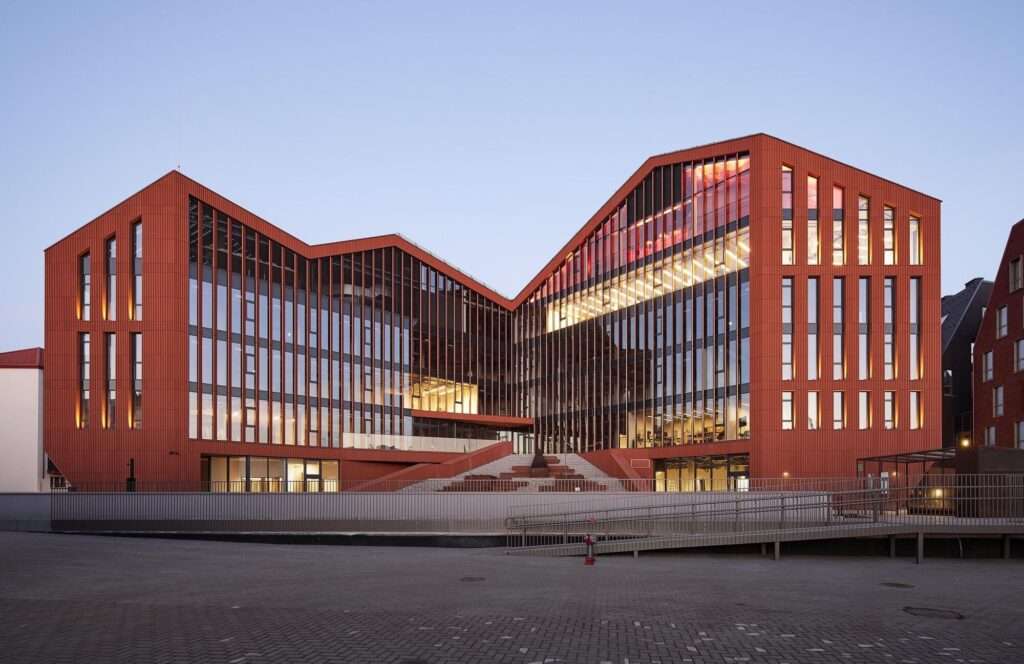
The architectural composition of the project is founded on a contemporary reinterpretation of Klaipėda’s urban heritage, responding to present-day functional requirements. The primary mass draws its formal character from the historic urban fabric associated with the Hanseatic cities, where pitched roofs and the vertical rhythm of the façades are rearticulated through a contemporary architectural language that avoids direct imitation. Rather than replicating historical elements, the project evokes their essential morphological qualities, establishing a balanced visual relationship with its surroundings near the former castle site while maintaining its own architectural autonomy.
Spatial Experience and Architectural Scene Formation
The project’s spatial experience is shaped through a carefully orchestrated sequence of exterior and interior spaces, where the architectural mass functions as an organizing element that guides movement and frames visual corridors. The articulated façade composition introduces a dynamic sense of depth through the interaction of surfaces with natural light throughout the day, enhancing the perception of the building’s volume and granting it a continually evolving presence within the urban landscape. Such spatial qualities align with broader discussions in design and contemporary urban development.
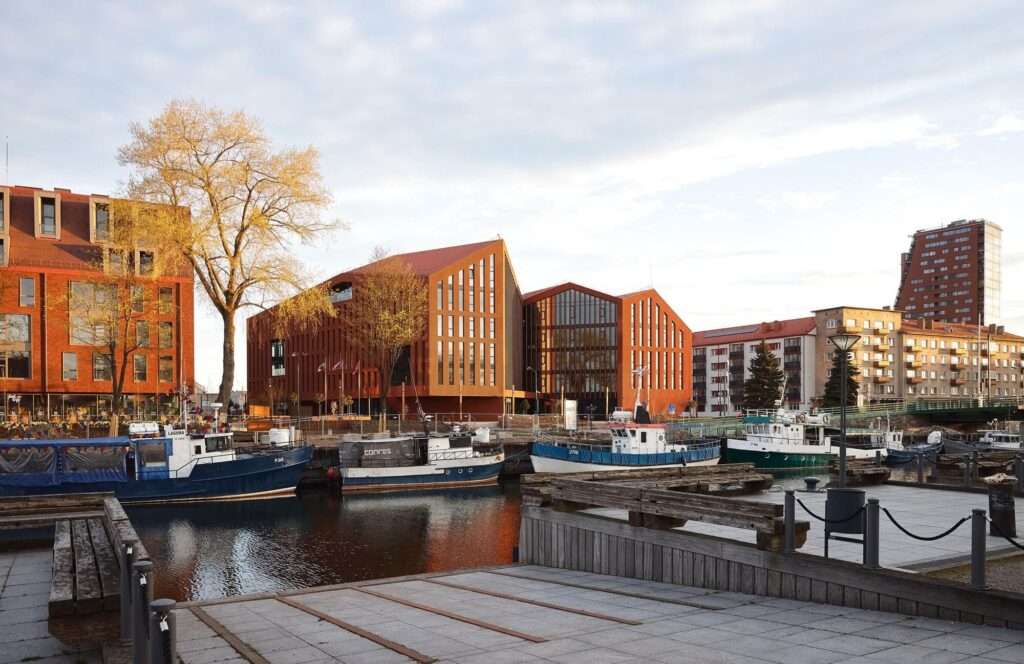
Mass Orientation and Harmony with the Urban Scale
The organization of the building mass and its pitched roofs reflects a direct response to the surrounding urban movement axes, particularly the extension of Naujojo Uosto Street. This orientation helps break down the overall building volume into smaller components that correspond more closely to the historical urban scale, reducing the visual impact of the large mass while strengthening its integration into the existing urban fabric. This approach also fosters a reciprocal relationship between the façades and pedestrian movement at street level, reinforcing principles commonly explored in cities and urban planning studies.
Functional Organization and Vertical Connectivity
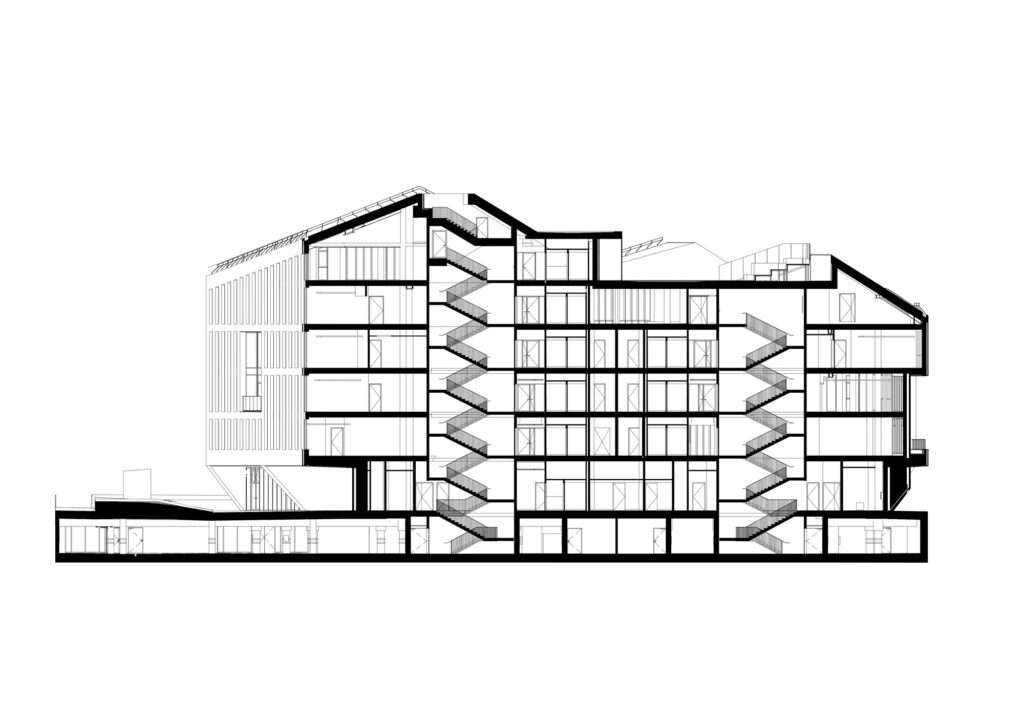
The triangular geometry of the site establishes a clear organizational logic reflected in the distribution of functions throughout the project. The ground floor is dedicated to commercial and public activities in order to reinforce the building’s connection with the surrounding urban realm, while the upper levels are linked through a multi-level stepped structure incorporating landscaped areas, staircases, and an elevator within an integrated circulation system. This central element strengthens both visual and functional connectivity between the various parts of the development, becoming an internal spine that organizes the daily user experience. Similar strategies can be observed across a range of contemporary projects and mixed-use developments.
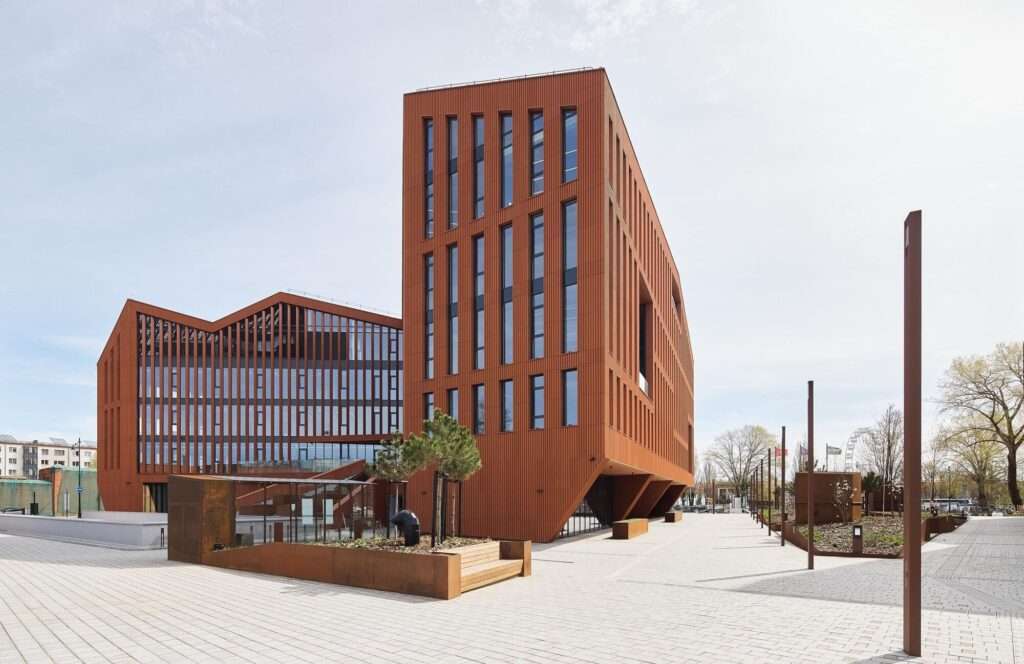
Spatial Configuration and Public Realm
The project reinforces its urban presence through the creation of a linear public square extending along the southwestern edge of the site, providing an open space for movement and social interaction. On the northern side, a formal arrival plaza is organized according to a clear geometric layout that facilitates access and directs movement toward the main entrances. The integration of underground parking further preserves the quality of public spaces while minimizing the impact of vehicular traffic on the surrounding urban environment, reflecting principles frequently discussed within construction and urban infrastructure frameworks.
Landscape Design and the Continuity of Urban Memory
The landscape strategy is informed by a historical reading of the site, drawing inspiration from the green elements documented in the 1839 Memel city plan. The project reinterprets these references within a contemporary framework that integrates planted areas and public pathways into the new urban structure. This approach contributes to the continuity of spatial memory and establishes a clear connection between the site’s contemporary transformation and its historical legacy, a topic often examined through research and urban heritage studies.
✦ ArchUp Editorial Insight
The project diagnoses the erosion of regional identity through the deployment of an urban typology that utilizes historical formations as a defensive spatial framework. By translating the traditional Hanseatic block into a triangular urban vector, the design successfully addresses the structural tension between collective memory and investment-driven expansion, generating active ground-floor vitality while establishing a multifunctional node within Klaipėda’s evolving urban fabric. This intervention contributes to broader conversations in discussion surrounding heritage-led urban regeneration and contemporary buildings.
Nevertheless, this reliance on an idealized cartographic model dating back to 1839 reveals a romantic blind spot regarding contemporary civic behavior. The revival of open-space geometries derived from historical precedents inevitably confronts the realities of aggressive commercial urbanism that govern modern cities. The narrative assumes a spontaneous alignment between historical morphology and public benefit, overlooking the capitalist real-estate mechanisms that continuously seek to privatize public squares and subject them to increasing levels of control and surveillance. Such critiques remain central to ongoing debates in architectural news, archive studies, and critical urban theory.