Feixue Pavilion: Architecture, Nature, and Rural Education

Mass Composition and the Relationship Between Light and Space
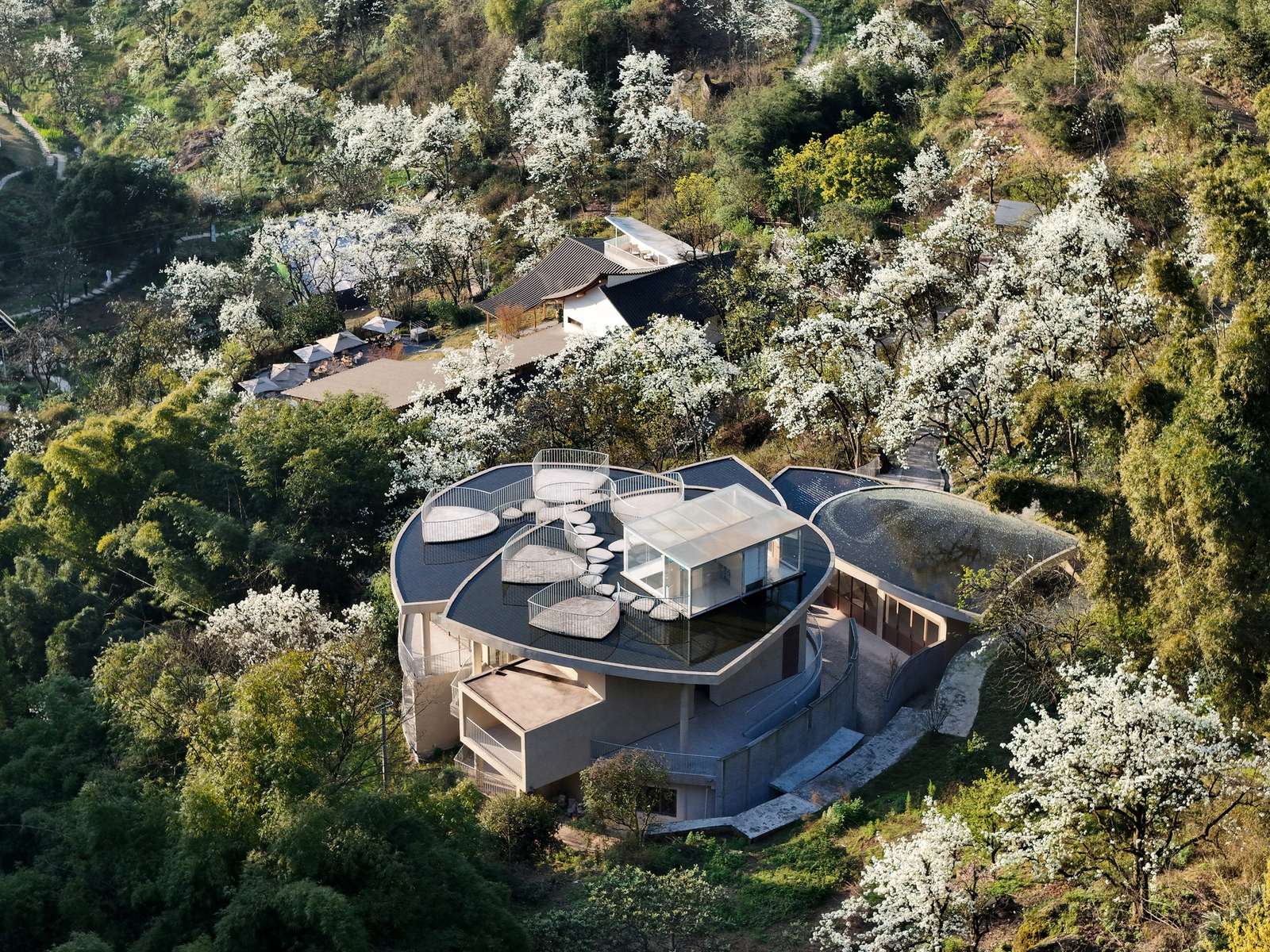
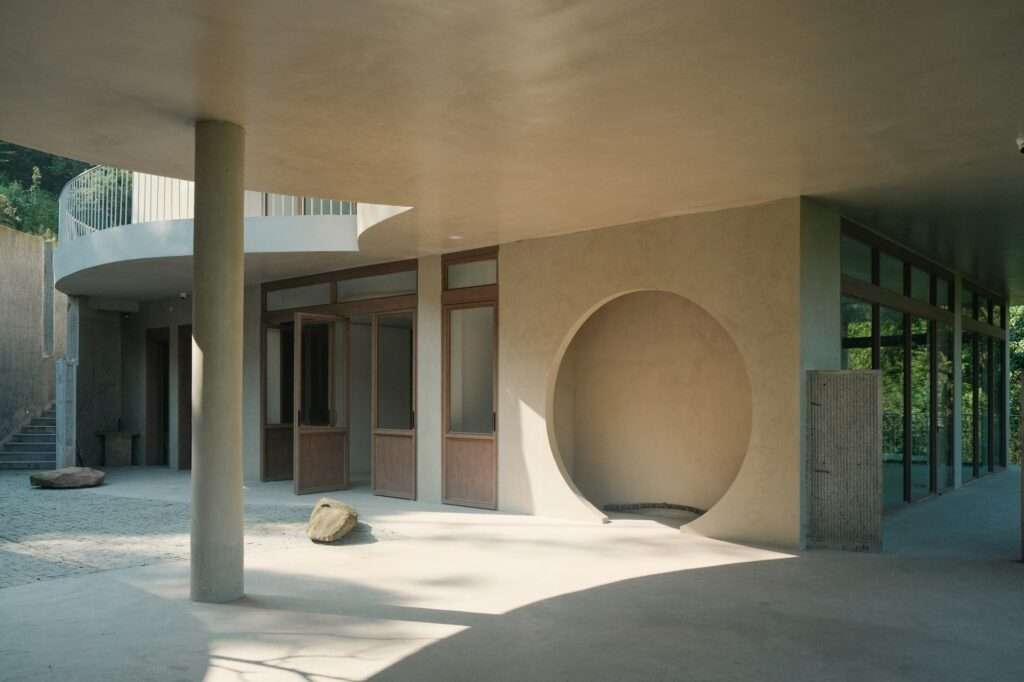
The architectural composition of the project is based on a concept inspired by five pear-shaped petals, where independent concrete slabs overlap at varying heights and projections. This layering helps reduce the perception of mass rigidity and creates voids that allow natural light to penetrate during the day. At night, artificial lighting highlights the edges of the volumes and clearly defines the building’s silhouette.
Integration with the Natural Site
The new building is connected to the mountainous character of the site through the extension of its rear section into a vegetation-covered slope, continuing the relationship established by the original house with the terrain. In addition, the winding path establishes a sequential movement that passes first by a large rock and an old pear tree before reaching the entrance, strengthening the connection between circulation and existing natural elements. The shadow of the tree is reflected in the shallow water basin on the surface, adding a visual layer tied to the site context.
Materiality and Hand Treatment of Concrete
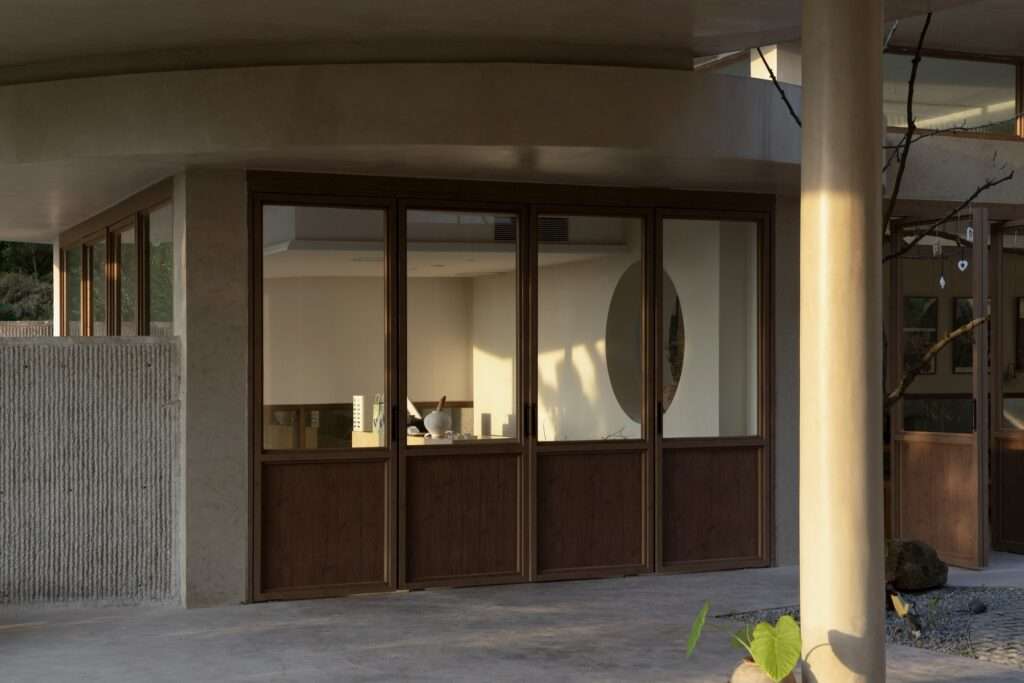
The project combines industrial construction techniques with manual material interventions. The courtyard walls were hand-carved after the concrete had hardened, resulting in a rough, irregular surface that evokes the texture of eroded rock or tree bark. In this way, the material becomes a medium that visually and tactilely connects the building to its surrounding mountainous environment.
| Category | Details |
|---|---|
| Architects | Archermit |
| Area | 672 m² |
| Year | 2025 |
| Photographs | Arch-Exist |
| Lead Architect | Pan Youcai |
| Construction Company | Luzhou Xingyang Jianchuan Industrial Co., Ltd. |
| Category | Tourism |
| Design Director | Yang Zhe |
| Technical Director | Chen Renzhen |
| Design Team | Yang Rui, Hu Qinmei, Gou Yuanjun, Zhao Yaxian |
| Construction Drawing Team | Chengdu Meixia Architectural Design Co., Ltd |
| Client | Lihua Village Collective Asset Management Co., Ltd., Jiangyang District, Luzhou |
| City | Luzhou |
| Country | China |

Roof Treatment and Its Relationship with Natural Elements
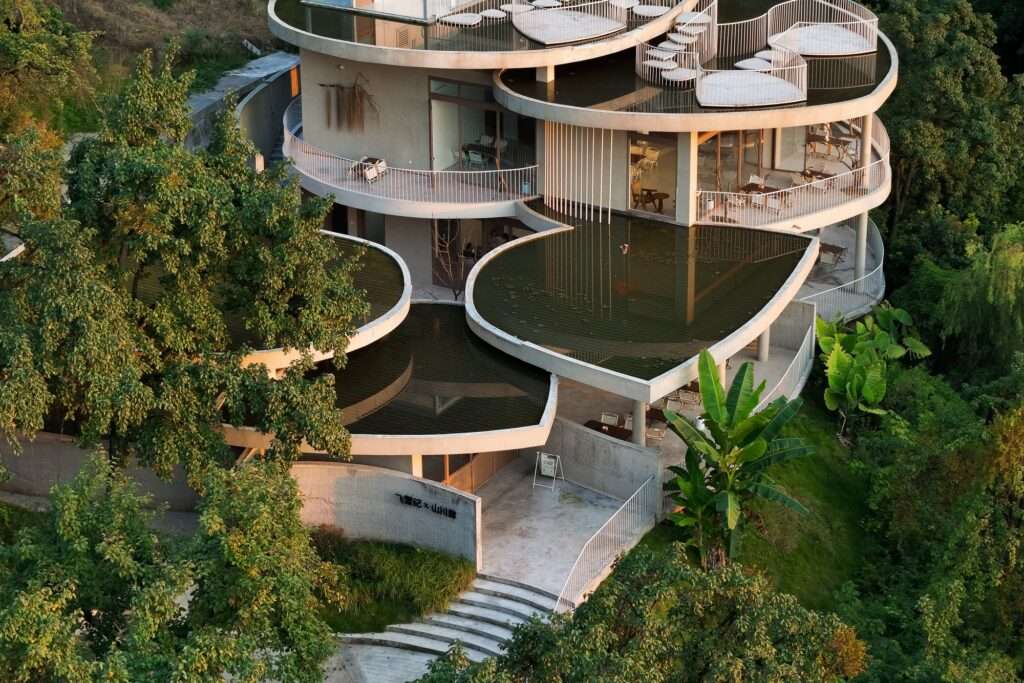
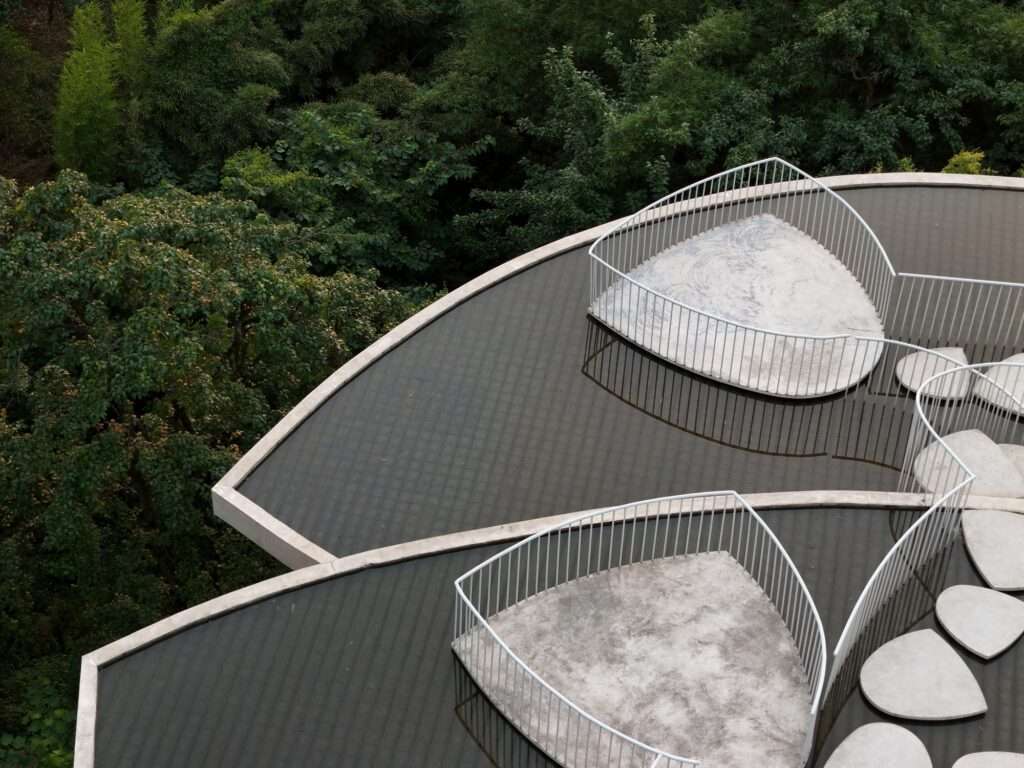
The roof design is based on flat surface models equipped with water reservoirs found in local villages, integrated with small green tiles inspired by traditional sloped roofs. After waterproofing the concrete slab, the tiles were laid horizontally as a base layer, followed by a shallow water layer that reflects surrounding environmental elements such as trees, clouds, and bird movement. Air movement across the surface generates water ripples that are projected onto the ceilings of the second floor, while drainage openings during the rainy season transform into small water channels that interact with the humid mountain climate.
Functional Distribution within the Architectural Composition
The internal functions are organized according to a division derived from the five petals that form the project. The first petal contains the reception hall, while a circular opening visually connects it to the craft activity hall in the second petal. The third petal serves as a semi-open transitional space inspired by traditional pavilions in classical gardens. The fourth and fifth petals contain study rooms, activity areas, and relaxation zones.
Central Void and Deconstruction of the Building Mass
The architectural volume relies on overlapping concrete slabs at different heights, which visually softens the perception of a two-story mass. At the same time, the five petals form a central courtyard open to the sky, allowing natural light to enter through the gaps between them. This produces shifting shadows on the ground plane and enhances the sense of openness within the interior space.


Interior Composition and Spatial Program
The “Feixue Pavilion” operates as a miniature theater of nature, organized into six thematic spaces: “Awakening” (the seed suitcase), “Weaving Green” (leaf-vein weaving workshop), “Chirr” (insect concert hall), “Grain Reading” (wood grain library), “Stone Rise” (lithography room), and “Forge” (wooden tool workshop). This organization transforms natural elements into sensory educational activities rooted in observation and direct experience.
Educational Experience and the Child’s Relationship with Nature
The project emphasizes experiential learning based on sensory interaction with the natural environment rather than direct instruction. Within these spaces, children engage with natural materials such as tree bark, stones, seeds, and leaves as mediums for reading and expression. In this sense, learning becomes an act of discovery, where knowledge emerges through direct experience within a changing natural environment.
Community Dimension and the Project’s Relationship with the Rural Context
The pavilion treats the rural environment as an integral part of its functional structure rather than a detached backdrop. By linking educational activities to agricultural life, the project creates interactions between urban visitors and local residents, resulting in a shared social use of the space. Through repeated activities, the building becomes embedded in the village’s daily cycle and gains meaning through its continuous interaction with its natural and social context.

✦ ArchUp Editorial Insight
The “Feixue Pavilion” can be read as a structural response to rural revitalization policies and the economics of experiential education tied to urban tourism flows, where cultural policy and seasonal visitor dynamics act as primary drivers rather than design intent alone. Capital allocation appears linked to regional development incentives that redefine the village as an educational service node within an urban demand network. Regulatory and logistical constraints manifest in dispersed material sourcing, unstable occupancy patterns, and the integration of local labor into a visitor-driven economy. This results in a spatial distribution that organizes movement across six functional zones as an operational solution for sensory learning, transforming natural elements into educational interfaces. The project is not read as an autonomous design act, but as a negotiated condition between education, rural labor absorption, and visitor density, reflecting architecture as a delayed outcome of policy and demographic transformation.