9th Félix Candela Prize

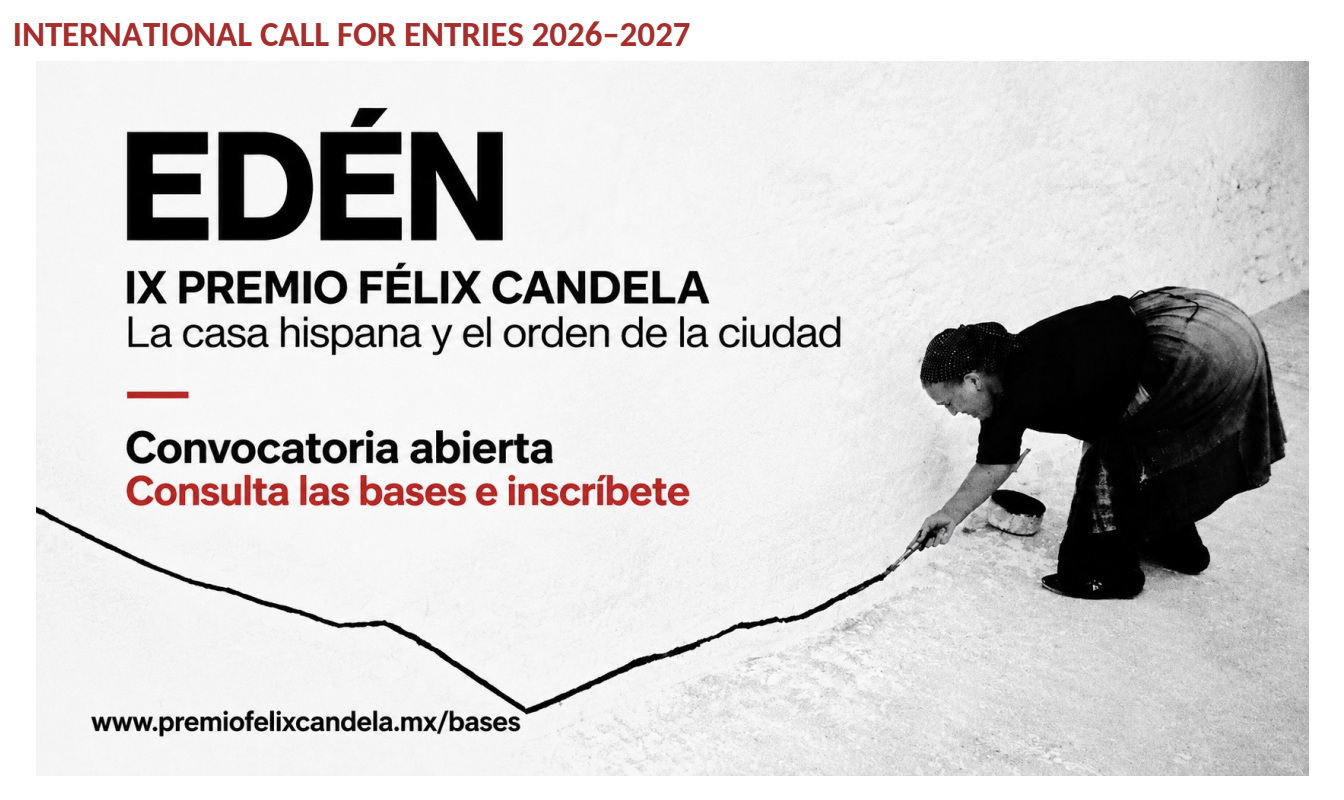
The 9th Félix Candela Prize, titled EDÉN, is an international architectural ideas competition organised by the Instituto Español de Arquitectura (IESARQ). Its 2026–2027 edition, The Hispanic House and the Order of the City, asks entrants to examine how domestic space shapes collective urban life. The call was submitted directly to ArchUp by the organiser.
The assignment connects historical investigation with two contemporary proposals: a detached house and collective housing. Participation is international, but the work and presentations must be in Spanish. This language requirement, the research workload and the second-stage workshop are central to deciding whether the competition suits a prospective team.
Competition information
| Competition name | 9th Félix Candela Prize — EDÉN |
|---|---|
| Organizer | Instituto Español de Arquitectura (IESARQ), Mexico |
| Competition type | International architectural ideas competition; two phases |
| Eligibility | Students and professionals worldwide; individual entries or teams of two or three. The representative must be an architect or architecture student. |
| Language | Spanish; additional language eligibility applies to non-Spanish speakers. |
| Registration deadline | |
| Submission deadline | |
| Total cash prizes | Approximately USD 7,867.93 |
| Prizes | First: approximately USD 4,568.47; second: USD 2,030.43; third: USD 1,269.02. |
| Entry fee | Approximately USD 91.37–152.28 per entry/team, depending on registration period; transaction charges extra. |
| Official website | Félix Candela Prize |
The UTC dates above are one calendar day later than the organiser’s local dates: registration closes on 30 September 2027 and first-phase submission on 30 October 2027, both at 23:59 in Mexico City (UTC−06:00). The countdown below is for submission; registration must be completed earlier.
From the house to the city
EDÉN treats the house as a cultural institution: a framework for intimacy, care, coexistence and memory. The brief follows Hispanic domestic traditions through Greek and Roman precedents, the Iberian world, Hispano-Muslim architecture and encounters with American cultures. Entrants are asked to identify enduring spatial principles while accounting for geographical, historical and social differences.
The research must inform a graphic manifesto and the two connected housing designs, placed in a freely chosen context within the Hispanic cultural world. An atlas of exemplary houses supports the investigation through plans, schematic sections and comparative diagrams. Its purpose is to make architectural relationships legible, rather than assemble a catalogue of attractive references.
For a convincing proposal, the transition between these stages matters. A principle found in historical houses should produce a demonstrable decision in the new dwelling, and that decision should remain meaningful when repeated or adapted within collective housing. Contemporary work patterns, access to housing and environmental demands give this investigation its present-day stakes.
Who can enter
Students and professionals in architecture, design, urbanism and related disciplines may enter without age or nationality restrictions. Participation may be individual or in teams of two or three. The team representative must be an architect or architecture student; university affiliation is not required.
All submissions and presentations must be in Spanish. According to the brief, non-Spanish-speaking entrants may participate individually with DELE A2 or higher, or enter a team with at least one Spanish-speaking member. Entrants should review the exact documentary requirements before registering.
Submission and selection
The first phase requires three anonymous vertical A1 JPG panels in RGB, at a minimum of 150 dpi and a maximum of 15 MB per panel, together with an A3 PDF atlas and eligibility documentation. Proposals must be original and must not have been entered in another competition. Consult the official brief for the complete anonymity, naming and delivery instructions.
The jury will assess originality, research rigour, spatial principles, design quality, contextual and urban relationships, and graphic clarity. Eight finalists proceed to an intensive design workshop with architects selected by IESARQ, then present their final work to the jury. Jury names are scheduled for announcement on 16 February 2027; they were not identified in the supplied press kit.
Calendar and registration fees
| Launch | 15 November 2026 |
|---|---|
| Registration period 1 | 15 November 2026–20 February 2027: approximately USD 91.37 |
| Jury, FAQ and enquiry deadline | 16 February 2027 |
| Registration period 2 | 21 February–31 July 2027: approximately USD 121.83 |
| Registration period 3 | 1 August–30 September 2027: approximately USD 152.28 |
| Finalists announced | November 2027 |
| Second-phase workshops | From November 2027; detailed arrangements to be confirmed. |
Fees apply per entry/team. Entrants outside Mexico must use PayPal and bear transaction charges. Registration requires payment verification and the organiser’s confirmation. The fee is non-refundable.
Awards and currency basis
The three cash awards are approximately USD 4,568.47, USD 2,030.43 and USD 1,269.02. Winning teams also receive medals and diplomas; the eight finalists receive architecture books and magazines and a diploma. Honourable mentions carry no cash award. The rules provide for applicable tax withholding and payment within 90 days of the jury’s decision.
All USD figures are indicative conversions using ECB reference rates dated 25 November 2026: EUR 1 = USD 1.0935 and MXN 21.5422. The original prize fund is MXN 155,000 and fees are MXN 1,800, 2,400 and 3,000. Actual billing and awards are denominated in Mexican pesos; exchange rates, rounding and payment-provider charges can change the USD amount.
ArchUp assessment
The strongest aspect of this brief is the requirement to carry a research argument across two housing scales. It can produce a substantial portfolio study if the atlas, manifesto and designs form one coherent architectural investigation. A weakness to guard against is treating the Hispanic house as a single timeless type: the brief’s own historical range calls for careful distinctions between climates, social arrangements and cultural encounters.
The workload is substantial relative to the entry fee and prize pool: research, an atlas, three boards, two designs and potentially a second-stage workshop. Teams should budget for that commitment and verify workshop attendance, location and associated costs before relying on finalist participation. No construction commission or travel funding is established by the supplied press kit.
The rights clause deserves attention. The rules provide for publication and exhibition of selected submissions, and describe winning proposals as becoming IESARQ property, with the cash award treated as payment for a preliminary design. Entrants should clarify the scope of that provision before committing an existing research project or reusable design work.
Document review: points to check
Reviewed on 25 November 2026. The fee section of the official brief contains an apparent year typo, ending period 2 on “31/07/2026”. The calendar, supplied press kit and current registration page agree on 31 July 2027, which is the date used here. The rules also pair “CET” with UTC−06:00; this listing uses the explicit Mexico City UTC−06:00 offset, consistent with the press kit, rather than that inconsistent abbreviation.
The registration form also marks a university field as required for the team representative, although the brief says university affiliation is not compulsory. Independent practitioners should ask the secretariat how to complete that field. These are document and form inconsistencies to clarify, not additional eligibility restrictions introduced by ArchUp.
Sources: organiser’s emailed press kit; official brief; registration page; ninth-edition rules PDF. Competition enquiries: secretaria@premiofelixcandela.mx. Featured artwork: IESARQ / Félix Candela Prize; photograph: Ramón Masats.
Submission deadline
31 October 2027, 05:59 UTC. Registration closes earlier, on 1 October 2027 at 05:59 UTC.